I was just a few minutes past midnight when I stepped into the elevator of my apartment building, after a 48-hour shift. My hands still smelled faintly of smoke, and my boots left city dust behind on the floor.
I pressed the third-floor button, resting my head against the wall, trying to stay awake. The elevator started with its usual tired groan.
Then I heard it.
A faint, uncertain cry.
At first, I thought I was imagining it. But then it sounded again – weak, fragile, as if the very world had scared it.
I looked around.
Behind the cleaning trolley, half pushed into the corner, there was a baby carrier.
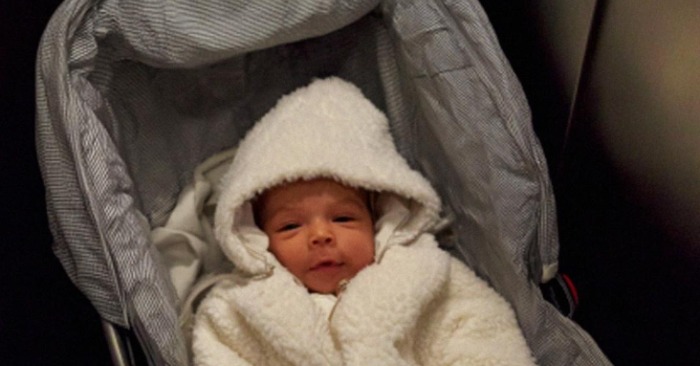
I moved closer, carefully pulling it into the light. The bottom was wet from the rain, the straps soaked through. Inside, a tiny girl lay, maybe eight weeks old. Wrapped in a pink, white starry blanket.
HER DARK EYES BLINKED UP AT ME.
Her dark eyes blinked up at me.
“Hi, little one,” I whispered. “Where’s your mommy? Or your daddy?”
A note was pinned to her blanket.
“I can’t do this. Please, take care of her. Give her a home and joy.”
“Oh my God…” I whispered. “They left you here.”
I called 911, holding her tightly to my chest. Her tiny hand gripped my shirt collar, as if she’d always known me.
Eight weeks earlier, I thought I had lost my own child.
My fiancée, Lauren, and I had been together for four years. When she showed me the positive test, I felt like I was finally running toward peace, not chaos.
BUT LAUREN BEGAN LABOR EARLY.
But Lauren began labor early. By the time I arrived at the hospital, she had already given birth.
The doctor pulled me aside.
“Ethan… there were complications. The baby didn’t survive.”
The world ceased to exist.
Lauren didn’t look at me.
“You weren’t here,” she whispered. “You always run to other people’s problems.”
Two days later, she disappeared. No goodbye, no address. It was as if she had never existed.
And now, here was this little girl in the elevator.
THE POLICE FOUND NOTHING.
The police found nothing. Cameras? Nothing usable. Witnesses? No one. Fingerprints? Zero.
Child protective services took over. Teresa, the social worker, called me three weeks later.
“Ethan… we haven’t found any relatives. Would you consider temporary placement?”
“Me? I’m a firefighter. I don’t know anything about changing diapers.”
“But you knew how to calm her down.”
I didn’t think any further.
“Yes. I’d like to.”
I named her Luna – after that night when she came into my life like a quiet moonbeam.
SIX MONTHS LATER, I FILED FOR ADOPTION.
Six months later, I filed for adoption.
On her first birthday, she officially became my daughter.
That evening: cake, gold balloons, laughter. The balloon got stuck in the fan, and Luna laughed, shrieking in my arms.
Then suddenly, she relaxed.
“Luna!” I cried.
At the hospital, the diagnosis was made: Diamond–Blackfan anemia. A rare blood disorder. She needed a stem cell transplant. Ideally from a relative donor.
“I don’t know her biological family,” I said.
“We can test you.”
“Of course.”
Three days later, they called me back.
The doctor’s face was pale.
“Ethan… not only are you compatible. You are her biological father.”
“This is impossible. My daughter died.”
“We tested twice.”
Lauren’s voice echoed in me: “Not even the baby wanted to stay in this life.”
The next morning, I drove for three hours to Lauren’s mother’s house.
LAUREN OPENED THE DOOR.
Lauren opened the door.
“Why did you say she died?!” I asked.
She cried.
“I panicked. I didn’t know how to leave. I didn’t know how to be a mom. At the hospital, I said you were abusive… that if you knew she was alive, you’d find us.”
“You claimed I would hurt her?”
“They believed it.”
“You left her in the elevator.”
“I knew your schedule. I knew you’d find her. I couldn’t raise her. But I knew you could.”
ANGER AND PAIN RAGED IN ME.
Anger and pain raged in me.
“She’s my daughter,” I said quietly. “And you will never come near her again.”
The transplant was successful. Luna’s color returned, and her laughter filled the apartment again.
Two years passed. She’s now three years old. She’s obsessed with fire trucks.
I switched to office work at the firehouse. I live for her.
Last night, she climbed into my lap with her storybook. She fell asleep, her finger curled around mine.
I used to ask: Why did it happen this way? Why did I have to lose so much to get her?
Now I don’t ask anymore.
I JUST HOLD HER CLOSER.
I just hold her closer.
Because sometimes fate doesn’t knock loudly. Sometimes, it arrives quietly – wrapped in a pink blanket.
And if we’re brave enough, we open the door.