This story wasn’t supposed to start this way — but this was the truth: harsh, unsettling, and uncomfortable for a city that usually ignores boys like Ethan Miller.
The storm turned Cleveland’s streets into flowing rivers. Rain pounded the asphalt as if bouncing off it, pooling beneath the overpass where cars passed without slowing.
Headlights cut through the darkness, splashing water onto the sidewalks, but no one stopped long enough to care about anyone.
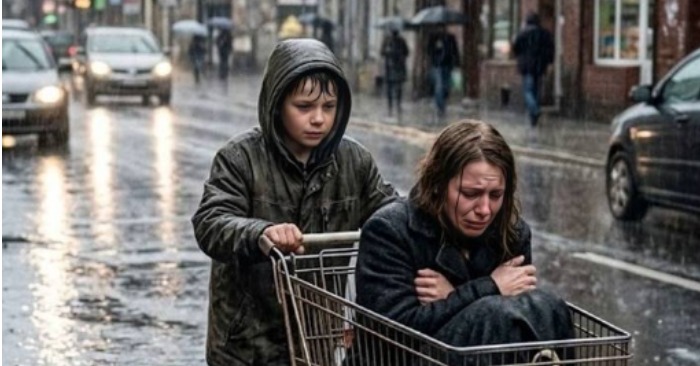
In the middle of the flooded road, a woman sat.
Clearly pregnant, drenched, shivering, barely able to stand. Her phone lay in the water beside her, useless. One of her shoes was gone. Every time she tried to rise, pain twisted her face, then she collapsed again, gasping for air.
Cars slowed.
Drivers looked.
Then drove on.
From under the overpass, Ethan saw everything.
Twelve years old — thin, almost invisible, in an oversized coat with torn sleeves. He slept on cardboard, ate wherever he could, and had long learned that invisibility was the safest survival tool. The rain soaked his clothes, and hunger gnawed constantly at his stomach.
HE SHOULD HAVE STAYED THERE. KIDS LIKE THIS DON’T INTERVENE. KIDS LIKE THIS DON’T MATTER.
Then the woman lifted her head.
Their eyes met.
Fear recognizes fear.
“Help…” she whispered, her words nearly drowned by the rain.
Ethan’s heart raced. He didn’t know her — and it didn’t matter. Something stirred in him.
He stepped into the rain.
“Ma’am?” he said softly, but firmly. “Can you hear me?”
The woman looked at him, and the shock almost broke the last of her strength.
“I can’t get up,” she said, tears mixing with rain. “I tried… I really tried.”
ANOTHER WAVE OF PAIN CRUSHED HIM.
Ethan didn’t hesitate.
“There’s a wheelbarrow under the bridge,” he said. “I can push it.”
The woman looked at him in fear.
“You’re just a kid.”
“I can handle it,” he replied. “But you can’t.”
The metal handles were icy and slippery, much heavier than he expected. His arms burned from the effort. His shoes were flooded. A horn blared. Someone yelled roughly.
Ethan didn’t stop.
“It’ll be okay,” he repeated over and over. “I’m here. I won’t let you fall.”
BY THE TIME THE RED FLASHING LIGHTS BROKE THROUGH THE STORM, HIS ARMS WERE SHAKING UNCONTROLLABLY. THE PARAMEDICS RUSHED OVER, LIFTING THE WOMAN ONTO A STRETCHER IN CALM BUT URGENT VOICES.
One of them turned to Ethan.
“You brought her here?”
Ethan nodded.
“You did the right thing,” the paramedic said firmly. “You may have saved two lives tonight.”
Ethan didn’t stay to hear more.
He stepped back into the rain — and disappeared.
Three days later the storm seemed almost unreal, as if it had happened to someone else.
Ethan sat on the cold pavement in front of the soup kitchen, nibbling on dry bread. His body ached strangely. He couldn’t stop thinking about the woman’s face — especially how she clung to hope.
NO ONE KNEW ABOUT HIM. WHY WOULD THEY?
Good deeds don’t change anything in the life of a kid like him. Help doesn’t always come back.
Then he heard it — the deep rumble of an engine.
A black SUV slowly pulled up in front of the soup kitchen. Tinted windows. Flawless exterior. The kind of car that signals trouble.
“Time to move,” Ethan muttered, gathering his things.
But the door opened.
A tall, elegantly dressed man stepped out, scanning the sidewalk until his eyes landed on Ethan.
THEN ANOTHER DOOR OPENED.
A woman stepped out carefully, one hand protectively on her stomach.
Ethan froze.
He recognized her immediately.
Stronger — healthier — but it was her. The woman from the storm.
Ethan’s pulse quickened.
“I… I didn’t steal anything,” he blurted. “I was just sitting here.”
The man raised his hand reassuringly.
“No one’s accusing you,” he said. “My name is Michael Harris.”
THE WOMAN STEPPED CLOSER, TEARS GLISTENING IN HER EYES. “I’VE BEEN LOOKING FOR YOU FOR DAYS,” she said.
Ethan swallowed hard.
“I didn’t do it for money,” he said quickly. “I swear.”
The woman smiled through her tears.
“I know. That’s why we’re here.”
She told him everything — the emergency surgery, the baby they helped deliver just in time, and the doctors who kept talking about “the boy in the rain.”
“I wouldn’t be here without you,” she said. “And neither would my son.”
Ethan looked at his shoes, overwhelmed.
“I just didn’t want her to be alone,” he whispered.
Michael cleared his throat.
“We want to help you,” he said. “If you let us.”
Ethan hesitated.
HELP ALWAYS COMES WITH CONDITIONS.
“What kind of help?” he asked softly.
The following weeks changed his life.
Ethan was placed in a safe foster home. He received clean clothes. Warm meals. A bed that wouldn’t disappear. The Harris family didn’t adopt him — but they didn’t vanish either.
They were present.
They cared.
They watched over him.
School was difficult at first. Ethan wasn’t used to being noticed for anything good. But slowly he began to believe the world hadn’t given up on him.
Months later he returned to the soup kitchen — not to eat, but to help.
A volunteer asked why he kept coming back.
ETHAN SMILED SOFTLY. “BECAUSE SOMEBODY ONCE STOPPED FOR ME.”
And in that moment, the city finally saw what had always been there.
Not a homeless boy.
Not a problem.
But a hero — who stepped into the rain when everyone else just drove by.