I don’t usually stop at the supermarket when there’s drama happening.
Most days, I’m too tired to deal with anything beyond pure survival mode—and wondering whether the Care Bears would like peanut butter cookies.
Being a single mother of a seven-year-old means living somewhere between exhaustion and a constant state of crisis—and there are no days off for either.
My daughter Mia has asthma, and her new medication is only “partially covered,” which basically means, “You’ll have to figure out how to pay for it yourself.” Last month, my car stalled at a red light—the mechanic called it a “mercy killing.” But the repair ate up my savings like gutting a fish, and I’ve been drowning in overdraft warnings ever since.
And food?
This has less to do with diet and more to do with strategy: three nights in a row of pasta, soup I diluted with hot water and a bouillon cube, and cornflakes for dinner again.
Mia never complains. And somehow… that’s the worst part.
The night it happened, I had exactly $18.47 in my account. This money wasn’t a gift—it was our lifeline. And it had to last for the next seven days until my next paycheck arrived.
My shopping list was surgically precise: flour, milk, potatoes, tea, yogurt for Mia’s breakfast, and bread. Maybe apples if I found a discount sticker. No room for impulse, no room for mistakes… no room for anything else.
I was standing in front of the flour shelf, comparing store brands and prices, when I heard it.
A sharp, startled gasp… and then that unmistakable sound of a body hitting the floor.
I turned around.
And there she lay.
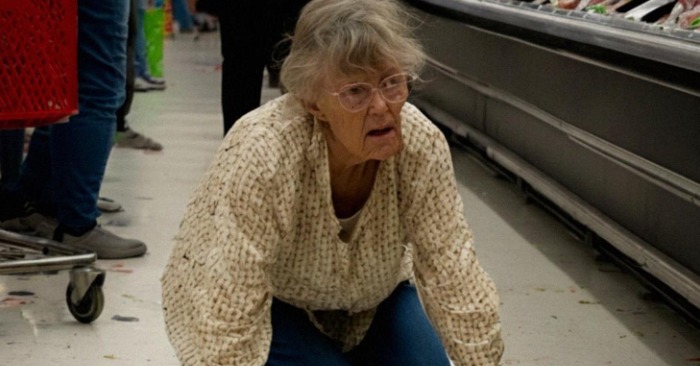
An older woman had fallen at the fruit stand, and red apples rolled in all directions as if trying to escape. Her long skirt had caught under the heel of her low boot—just enough to send her tumbling mid-stride.
Now she sat awkwardly on the cold linoleum, her knees bent at an angle, her cheeks bright pink. Her hands trembled slightly as she tried to push herself up, and for a moment I saw something in her eyes—something like shame.
The worst part wasn’t the fall.
The worst part was the people.
A man in a blue windbreaker took a large step around her and muttered, “She shouldn’t be shopping alone if she can’t walk straight. Good grief.”
A woman with a full shopping cart paused just long enough to sigh loudly in annoyance before turning into the next aisle. She didn’t even look back.
Someone stepped over a fallen apple and kept walking, headphones in.
No one helped. No one even paused. The old woman was invisible—and in that fleeting moment, something tightened in my chest.
I dropped my basket and ran over.
“Oh my God, are you alright?” I asked, kneeling beside her.
“Oh my God, are you alright?” I asked, kneeling beside her. “Did you hit your head? Should I call someone? Come, let me look at your arm.”
When she spoke, her voice was thin and shaky.
“I’m fine, love,” she said. “I… my skirt got caught, and I tripped. I’m okay. I’m sorry, I didn’t mean to cause any trouble.”
“You weren’t causing any trouble at all,” I said firmly. “You just tripped. That’s all.”
She looked around, ashamed. Then her gaze drifted to the apples scattered all over the floor—and when she spoke again, her voice broke.
“I only wanted a few,” she said. “For a cake.”
“That sounds wonderful,” I said, helping her sit up straight. “But we’ll take it slow, okay? I’ve got you. My name is Kylie.”
She smiled small, apologetically. “People probably think I’m pathetic, don’t they, Kylie?”
“NO,” I said. “YOU’RE PROBABLY JUST IN A HURRY.”
“No,” I said. “You’re probably just in a hurry. It has nothing to do with you. It’s not your fault. What’s your name?”
“Evelyn,” she managed quietly.
“Then, Evelyn,” I said, “stay here for a moment, and then we’ll take you upstairs.”
She nodded slowly, but her eyes were glazed. I began gathering the apples, wiping each one with my sweater and gently placing it back in her cotton bag. My hands were trembling too—but not from the work. It was something deeper.
The people kept walking. I stayed. And I couldn’t imagine doing anything else.
I helped her up slowly and took her to the bench next to the pharmacy counter. I should have remembered the tea I still needed, but I couldn’t leave her alone.
“What else do you need, Evelyn?” I asked.
“Just the apples,” she said. “I had a few other things, but I didn’t want to overdo it today. These legs don’t always listen, love.”
She tried to laugh—but it caught in her throat.
I didn’t let myself get lost in thought. If I’d thought about it too long, I might have talked myself out of it. I told myself I needed the money more. I remembered that kindness doesn’t always pay the bills.
But in that moment, the way she sat there, holding herself together—I couldn’t leave.
I took her bag and carried it to the front. The cashier didn’t say much; she just scanned the items and gave me a look I couldn’t interpret. I held my breath as I held my card to the terminal and stared at the screen—$16.86.
Almost everything I had for the week. But at least I’d gotten most of what Mia and I needed.
When I returned, Evelyn was still sitting on the bench, tugging at the hem of her sleeve. Her eyes lifted when she saw the bag in my hands.
“YOU DIDN’T HAVE TO DO THAT,” SHE SAID.
“You didn’t have to do that,” she said. “Darling… no. You didn’t have to.”
“I know,” I said softly. “But I wanted to.”
I handed her the receipt for the apples—she stared at it, blinking furiously.
“Today would have been my grandmother’s birthday, Evelyn,” I added, tucking a strand of hair behind my ear. “She always wore long skirts and dresses, too. I… I don’t know. They reminded me of her.”
“You’re the only one who stopped,” she whispered. “God bless you, Kylie.”
She slowly stood up and reached out her arms toward me. Her arms were thinner than I had expected, but she held me with surprising strength. Her skin was cool against mine, and I felt her shoulders tremble ever so slightly.
“I hope someone’s looking out for you, too, love,” she said as we headed for the exit.
“Me too,” I said, smiling small.
Then she was gone.
I went home with flour, milk, and yogurt, wondering how I was going to get through the rest of the week. I should have felt regret. Maybe even panic.
But somehow, I didn’t.
I felt… peace. Maybe kindness doesn’t fix everything. But maybe it fixes something. And maybe that’s enough.
The next afternoon, I went back to the store. I hadn’t planned to go back so soon, but in the chaos of the night before—after the fall, the crowd, and that unexpected wave of emotion—I’d forgotten the one item that was really important to me.
Tea.
My cheap black breakfast tea – the one thing that makes mornings bearable, giving me something hot to hold onto when everything else feels cold. Without it, I would just stare into my chipped mug in the mornings, pour hot water over regret, and pretend it tasted like comfort.
Mia was next door, playing with our neighbor’s daughter. I’d promised to be back in twenty minutes. Just tea—in and out.
I was reaching for the store brand on the middle shelf when I saw them.
Two security guards in uniform.
They walked straight toward me. Not patrolling, not searching. Purposeful. And apparently, I was their target.
“Ma’am,” one of them said when they were standing in front of me. “You have to come with us.”
“What?” I froze. “Why? What did I do?”
“We’re supposed to take you to the back office,” the other man said. “Your photo was taken from last night’s surveillance footage.”
My stomach sank. People stopped in the middle of the hallway and stared as if they’d just caught me sneaking shrimp out under my coat.
“I DIDN’T STOLE ANYTHING!” I said too loudly.
“I didn’t steal anything!” I said too loudly. “I paid for everything yesterday! I just forgot something. I came back to buy tea. My daughter’s waiting for me at home!”
Neither of them answered. They just turned around, as if it were a given that I would follow. So I followed, my legs stiff and unsteady.
We walked down a long service corridor that smelled of bleach and packing tape, past boxes of canned soup and a stack of discounted Halloween candy. When they opened the gray door at the end, I saw a small office: a desk, harsh neon lights, and behind it a man who seemed to be made entirely of rules.
I recognized him. Mr. Franklin, the branch manager. I’d never spoken to him before, but I’d often seen him marching down the aisles with a clipboard, that stern expression on his face. He didn’t look like someone who tolerated nonsense.
On the desk were a large gift basket, a thick envelope, and a clipboard.
I stepped inside, my heart pounding.
“As for yesterday,” I began, “I swear I didn’t take anything. I paid for my things and the old woman’s apples, too. I forgot my tea, and that’s why I—”
HE RAISED HIS HAND AND LOOKED DIRECTLY AT ME.
He raised his hand and looked directly at me.
“What’s your name?” he asked.
“…Kylie,” I managed.
He wrote something on a piece of paper and slipped it into the envelope.
“We watched the footage from last night, Kylie,” he said. “We saw what you did for the woman who fell. You helped her up, comforted her, and paid for her groceries. No one else even slowed down.”
“Wait… what?”
He opened the envelope, pulled out a check, and carefully placed it on the desk.
“We have a company initiative that rewards kindness. Once a quarter, we recognize a local customer who demonstrates exceptional character. It’s always anonymous because we believe that’s how you see a person’s true nature. You were chosen.”
I stared at the check Mr. Franklin slid toward me.
$5,000.
“Is this… is this real?” I asked.
“Yes, Kylie.” He nodded. “Congratulations. And thank you for showing us all what compassion looks like. You can accept this or choose a gift certificate instead. It’s your decision.”
I pressed both hands to my mouth. I couldn’t speak. I could barely see; everything was blurred by tears.
“And,” he added, “someone else asked us to call you in today.”
“Who?” I asked, and immediately faces flashed in my mind.
“Evelyn,” he said simply.
She stood a little way off the top of the stairs—small, frail, wrapped in a cardigan too thin for November. But her eyes were warm and clear.
“There you are, my child. I was so hoping to see you again,” she said.
She reached into her cloth bag and took out something soft and folded. A hand-knitted scarf—deep blue, with tiny embroidered flowers. It looked well-loved.
“I want you to have this,” she said, placing it in my hands.
“Oh no… I can’t.”
“Yes, you can.” Her voice trailed off. “I made it for my granddaughter years ago. She told me it was ugly and ‘grandma junk.’ She hasn’t visited me in years.”
I pressed the scarf to my chest.
“But you… you saw me. You didn’t leave.”
I swallowed hard, a sensation rising in my throat.
“I was wondering,” she said gently, “if you might like to come for dinner? I hate cooking for just one person.
“Would you cook for three?” I smiled. “I have a little girl who would love that.”
Mia was quiet at first, sitting cross-legged on Evelyn’s living room rug, playing with a box of old dolls that Evelyn had taken out of a cupboard.
Evelyn’s home was small and warm, smelling of cinnamon and baked apples. She had made cobbler “just in case you two like dessert,” and a spicy chicken stew. I brought a small meatloaf casserole—the closest thing I could come up with to comfort food.
We talked while Mia played. We talked about books and about her late husband, George. We talked about how long it had been since anyone had sat at her kitchen table and complimented her tea.
At one point, Evelyn took an old record player out of a cupboard and let Mia help place the needle on it. A soft crackle, then the first notes of an old swing song filled the room. Mia’s eyes lit up.
“That was George’s favorite song,” Evelyn said, leaning back with a smile. “He used to dance with me in the kitchen. Even when the cake was burnt.”
“Did you burn the cake on purpose?” Mia giggled.
“Maybe once or twice,” Evelyn said with a wink.
Around nine o’clock, Evelyn stood up and walked slowly to her handbag.
“I didn’t just thank you today,” she said quietly. “I wanted to give you something.”
I watched as she pulled out a small set of keys. Three silver keys hung from them.
“These are for my little house,” she said. “By the lake. My husband and I built it when we were young. There’s a porch swing and wildflowers in the spring.”
“Evelyn, I don’t understand,” I said.
“I can’t keep it up anymore,” she said, sitting down again. “I can barely manage the stairs. But I don’t want it to fall apart. I want to hear a little girl running through the hallways again. I want someone to love it.”
I looked at Mia, who was intently braiding a doll’s wool hair.
“I can’t take your house,” I said quietly. “It’s too much.”
“Yes, you can. And you will.” Her voice remained calm. “I’ve already signed the papers. I don’t want my granddaughter to get it. She insulted the scarf, she insulted me, and she never made an effort. She hasn’t spoken to me in years.”
I was silent for a moment, completely taken aback.
“Only on one condition,” she said then, her eyes immediately filling with emotion. “You come to us. For a weekend. When everything is clean and ready. Promise me that.”
“You’re the first person in a long time to ask me to stay, Kylie,” she said, her voice trembling as tears gathered in her eyes.