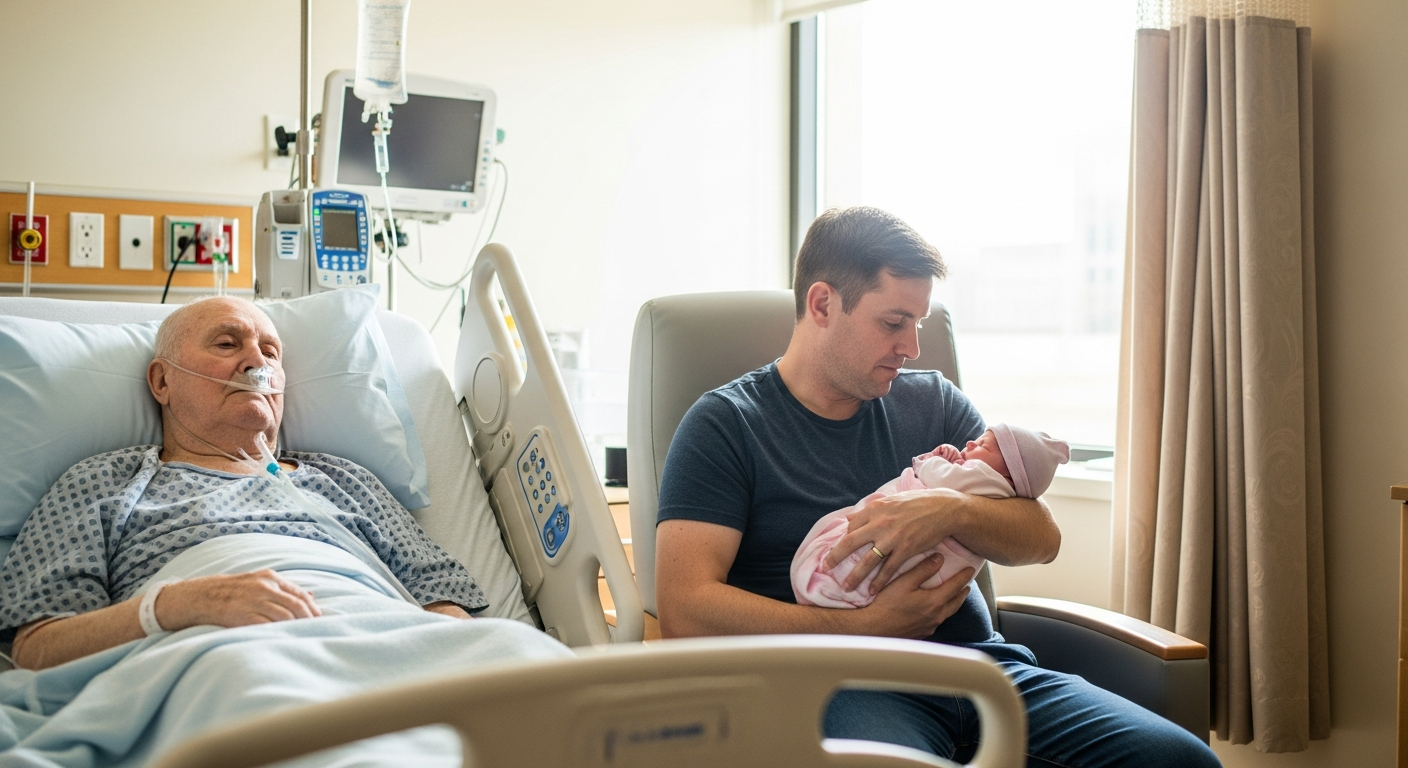
The nurse quietly placed the newborn on the chair next to my father’s hospital bed and said, “She has nowhere else to go now.” For a second I thought I’d misheard her. The beeping monitors, the smell of antiseptic, my father’s shallow breathing — everything froze around that tiny bundle of pink blanket and the word newborn.

I am Mark, forty-two, divorced, with a teenage son who barely texts me back and a father whose lungs are failing. I came to this hospital to sign palliative care papers, not… whatever this was.
The nurse, Elena, adjusted the baby’s hat with practiced tenderness. “Her name is Lily,” she added softly. “Your father signed some documents two months ago. He wanted you to know.”
My father, John, opened his eyes, cloudy but suddenly alert. His voice was little more than a whisper. “Mark… don’t be angry.”
Angry wasn’t even the word. My first reaction was a hot, almost childish panic. “What is this? Dad, what did you do?”
Elena glanced between us, then stepped back. “I’ll give you a moment,” she said, leaving the room with the quiet efficiency of someone used to scenes like this.
Silence settled. The baby let out a small, hiccuping sigh, the kind that feels too fragile for this loud, indifferent world.
My father’s hand fumbled toward mine. I took it automatically, the way a son does, even when he’s scared and confused. “I’m sorry,” he whispered. “I should have told you sooner.”
“Dad, whose child is this?”
His eyes filled. I hadn’t seen my father cry since my mother’s funeral fourteen years ago. “Your mother was sick for a long time,” he began slowly. “Toward the end, she was afraid I’d be alone. She made me promise that if I ever felt strong enough… I wouldn’t spend my last years in an empty house.”
I frowned. “Are you saying—”
He shook his head impatiently, coughing. “No. No scandal. No affair. Not like that. After she died, I… I volunteered. The social worker… she told me about a young woman, Anna. Pregnant, no family, no one. She was thinking of leaving the baby at the hospital.”
He paused, catching his breath. “I couldn’t stand the idea, Mark. A child left like that. Your mother would have taken her home on the spot.”
The room tilted. “Dad, are you telling me you… adopted a baby? At seventy-two? Without telling me?”
His fingers tightened on mine with surprising strength. “I signed temporary guardianship. I thought I had more time. I thought I would get stronger again, and then I’d tell you, and we’d figure it out together.” His voice cracked. “But then the cancer… it was faster than they said.”
I looked at the baby, at the absurd little hospital bracelet on her tiny wrist. Lily. My father, who now struggled to lift a glass of water, had signed up to protect this child.
“Where is her mother?” I asked.
His eyes drifted to the window. “She… she couldn’t do it. The last time she came, she left in the middle of the night. The social worker found a note. She wrote that she wasn’t coming back, that Lily would be better off with ‘the kind old man and his family.’” He swallowed. “Family, Mark. She wrote that word because I told her I had you.”
The twist of guilt was physical. I had barely visited my father this year, always busy, always tired. We spoke in short, practical sentences, like colleagues, not family.
“So now what?” I asked, my voice lower than I meant. “They just… bring her here and put her on a chair?”
My father’s face crumpled. “They’re going to send her to foster care if no one from ‘my family’ takes her. That’s why they brought her today. They wanted me to say goodbye.”
The word goodbye did something to my chest. I looked at Lily again. She had one tiny hand stretched out, fingers trembling in dreams. She had no idea her life was being negotiated over a wheezing old man and a middle-aged son who still hadn’t figured out his own.
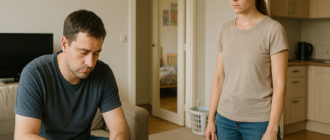
“I can’t take a baby,” I heard myself say. “I live in a one-bedroom apartment. I have a sixteen-year-old son who hates staying over as it is. I work late, I—”
“I know,” my father interrupted, his voice suddenly firm. “I know it’s too much to ask. I know I failed you in many ways. But, Mark…” His eyes burned into mine. “Don’t let her start life the way you felt you grew up — with someone always half-absent, half-distracted. She deserves someone fully there, even if it’s not you.”
The unfairness of his words made my throat tighten. “So what are you asking?”
“I’m asking you to at least hold her,” he whispered. “Just once. Before they take her away.”
It sounded simple. Harmless. I stepped closer. Her face was small, slightly red, with a tiny birthmark under her left ear. For a moment I saw my son, Daniel, as a baby — the same helpless fists, the same round, trusting cheeks. Back then I had been terrified too, but I was younger, cockier. I thought I had time to fix everything later.
I slipped my arms under her. She was so light I almost didn’t feel her weight, yet somehow she pressed down on every piece of me. She opened her eyes — deep, dark, unfocused — and stared straight at my collarbone, as if memorizing the pattern of my shirt.
My father watched us, tears sliding silently down into his graying beard. “She calms when someone talks to her,” he murmured. “Tell her anything.”

I cleared my throat, feeling ridiculous. “Hey, Lily,” I said quietly. “I’m… Mark.” The words caught. “Your… I don’t know what I am.”
Her mouth twitched, and in that broken, fluorescent-lit room, it looked almost like a smile.
That was the moment the real twist hit me, like a delayed punch. Not that my father had secretly taken in a baby. Not that a stranger had vanished in the night. It was the simple, brutal realization: I was about to walk out of this room, sign some forms, and condemn this tiny human to start life with no one waiting for her. Again.
I remembered Daniel at five, waiting at the window for me on the weekends, pressed up against the glass, his breath fogging a small circle. Remembered the day I didn’t show up because of a work emergency, and my ex-wife’s cold text: “He waited for three hours. Don’t do that again.”
“I can’t do it,” I whispered, more to myself than to my father. “I can’t fail another child like that.”
My father’s hand searched for mine again. “Then don’t,” he said simply.
The social worker, a tired woman named Karen, came in a few minutes later with a folder of papers. “Mr. Collins,” she began, glancing at the baby in my arms, “we have some urgent decisions to make about Lily’s placement. Time is—”
“I’ll take her,” I cut in, before my courage fled. Both she and my father stared at me.
Karen blinked. “Sir, this is a serious—”
“I know exactly how serious it is,” I said, my voice shaking. “I’m not promising I’ll be perfect. I’ve messed up more than I care to admit. But I’m not letting her go into the system if I can help it.” I looked at my father. “You told her mother you had family. You weren’t lying.”
He made a small, broken sound that might have been a laugh or a sob. “That’s my boy,” he whispered.
Karen sat down, suddenly gentler. “We’ll need to do assessments, home visits, background checks. This isn’t instant.”
“I understand,” I said. “But start them. Today.”
Lily yawned, an enormous, comical yawn for someone so small. Her tiny fingers found the fabric of my shirt and clung to it.
The next hours blurred into forms, questions, and practical arrangements. I called my ex-wife, expecting anger. Instead there was a long pause, then a soft sigh.
“Maybe this time you’ll show up when you say you will,” she said. “For both of them.”
When it was finally just the three of us again — my father, Lily, and me — the sun was low, staining the hospital window with pale gold. My father’s breathing had grown weaker, but his gaze was clear, anchored on the baby in my arms.
“She won’t remember me,” he murmured.
“I’ll make sure she does,” I replied. “I’ll tell her about the stubborn old man who tried to adopt a baby at seventy-two because he couldn’t stand the thought of her crying alone.”
His lips curved. “Tell her… tell her I loved her. Even if it was only for a little while.”
“You loved all of us,” I said, surprising myself with how true it felt. “You just didn’t always know how to show it. I’m the same. But I’m going to learn.”
He closed his eyes, satisfied. “That’s all I ever wanted, Mark. For you to learn sooner than I did.”
He slept after that, deeper than before. A nurse came in, checked his vitals, adjusted a drip. I sat by the bed with Lily on my chest, listening to two fragile rhythms: the slow beeping of the monitor and the faster, determined flutter of her heart against mine.
When my father’s hand finally relaxed, hours later, it slipped not into emptiness, but onto the edge of Lily’s blanket. His fingers brushed the soft fabric, and I gently moved her closer, letting them rest together for a moment that belonged only to them.
I walked out of the hospital that night with a diaper bag I didn’t know how to pack, a car seat I struggled to buckle, and a newborn who had no idea I was a stranger who had just promised her the world.
But as I strapped her in and she stared up at me with that same unfocused, unwavering gaze, I realized something quietly devastating:
For the first time in my life, I wasn’t running away from responsibility. I was walking straight into it, holding it like a fragile, breathing miracle — the last gift from a dying father, and the first chance to finally become the man he always hoped I could be.