I was born in the autumn of 1995 in a small Lithuanian village where fewer than one hundred people lived. Our home stood at the edge of the fields, next to an old wooden barn that my father had built with his own hands before I was born. My mother died when I was seven, so from then on my father and I lived alone.
My father was 46 when he became a widower. He worked as a mechanic at a local farm, got up every day at five in the morning and returned late in the evening. He was not a man who talked much, but his presence was always stable and predictable.
As a child, I lacked nothing materially. The clothes were simple but warm. The food was filling, though without luxury. But the most important thing was the feeling that I was safe.
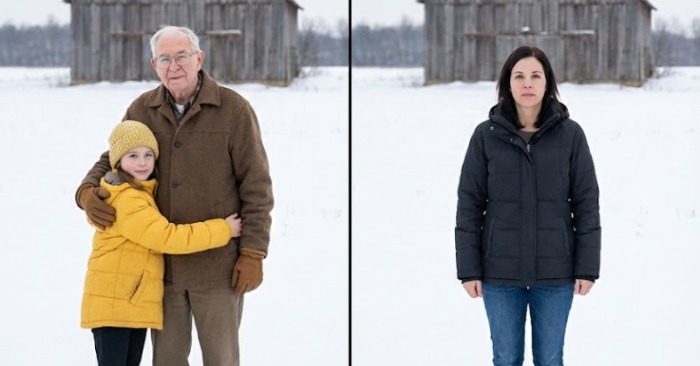
January of 2006 was especially cold. That day my father returned from work earlier and suggested we go for a walk to the barn. I was a child and did not understand why it was so important to him. He stood me next to him, hugged me, and said that the home would always be mine, no matter what happened.
At the time it seemed self-evident to me. I was his only child. Why should it be otherwise?
The years passed quickly. After finishing school, I left for Vilnius to study economics. My father saw me off quietly, without long speeches. He gave me an envelope with money and said that if I ever needed it, I could always come back.
During my years of study, I returned home only for Christmas and Easter. The village changed slowly, and my father hardly at all. He still lived by the same rhythm, the same habits.
When I was 26, my father began to complain of fatigue. At first he said it was nothing serious, but after a few months doctors diagnosed heart failure. From then on I began visiting him every week.
Our conversations became shorter. He was silent more often, sometimes it seemed he wanted to say something, but stopped. I attributed it to illness and fatigue.
My father died in the spring of 2021, at the age of 72. His funeral was simple, just like him. A few neighbors came, former colleagues, more distant relatives.
After the funeral I stayed alone in the empty house. That evening I felt for the first time that I had lost not only my father, but also a part of myself. But life in the city was waiting, and I returned back.
Four years passed. I got married, had a son, lived in a rented apartment. My father’s house stood empty, neglected, but still belonged to me.
In the autumn of 2025, my husband and I decided that the homestead needed to be sold. Neither of us intended to live there, and the money would be useful.
I went alone to tidy up the house before the sale. On the first day I cleaned the interior, sorted old items and documents. On the second day I went to the barn.
There, among old tools, I found a metal box that I had never seen before. It was hidden under a shelf. Inside lay a folder with documents.
They were not debts and not old contracts. It was a will, drawn up in 2008. According to it, my father had left part of the property not to me, but to a woman whose surname I did not recognize.
Attached to the documents was a handwritten letter. In it my father explained that after my mother’s death he had lived for a short time with another woman who had a daughter. He felt responsible for her, even though he never told me about it.
He wrote that he was afraid of hurting me and losing my trust. Therefore he chose silence. But he also wrote that he did not want to leave that child with nothing.
That woman and her daughter moved out after two years. I never saw them. However, my father kept in touch and supported them financially until his death.
The will was legally valid. I could have contested it, but I understood that it was my father’s conscious decision.
After a few weeks I met that woman. Her daughter was 30 at the time. She knew as little about me as I did about her.
We talked for a long time. She told me about a man who never called himself a father, but always helped. I told her about a man who was my whole world.
In the end we both agreed that neither of us had been deceived. We simply lived on different sides of the same man’s silence.
We sold the homestead. I divided the money as provided for in the will. It was not easy, but it was right.
Today, looking at old photographs, I no longer feel anger. Only an understanding that love sometimes shows itself not through words, but through decisions that we do not understand until the very end.
Could you accept the truth about a close person, even if it destroys what you believed your whole life?