My son started calling my brother “dad”, and no one corrected him.
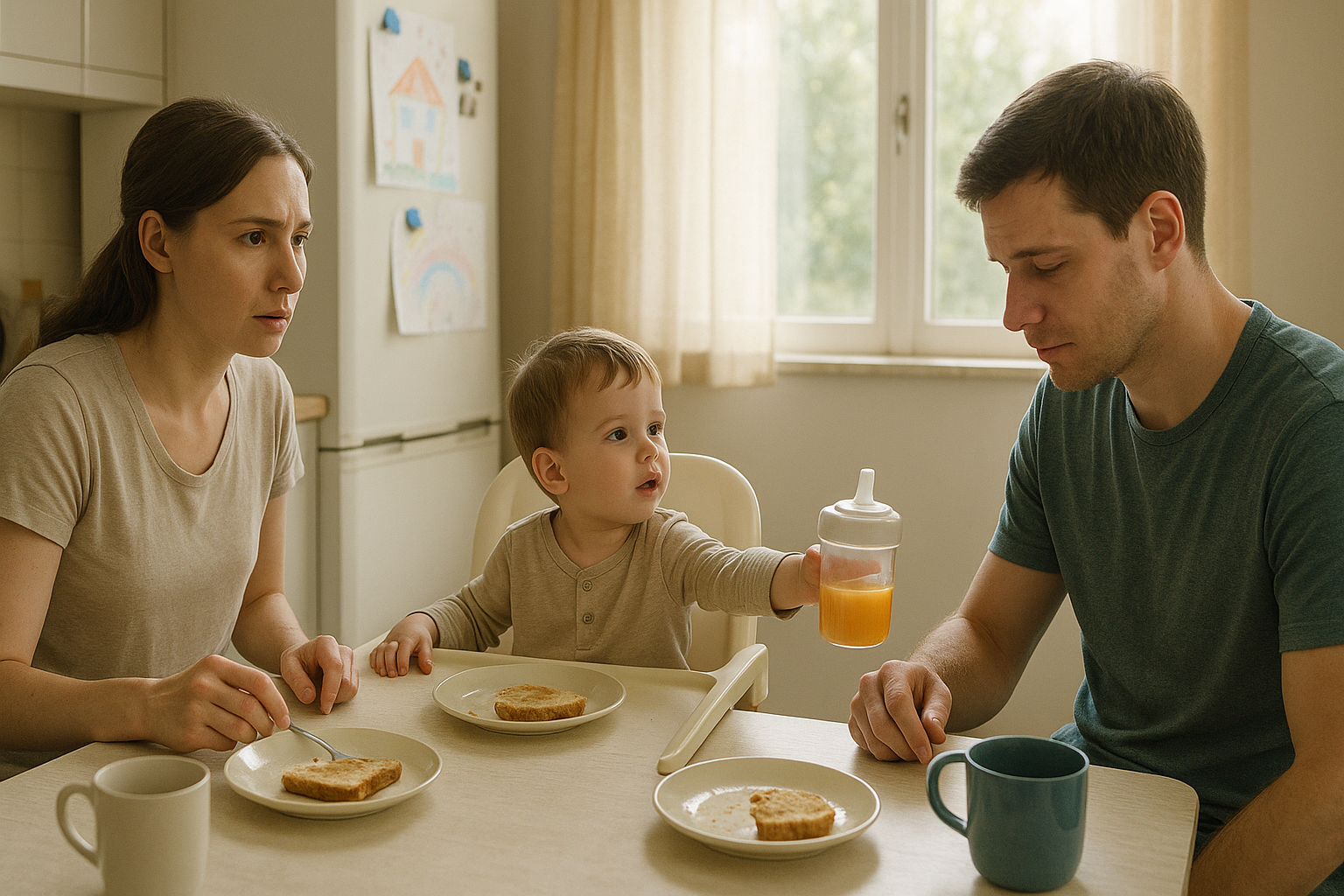
It began at a Sunday lunch in my mother’s apartment. Small table, four plates, one high chair. Liam reached out his arms to Daniel and said it for the first time:
“Dad, more juice.”
The room went quiet for half a second. My mother looked at me. Daniel looked at his plate. And nobody said anything.
Liam was three. He mixed up words all the time. That’s what I told myself while I cleaned his face and pretended not to hear.
After lunch, I stayed to help my mother with the dishes. She turned on the tap, louder than usual.
“Children feel things,” she said. “Don’t be angry at him.”
“At Liam?” I asked. “Or at Daniel?”
She didn’t answer. Just scrubbed a plate as if it had insulted her.
Daniel and I had always been close. He was two years older, the “responsible” one. When my husband Mark left a month after Liam was born, it was Daniel who drove over at midnight, carried the crib, put together the stroller, bought formula when I ran out.
“Don’t worry,” he kept saying. “We’re a team.”
For three years, he came every week. Sometimes with groceries, sometimes just to fix a shelf or play with Liam. Neighbors thought he was the father. I didn’t correct them; it was easier than explaining.
The first time Liam called him “dad”, I told myself he didn’t remember Mark’s face. Mark had disappeared so fast he was basically a story. Daniel was the man who showed up. It was logical.
But after that Sunday, it kept happening.
“Dad, look!” when Daniel lifted him above his head.
“Dad, stay,” when Daniel put on his shoes to leave.
Every time, the same silence. My stomach tightened, but my mouth stayed closed.
One evening, after I put Liam to bed, I finally said it.
“You should correct him.”
Daniel sat at my kitchen table, scrolling his phone. He didn’t look up.
“He’s a kid, Anna. It’s just a word.”
“It isn’t just a word,” I said. “He’s going to be confused.”
“He already is,” Daniel answered. “He lives in a house where nobody says his father’s name.”
I opened my mouth, then closed it. I hadn’t said “Mark” out loud for months.
The next week, I got a call from Liam’s daycare.
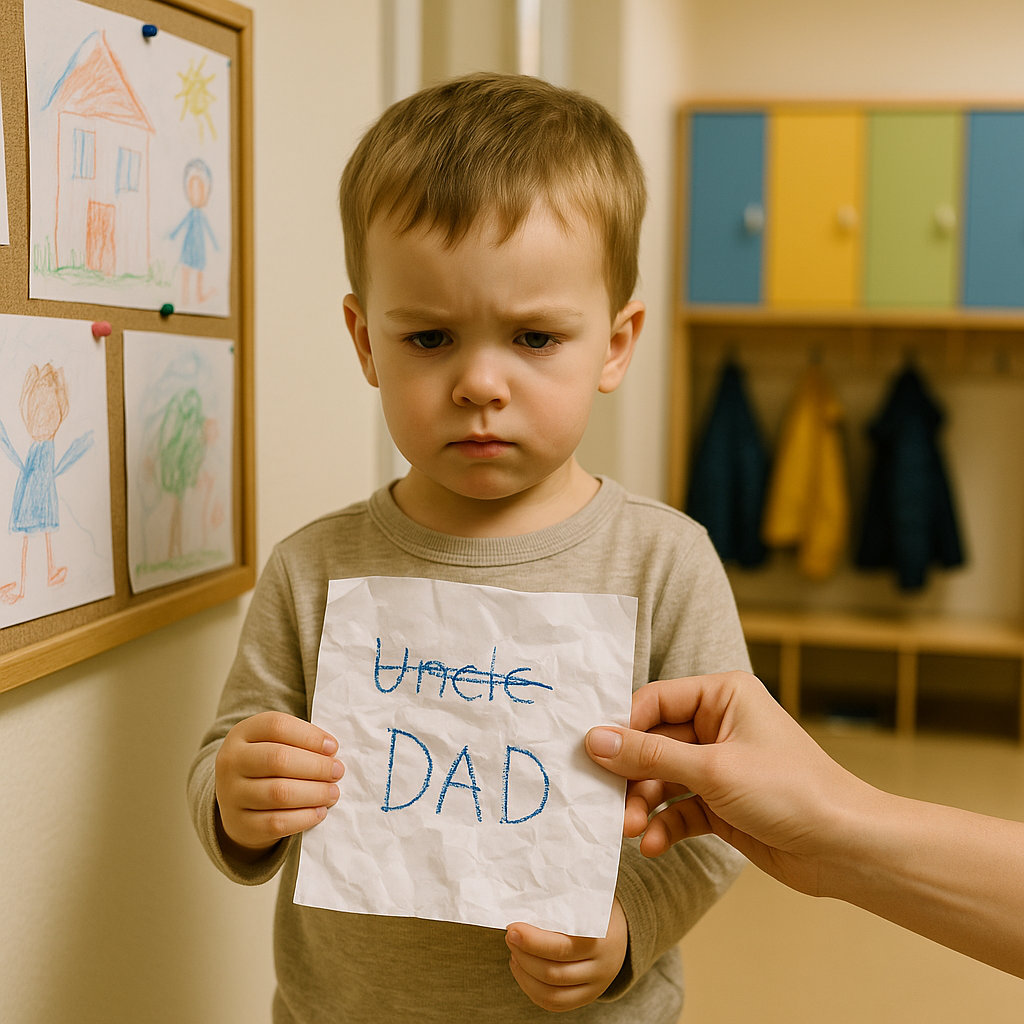
“Nothing serious,” the teacher said. “We’re just updating emergency contacts. Is Daniel the father? His number is listed under ‘dad’ on the form you filled out.”
I checked the form that night. I had written “Uncle” in the blank space. Someone had crossed it out and written “Dad” in clumsy blue letters.
Liam’s handwriting.
I stared at it for a long time. The cheap paper felt heavier than it should.
That Friday, my mother asked us to come earlier for dinner. Her living room was too tidy, her voice too calm.
“I need to talk to you,” she said when Liam ran off to play with his cars.
Daniel leaned on the doorframe, arms crossed. He looked like he already knew what was coming.
My mother took a deep breath.
“Liam asked me why his daddy doesn’t live with him,” she said. “I told him his daddy had to go away. He said, ‘No, my dad is here. Uncle Daniel is my dad.’”
She looked from me to Daniel.
“I told him the truth,” she added quietly. “That Mark is his father. And that Daniel is his uncle.”
“And?” I asked.
“He cried,” she said. “But not the way you think. He didn’t cry for Mark. He cried because he thought he’d done something wrong calling Daniel ‘dad’.”
Daniel turned away then, ran his hand over his face. His shoulders shook once.
“I’ll talk to him,” he said.
That night, I stood outside my old bedroom door. Liam was inside with Daniel. I could hear their voices through the wood.
“Listen, buddy,” Daniel said softly. “You know how you have lots of people who love you? Mom, Grandma, me.”
“You’re my dad,” Liam answered, with the stubborn certainty only children have.
Daniel paused.

“I’m your uncle,” he said. “Your real dad’s name is Mark.”
“Where is he?” Liam asked.
Another pause.
“He doesn’t live with us,” Daniel said. “But that’s not your fault. That’s between grown-ups.”
Silence. Then, Liam again:
“Do you still come on Sundays if you’re not my dad?”
I heard the scrape of a chair.
“I’ll always come,” Daniel said. “The name doesn’t change that.”
The next weeks were strange. Liam stopped saying “dad” at all. Not to anyone.
“Say hi to Uncle Daniel,” I’d tell him.
He’d wave, but his face stayed careful, like he was walking across thin ice.
One afternoon, we were drawing at the kitchen table. I drew a stick figure family to make him laugh: a tall one, a short one, a tiny one.
“Who is this?” I asked, pointing at the tall one.
He looked at it a long time.
“Just a man,” he said finally.
I didn’t push. I threw the paper away when he went to wash his hands.
The breaking point came three months later.
I was picking Liam up from daycare when I saw another boy run into his father’s arms at the gate. The man lifted his son, kissed his hair, laughed when the boy shouted something in his ear.
Liam watched them with that same careful face. No jealousy, no anger. Just distance, like he was watching a movie.
In the car, he asked, “If my dad came back, would Uncle Daniel go away?”
The question caught me so off guard that I stopped at a yellow light.
“Why would he go away?” I asked.
“Because you can’t have two,” he said. “We only have one chair for grown-ups at the table.”
That night, after Liam fell asleep, I went to my mother’s again. Daniel was already there, fixing a broken lamp.
“I think we made this worse,” I said, sitting down.
Daniel put the screwdriver on the table.
“We tried to do the right thing,” he answered. “We just did it late.”
I nodded. There was nothing to argue with.
We decided on something simple. No big talk, no new words. Just facts.
On Sunday, when Daniel walked in with a bag of groceries, I called from the kitchen:
“Liam, your uncle is here.”
Liam ran out, stopped in the doorway, looked from me to Daniel.
Daniel crouched down so they were at the same height.
“I’m your uncle,” he said. “But I’m not going anywhere. I’ll be here when you’re big. I’ll be here when you’re taller than me. I’ll be here when you don’t want to play cars anymore.”
Liam didn’t answer. He just climbed into his lap and stayed there, quiet.
He didn’t call him anything that day. Not “dad”, not “uncle”, not “Daniel”.
He just followed him everywhere, like a shadow.
Now it’s been a year.
On forms, I write “Uncle” in the blank. Liam sometimes says “Uncle Dan” when he remembers, sometimes just “Dan”. He almost never says “dad” at all.
When people ask about his father, I say, “He doesn’t live with us.”
I don’t explain who taught Liam to ride a bike, who comes to every school event, who sits with him when he’s sick.
There’s no right word for that.
We just set another plate at the table and moved the chairs a little closer.