My husband died on a Wednesday. On Friday I found his other family.

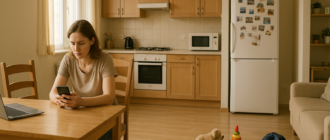
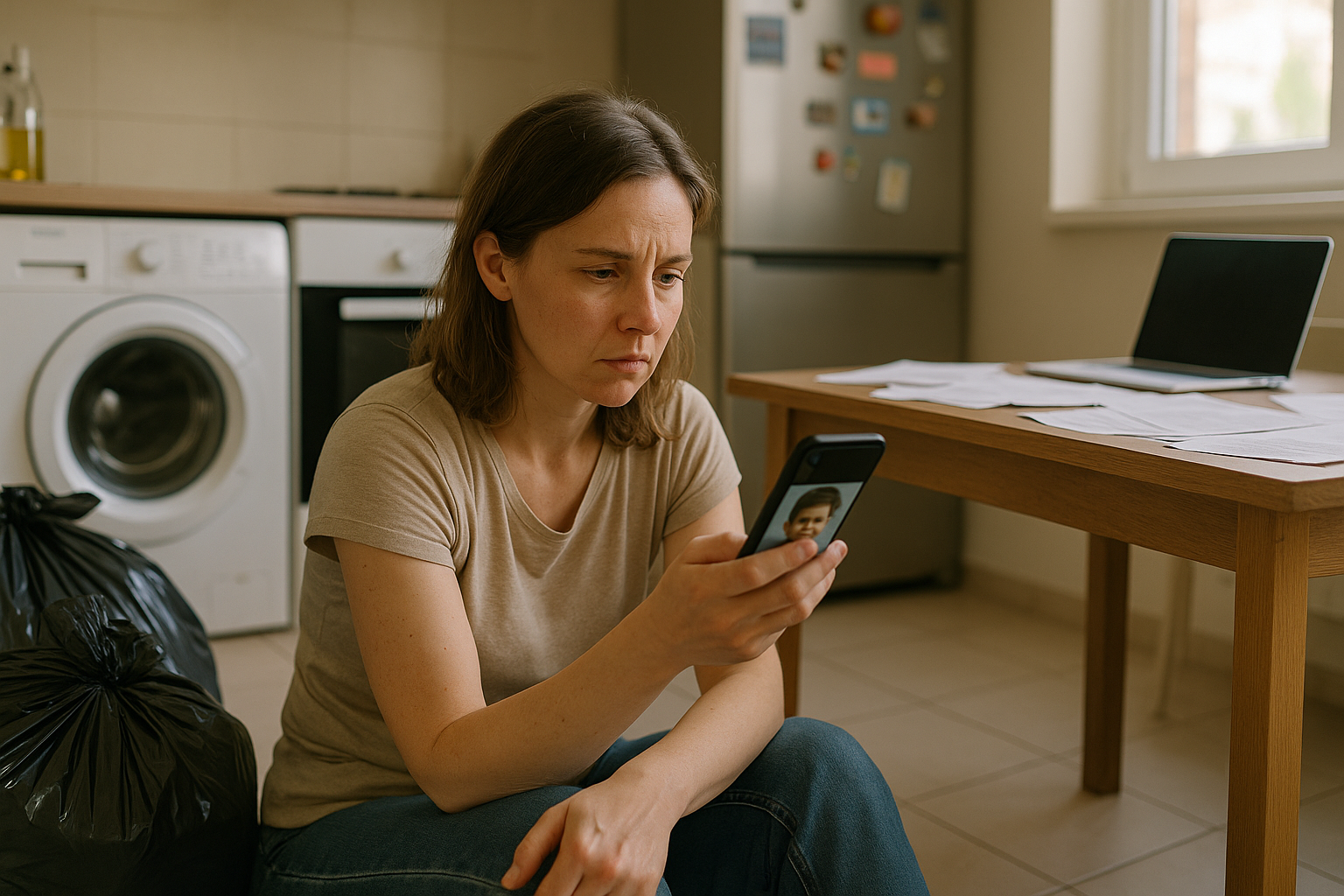
I was sitting on the kitchen floor, between two garbage bags of his clothes, when his phone lit up. It had been buzzing all morning. I thought it was work. Or banks. Condolences.
The name on the screen was “Liam (school)”.
We don’t have a child named Liam.
The call stopped. A second later a message popped up on the locked screen: “Mom says you didn’t answer. Are you still coming for Saturday?” Then a photo. A boy of maybe eight, skinny, holding a cardboard sword. Behind him, a man with my husband’s smile, crouching, half in frame.
My hands were wet from cleaning spray. I wiped them on my jeans, opened the phone. The code was our anniversary. Same as always. It opened.
The chat history went back years.
“Dad, I lost my tooth today!”
“So proud of you, champ. Show Mom when she gets home.”
Different city at the top of the thread. A town two hours away. I scrolled faster. Pictures of school plays, Christmas trees, a small apartment with yellow walls I had never seen.
In one photo, my husband was at a kitchen table. Next to him a woman about my age, dark hair in a messy bun. The boy leaned on his shoulder. On the table, a cake with cheap candles in the shape of a 7.
The caption under it: “Our little family.” His comment: “My everything.”
I don’t remember putting the phone down. I remember the feeling in my throat, like I had tried to swallow a stone. The washing machine beeped. Somewhere upstairs, my daughter Emma turned on the TV.
I went to the living room. Emma was on the sofa under his hoodie, the one she had claimed the night he died. She was watching some cartoon, eyes empty. Her hair was still in the braid he had done before his last business trip.
“Mom, can we keep Dad’s car?” she asked without looking away. “It smells like him.”
I couldn’t answer. I just nodded and walked back to the kitchen, because I suddenly wanted to be sick.
On the table lay the folder with the death certificate, our mortgage documents, his life insurance policy. I moved them aside and opened his email on the laptop. Same password. Same stupid date we put on all our luggage tags.
There were flight confirmations I knew about. And others I didn’t. Weekends he was supposed to be at conferences were actually cheap train tickets to that other town. Hotel bookings under his name for two adults and one child.
I typed the woman’s name from the photo into the search bar. “Anna”. Her email appeared in his sent folder.
The subject lines were simple: “Rent money”, “Liam’s shoes”, “Sorry”.
I opened one from six months ago.
“I’ll be there this weekend. Tell Liam I didn’t forget his game. Please don’t post any more photos of us. It’s complicated. You know why.”
Below, her reply: “He’s not a game, Daniel. He’s your son.”
I read that sentence three times. The letters didn’t change.
In the hallway, the doorbell rang. I jumped. My first thought was that someone had found out. That this was all a mistake and he’d walk in, alive, holding takeout.
It was his sister, Maria, with a casserole and red eyes. She hugged me in the doorway. Over her shoulder, I saw his shoes lined up neatly, the left one still with a scuff from the last time he took Emma to the park.
“How are you holding up?” Maria asked.
I opened my mouth. Instead of answering, I blurted out, “Did you know?”
She frowned. “Know what?”
I walked to the kitchen, picked up the phone, held it out. The chat with Anna and Liam was open. Her eyes scanned the screen. Her face changed, slowly, like a curtain being pulled down.
“Oh,” she said. Then, quieter: “Oh God.”
“How long?” My voice came out scraped. “How long have you known?”
She sat down without asking, pulled out a chair like she had lived here her whole life. “Three years,” she said. “He told me when Liam was in the hospital with pneumonia. He needed money.”
My legs went hot, then cold. “And you said nothing?”
“He begged me,” she said. “He said he would tell you. After he sorted it. After Liam was older. He always said ‘after’.”

In the living room, Emma laughed suddenly at something on the TV. The sound knifed through the kitchen.
“He has a son,” I said, and heard myself switching to present tense. “He has another child.”
Maria nodded, staring at the table. “He met Anna before you,” she said. “It was… complicated. She got pregnant. He panicked. Then he met you. Then she kept the baby. He tried to do both. Badly.”
I thought about all those “urgent trips”. The missed birthdays. The Christmas when he “had to” leave on the 26th because of some crisis at work. How he always came back with cheap gifts that looked like they were bought in a hurry at a gas station.
I had defended him to my parents, to friends. “He’s busy. He’s responsible.”
Maria slid a folded paper across the table. “He made a will,” she said. “He asked me to give you this if… if something happened. I didn’t read it. I swear.”
I unfolded it. The date in the corner was from last year. His handwriting, messy, rushed.
He left half of everything to Emma. A quarter to “my son, Liam”. A quarter to “Anna, for the care of Liam”.
There was a paragraph to me. “To my wife, Sarah,” it said, “I am sorry. I should have told you. Please don’t punish the children for my mistakes.”
I put the paper down. Carefully. Like it was a hot plate.
Maria whispered, “He was going to tell you after Liam’s birthday. He told me that.”
“He died on the way back from there, didn’t he?” I asked.
She didn’t answer. She didn’t have to.
We sat in silence. The fridge hummed. A car passed outside. Somewhere upstairs, our neighbor slammed a door.
On the phone, another message from Liam appeared on the screen: “Dad, are you mad? Mom says you’re just busy.”
I stared at those words until they blurred.
Then I typed back, slowly, one finger at a time.
“Hi Liam. This is Sarah. Your dad’s wife. He… he died on Wednesday. I’m so sorry.”
It felt like pushing a boulder up a hill, pressing send.
Three dots appeared almost instantly. Then: “Is this a joke?”
Another line: “Mom is crying.”
I looked at my own child in the next room. Her feet tucked under her. Her hair coming loose from the braid he had done.
Two children. Two living rooms. One man who had been splitting himself into pieces until the road took what was left.
Maria stood up. “What will you do?” she asked.
I picked up the will, the phone, my own car keys. “I have to meet them,” I said. My voice sounded calm. It surprised me.
“Today?” she asked.
“Yes,” I said. “Before I change my mind.”
I went to the living room. Turned off the TV. Emma protested. I told her to get her shoes. “We’re going for a drive,” I said.
“Where?” she asked.
“To meet your brother,” I answered.
She froze for a second. Then she said nothing. She just put on her sneakers.
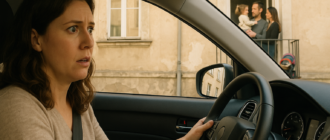
Two hours later, I was standing in front of a yellow-walled apartment I had seen only in photos. My daughter held my hand. My husband’s son was on the other side of the door.
I rang the bell.
And then I waited.