That morning started just like any other in the company’s tower surrounded by glass walls.
The reflective surfaces bounced back elegant suits and hurried steps. Conversations flew past people without making a real connection. Everyone was quick, efficient — and sufficiently distant.
In this perfectly organized routine, an elderly woman quietly entered through the door.
She was pushing a cleaning cart.
Her uniform was simple. Her gloves were worn. The name on her badge meant nothing to anyone — and most didn’t even glance at her.
To them, she wasn’t a person.
She was just part of the background.
She moved slowly through the hall, as if she had long ago learned how to be invisible.
NO ONE GREETED HER.
No one asked her name.
No one wondered why she was there.
But she didn’t come to clean.
She came to observe.
And what she saw spoke louder than any report.
At first, it was small things.
A half-sentence.
A CONDESCENDING TONE.
Behaviors that almost seemed normal by now.
A young man in an expensive suit nearly bumped into her at the entrance.
“Watch it,” he grumbled. “Don’t make a mess.”
Some people chuckled quietly.
No one said anything to him.
No one stopped.
The woman continued wiping the floor, head bowed — not out of humility, but because she was paying attention.
TO HOW EASILY PEOPLE FORGET THE MOST BASIC COURTESIES.
Later, an elegant woman stopped in front of her, holding a coffee cup.
“Do you always work this slowly?” she asked casually. “We don’t pay you to just stand around.”
Her smile was cold.
The woman’s hand tightened slightly around the rag.
She didn’t answer.
Her silence said more than any words.
By afternoon, the mood had shifted.
THE COMMENTS GREW MORE FREQUENT.
The stares lingered longer.
Then something happened that exposed everything.
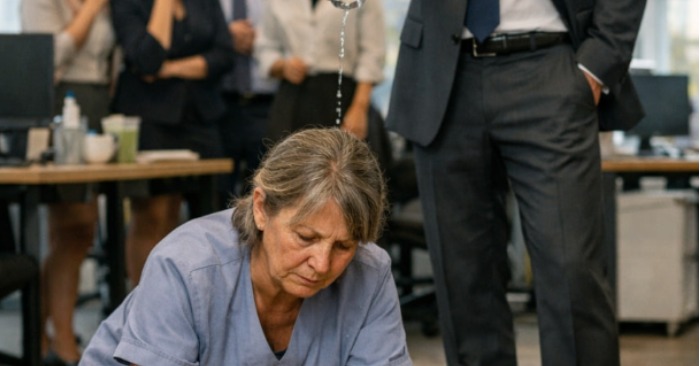
A supervisor walked past her with a water bottle.
As he passed, he slightly tilted it.
The water spilled down the woman’s back.
“Oh… sorry,” he said indifferently. “That’s what happens when someone’s in the way.”
Laughter followed.
Not loud.
But shared.
Accepted.
And in that moment, the silence became louder than anything.
Because no one intervened.
No one said anything.
The woman slowly lifted her head.
There was no anger in her eyes.
JUST SADNESS.
Not for herself.
But for what this place had become.
At the end of the day, she packed up and began to leave.
Then she saw him.
A man, stepping in with calm confidence.
Their eyes met.
For a moment.
AND EVERYTHING BECAME CLEAR.
An hour later, everyone was called into the meeting room.
The CEO walked in.
“Today,” he said quietly, “my mother worked here as a cleaner.”
Complete silence.
“And what I saw… was the true face of the company.”
Footage appeared on the screen.
Everything.
THE COMMENTS.
The laughter.
The water.
The turned-away gazes.
“We didn’t know who she was,” someone said.
The CEO shook his head.
“That’s exactly the problem.”
A pause.
“THEY THOUGHT THAT BECAUSE SHE WASN’T IMPORTANT… SHE DIDN’T DESERVE RESPECT.”
The consequences were immediate.
Those responsible left.
Not out of anger.
But out of principle.
But something deeper remained in the room.
The realization.
Silence is not neutral.
SILENCE CHOOSES.
The next day, the woman returned.
But not in uniform.
She walked alongside her son.
Same building.
Same people.
But everything was different.
Some lowered their eyes.
OTHERS HONESTLY GREETED HER.
Before she entered the elevator, she turned around.
“You never know who’s who,” she said softly. “But dignity doesn’t depend on what someone wears.”
The doors closed.
And it became clear:
Success isn’t about titles.
It’s about how we treat those who can give us nothing in return.
And on that day… everyone showed who they really were.