The old man kept sitting alone on the same park bench every evening, until a little girl asked him a question that shattered the lie he had been living for ten years.

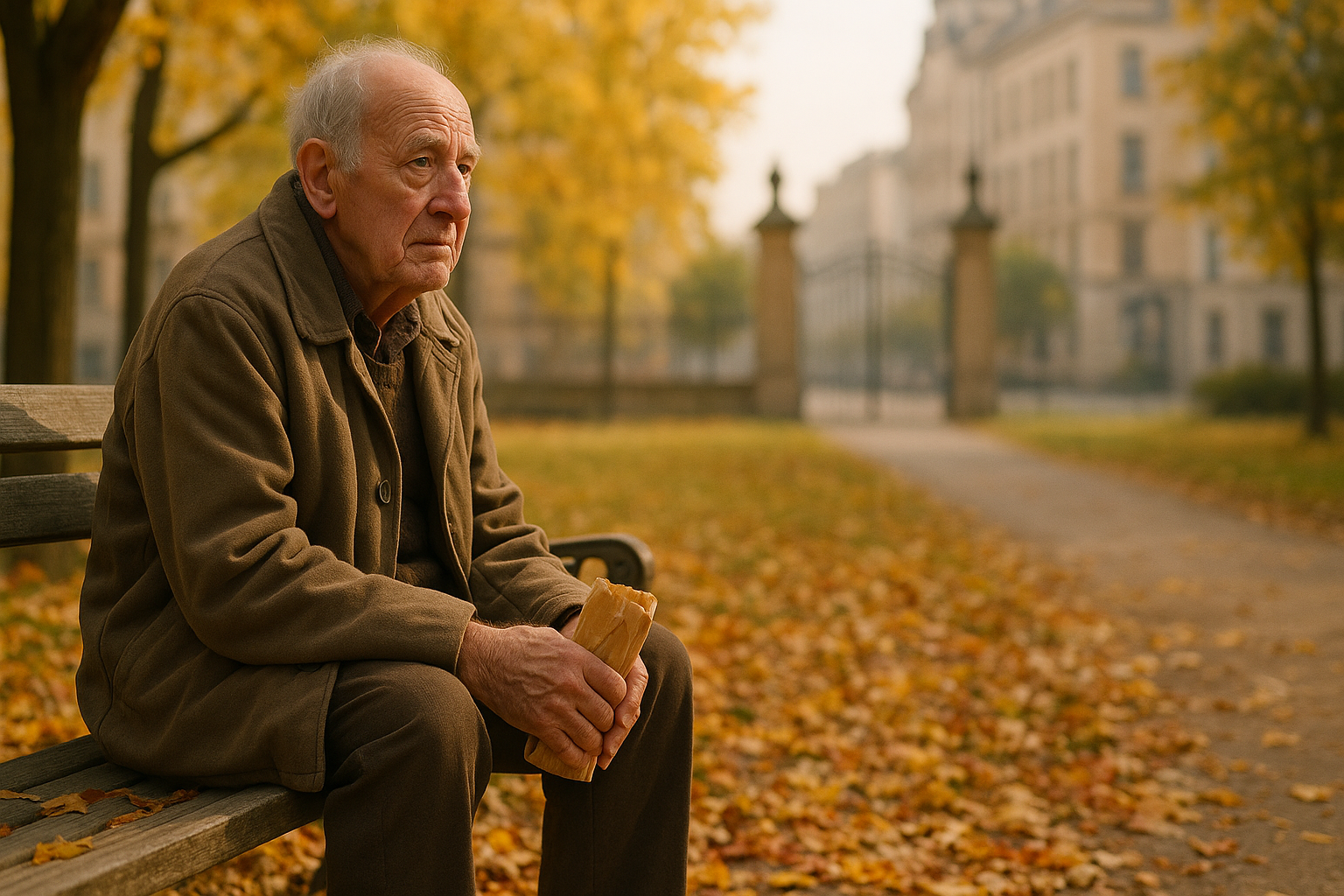
Samuel always came at five. The city changed around him – shops closed, new ones opened, trees grew and were cut down – but he arrived at the same bench, in the same worn brown coat, holding the same crumpled paper bag with a sandwich he rarely ate.
On the back of his left hand, the skin was thin and marked with brown spots. There, like a stubborn echo of another life, was a faint imprint of a tiny blue flower tattoo – once bright, now barely visible. His son had drawn that flower when he was five, pressing a cheap pen hard into Samuel’s skin, giggling as the ink bled.
“Now you can’t ever forget me, Dad,” little Daniel had said.
Ten years had passed since Samuel had last heard that voice.
At five fifteen, as always, Samuel began to look toward the park gate. He watched every boy whose hair curled at the neck, every teenager with a backpack, every tall man with a quick walk. His eyes slowed, searching for something only he would recognize: the way one shoulder was slightly higher, the way the right foot turned out just a little.
He told everyone who asked that he was just getting some fresh air. But the truth was tucked into his inside pocket, in a plastic sleeve worn at the edges – a missing child poster, yellowed and folded a hundred times.
One cold October evening, when the leaves were already lying in red and brown piles around his shoes, a small voice broke into his ritual.
“Excuse me, sir… are you waiting for someone?”
Samuel turned. A girl of about nine stood a few steps away, hugging a backpack to her chest. Her hair was in two messy braids; her eyes were too serious for her age.
“I am,” he answered. His voice sounded rough, as if it hadn’t been used all day. “I’m waiting for my son.”
She looked around the empty path, then at the darkening sky.
“Is he late?”
Samuel swallowed. “He’s… been late for a long time.”
The girl came closer and sat at the far edge of the bench, leaving a respectful distance.
“My name is Emma,” she said. “My mom works late on Thursdays. She says I can wait here where people can see me.”
Samuel nodded. “I’m Samuel.”
They sat in silence for a moment, listening to the rustle of leaves and the distant sound of traffic. Emma glanced at his hands.
“Is that a drawing?” she asked, pointing to the faded blue flower.
Samuel pulled his hand back slightly, then forced himself to relax.
“My son drew it,” he said quietly. “When he was your age.”
“Did you wash it off?”
He shook his head. “Time did.”
Emma’s brow furrowed. “Where is he now?”
Samuel opened his mouth. The answer he had repeated to police officers, social workers, and to the empty air over the years was ready on his tongue: “He disappeared.”
But instead he said nothing. His throat tightened.
Emma studied his face like children do when they sense something important.
“Did he run away?” she asked softly.
The question hit him like a stone. Behind his eyes, the memory unrolled, as clear and merciless as if it had happened yesterday.
The argument. The slammed door. Samuel shouting things he never truly meant. “If you walk out that door, don’t bother coming back!”
A fifteen-year-old boy, shoulders shaking, backpack thrown over one arm. The sound of his footsteps on the stairs. The silence afterward.
He had told the police that Daniel went missing on the way to school. He had told his ex-wife that he didn’t know what had happened. He had told the world a story where he was only a victim, never the cause.
For ten years, he had sat on that bench, telling himself he was a faithful father who never gave up. It hurt less than admitting what he had actually done.
Emma’s voice pulled him back.
“Did you say something bad to him?”
Samuel stared at her. Her eyes were brown and open, waiting. She had no right to ask, and yet somehow she did.
“Yes,” he whispered. “I did.”
“Did you say sorry?”
The simple question shattered the last defense he had.
He had never said sorry. Not to Daniel. Not to himself. Not even in his mind. It was as if saying it would make his guilt real, solid, impossible to escape.
“I didn’t get the chance,” he lied automatically.
Emma tilted her head.
“But you’re still alive,” she said. “So you still have a chance, right?”
Samuel almost laughed, but it came out as a dry cough.
“I don’t know where he is,” he said. “He could be… anywhere.” Or nowhere.
Emma hugged her backpack tighter.
“My dad left when I was three,” she said quietly. “He never said sorry either. Mom says he probably tells himself a story where he’s the hero.”
She looked at Samuel with a seriousness that made his chest ache.
“But he’s not. He’s just… someone who never came back.”

A gust of wind lifted a few leaves into the air. One landed on Samuel’s knee. He brushed it away with fingers that trembled.
“Maybe your dad is ashamed,” he said. “Maybe he thinks it’s too late.”
Emma shook her head. “It’s only too late when someone is dead. My grandma says that.”
They fell silent again. Somewhere behind them, a dog barked. A bicycle bell rang.
Then Emma asked the question that tore through the lie he’d been hiding behind for a decade.
“Sir… what if your son is also sitting somewhere on a bench, waiting for you?”
The world seemed to tilt. He saw it suddenly: another bench in another part of the city, a young man with tired eyes, maybe a cheap jacket, maybe a little scar from falling off a bike at seven. Checking his phone. Looking up every time an older man walked by. Waiting for a father who never came.
Samuel had always imagined himself as the one who was waiting. He had never allowed himself to see that his son might be waiting too.
His hand went to his chest. He could feel his heart pounding against the plastic sleeve of the old poster.
“What if he thinks you don’t want him anymore?” Emma asked in a whisper.
A sound escaped Samuel, something between a sob and a breath. He pressed his lips together, but it was too late. The tears came, hot and shocking after so many dry years.
“Are you okay?” Emma’s small voice shook.
“No,” he said honestly. “But maybe… maybe I can be.”
He pulled the poster from his pocket with unsteady hands. The picture of a fifteen-year-old boy looked up at him – Daniel’s eyes caught in a moment of surprised laughter.
Emma leaned closer. “Is that him?”
Samuel nodded.
“He’s probably taller now,” she said matter-of-factly. “And his hair might be shorter. Or longer. Or a different color.”
He let out a broken chuckle.
“You’re probably right.”
Emma hesitated, then reached into her backpack and pulled out a small notepad and a pen.
“Write your phone number,” she said, pushing the notepad toward him. “And his name. I go to the community center down the street. They help people find people. My mom takes me there.”
Samuel stared at her. At the seriousness in her face, the calm determination.
“You really think…?”
“I think doing nothing is the same as saying you don’t care,” she cut him off gently. “Do you care?”
The question landed in the hollow place he had been carrying in his chest for ten years.
“Yes,” he said, his voice breaking. “I care more than anything.”
“Then write,” she said.
His hand shook as he wrote his name and number, then, beneath it, slowly, as if carving it into stone: Daniel.
A car horn sounded near the park entrance. Emma stood up.
“That’s my mom,” she said. “I have to go.”
She took one step, then turned back.
“Sir… Samuel… if my dad ever looks for me, I want to be easy to find.”
She tapped the notepad.
“Maybe your son wants that too. Maybe he’s waiting for you to start.”
He watched her run toward a woman waving by a small blue car. The woman glanced at him, and Emma said something, pointing to the bench. The woman gave Samuel a small, polite nod before they drove away.
The park grew quiet again.
Samuel looked at the bench, at the path, at the gate.
For ten years, this had been the end of his world. The place where waiting was all he allowed himself to do.
He stood up.
His legs protested; his back ached. He ignored it. Instead of turning toward home, he turned toward the community center sign he had never really noticed before, even though he had passed it a hundred times.
With each step, his fear walked beside him. Fear that Daniel had built a new life without him. Fear that his son would refuse to speak to him. Fear that he was already too late.
But under all of that, like a thin, stubborn thread, there was something else.
Hope.
He pressed his hand over the faded blue flower on his skin.
“I’m coming, son,” he whispered into the bright, uncaring air.
For the first time in ten years, Samuel was not waiting on a bench for his past to return.
He was walking toward it.