The boy who knocked on my door every evening at 7:05 and asked the same strange question changed my life the night he didn’t come.

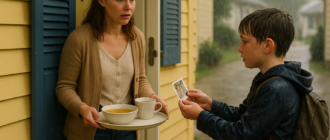
The first time I met Liam, I almost closed the door in his face. It was a rainy Tuesday, my first week alone after my wife Emma passed away. The world outside my apartment felt too loud, too bright, too indifferent. I had just sat down with a bowl of soup I didn’t want when the knock came: three short taps, then silence.
On the other side stood a thin boy with a backpack almost bigger than him. Ten, maybe eleven. Wet hair stuck to his forehead, blue eyes too serious for his age.
“Sir,” he asked, a bit out of breath, “do you maybe have any… stories?”
I stared at him, confused. “Stories?”
“Yeah. Old ones. The kind that make you remember things.” He said it like he’d rehearsed the line.
Something in my chest tightened. For forty years I’d taught history at the local school, filling classrooms with dates and lives that were no longer here. Now I couldn’t even fill my own kitchen with my wife’s laughter.
“I don’t have anything,” I muttered and started to close the door.
But he looked up, and there was so much quiet hope in his eyes that my hand froze on the handle.
“I can come back tomorrow,” he said quickly. “Same time. Maybe you’ll remember some then.”
He left before I answered.
The next evening at 7:05, the knock came again. Same three taps. Same thin boy.
“Sir, do you maybe have any stories today?”
I should have said no. Instead, I heard myself say, “I used to tell my students about a boy who crossed a frozen river to bring medicine to his village.”
Liam’s face lit up. “Can you tell me now?”
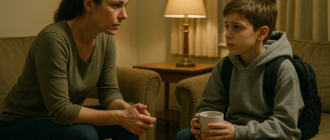
I hadn’t spoken more than a few polite words to anyone in days. My own voice surprised me as I waved him inside. He sat on the edge of the armchair, backpack still on, hands folded, listening like the world depended on every sentence.
He came the next day, and the next, always at 7:05, always with the same question:
“Sir, do you maybe have any stories today?”
I started waiting for that knock. I shaved. I opened the curtains. I warmed up the room before he arrived. We made a ritual of it: tea for me, hot chocolate for him, one story a night. Some were from books, some from my childhood, some about Emma and me when we were young and thought we had forever.
He almost never talked about himself. When I asked, he shrugged.
“My mom works evenings. She cleans offices. My dad… left. It’s just us and my little sister, Mia.”
“Does your mother know you’re here so late?” I asked.
He smiled a small, crooked smile. “She’s glad I’m somewhere warm.”
I wanted to believe that was enough.
Weeks passed. The apartment, once a museum of silence, now echoed with our voices. I caught myself telling Emma about him in my head, the way I used to share everything with her. “You’d like this boy, Em. He listens with his whole face.”
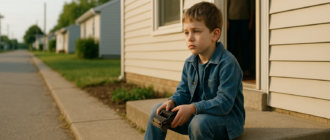
Then, one Thursday, the knock didn’t come.
I sat in my chair, teacup cooling in my hand, eyes on the door. 7:05. 7:10. 7:20. I told myself he was just late. Kids get distracted. By 8:00, the apartment felt smaller, the air too heavy.
By 9:00, the silence was screaming.
I barely slept. Every sound in the hallway made me sit up. The next evening I waited again. 7:05 passed like a missed heartbeat. The third night, I couldn’t stand it anymore.
For the first time since Emma’s funeral, I left the building after dark.
I didn’t even know his last name. Just “Liam” and “little sister Mia” and a mother who cleaned offices. I walked the neighborhood, asking strangers if they knew a thin boy with blue eyes and a too-big backpack. People shook their heads, hurried past, pulled their children closer.
I was about to give up when I saw the notice board in the small grocery store. Among the ads for used furniture and language lessons was a printed sheet with a photo.
A thin boy. Blue eyes. Backpack.
Missing.
My hands trembled as I leaned closer. Liam, age 11. Last seen three days ago, walking home from school. Underneath, a phone number.
The world blurred for a second. A ringing started in my ears. I forced my fingers to dial.
A tired female voice answered. “Hello?”

“I… I think I know your son,” I managed. “My name is Daniel. He—he’s been visiting me every evening. For stories.”
There was a long, sharp silence.
“He… what?” she whispered.
Within twenty minutes, a woman in a worn coat stood at my door. Dark circles under her eyes, hair pulled back too tightly, hands shaking. She looked nothing like the smiling mothers from commercials, but she looked exactly like a mother who hadn’t slept in three days.
“I’m Anna,” she said. “Please. Tell me everything.”
We sat at the table where her son had listened to me night after night. I told her about the knocks, the questions, the stories. How he always left at 8 sharp.
“I didn’t know where he went,” she said, voice breaking. “He just said he was at the library. I work until nine. Mia is with our neighbor. I thought… I thought books were the safest thing in the world.”
Guilt clawed at me. I should have called someone. I should have asked for her number. I should have done something more than open my door and my mouth.
The police came, asked questions, wrote things down. They checked my apartment, my hallway, the route Liam might have taken home. They took my number, promised to be in touch. When they left, Anna and I sat in the suddenly too-bright kitchen, two strangers connected by the absence of one small boy.
“Why did he come to you?” she asked quietly.
I thought of Liam’s face when he listened, how his shoulders relaxed, how the tension in his jaw eased.
“Maybe,” I said slowly, “because I was the only one with time to answer him.”
The following days stretched like years. I couldn’t sit, couldn’t read, couldn’t bear the sound of my own breathing. I walked the streets with Anna, handing out flyers, asking questions. We checked playgrounds, bus stops, parks. Every thin boy with a backpack made my heart leap and then crash.
Three days later, at 6:50 in the morning, my phone rang.
They had found him.
He was sitting on the floor of an all-night laundromat two neighborhoods away, wrapped in a blanket someone had given him. Hungry, exhausted, but unharmed. He’d been trying to walk to the address of his old school friend, a place he barely remembered. He got lost. Too afraid to ask for help, he’d wandered in circles until he finally fell asleep in the warmth of the machines.
When we arrived, he looked much smaller than I remembered. Anna ran to him, but stopped a step away, hands on her mouth, as if afraid he might vanish.
“Mom?” he whispered.
She didn’t hug him at first. She just knelt in front of him, searching his face with shaking fingers, as if checking every feature.
Then she looked at me.
“You,” she said, and tears spilled down her cheeks. “You’re the story man.”
Liam turned, and when he saw me, his eyes filled.
“I was going to come back,” he said quickly, as if the worst part was disappointing me. “I just wanted to bring you a story too.”
My throat closed up. For so long I had believed I had nothing left to give. Now I realized this boy had been giving me something every evening I hadn’t even named.
“Liam,” I managed, “you already did.”
The police officer cleared his throat gently. “We’ll need to talk to you all later. But for now, let’s get him home.”
On the way out, Anna touched my arm.
“I didn’t know how alone he felt,” she said hoarsely. “I work, I run, I collapse. I thought a roof and food were enough. I didn’t see he needed… more words than I had energy to give.”
I thought of my quiet apartment, of Emma’s empty chair, of my evenings before that first knock.
“He’s not the only one who needed words,” I said.
From then on, Liam didn’t come alone. At 7:05, three evenings a week, there would be two soft knocks: his and a smaller echo. Little Mia, with her tangled hair and serious eyes, would stand half-hidden behind him. And behind them, on some days, Anna, still in her work clothes, hands red and raw, but eyes softer.
We made a new ritual. One adult reads. Two children listen. Sometimes Anna talked too, haltingly at first, about the village she left, about the songs her mother sang when she was their age. Sometimes I stopped mid-story to ask Liam what he thought should happen next, and watched him realize he could shape endings too.
People say grief is a room that gets smaller and smaller until you can’t breathe. But sometimes, all it takes is a knock at 7:05 and a child asking for stories to crack a window open.
Now, when I tell this story, I always end it the same way: the night Liam didn’t come was the worst night of my life since losing Emma. But it was also the night I understood that the only thing more painful than losing someone is realizing you had one more chance to open your door and didn’t.
So I keep my door unlocked at 7:05. Not because I’m waiting for someone new to knock.
But because two children, and their tired, brave mother, already do.