The boy who rang our doorbell at midnight asking if this was the house that didn’t give children back.

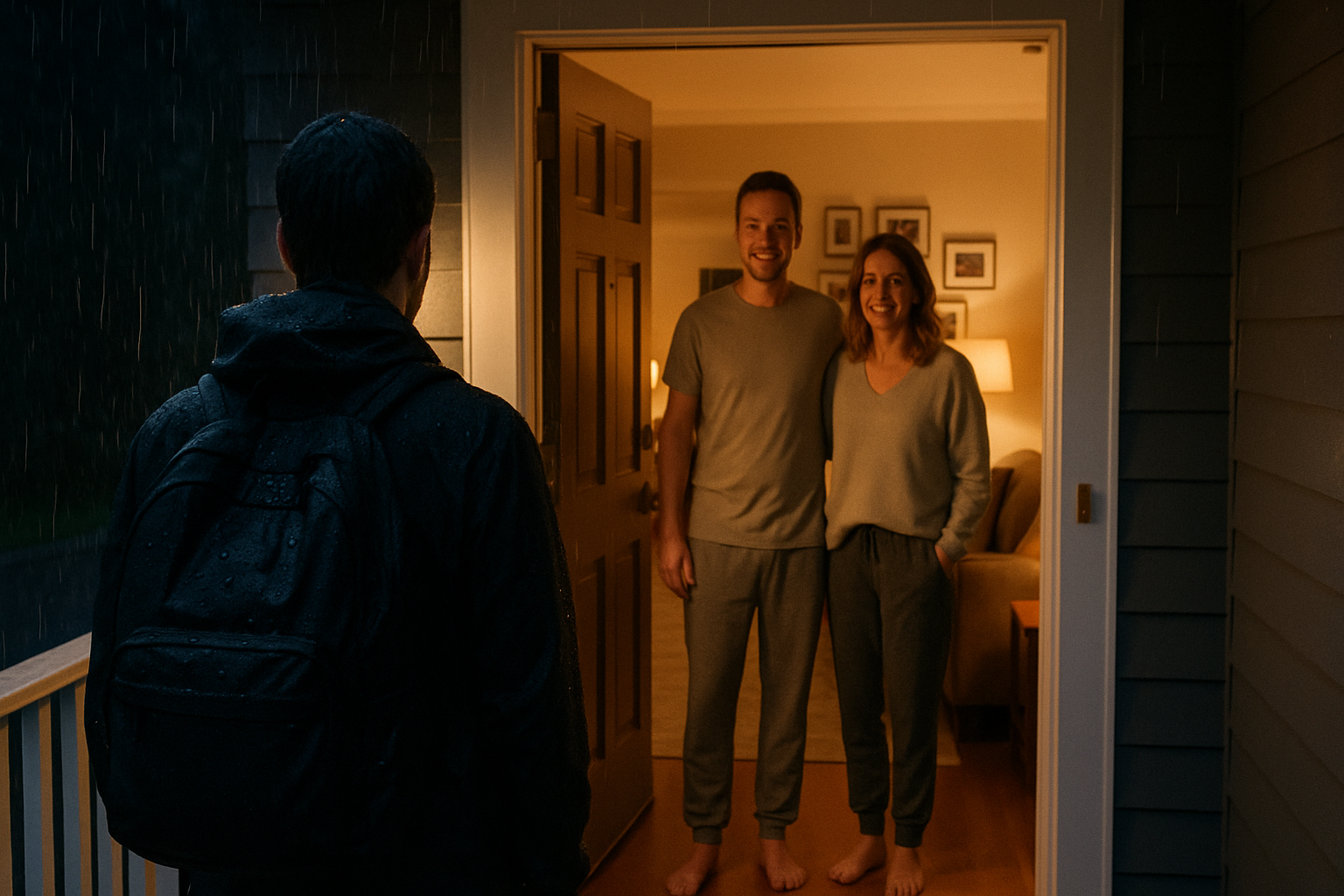
I thought I misheard him. It was late, rain tapping on the windows, my husband Mark dozing on the couch, the TV humming low. The doorbell cut through the house like a scream. When I opened the door, he was there: small, soaked through, maybe nine years old. His backpack hung off one shoulder, a cheap cartoon print already peeling.
“Is this the house that doesn’t give children back?” he repeated, clearer this time, looking past me into the warm light of our hallway.
For a second, my throat closed. We don’t have children. We had tried, for years, until doctors’ words like “never” and “unlikely” built a wall around that part of our life. We’d stopped talking about it out loud. But somehow, this stranger’s sentence cut straight through to the ache I thought I’d buried.
“Come inside,” I said quietly. “You’re freezing.”
He hesitated, glancing over his shoulder as if someone might be watching from the dark street, then stepped in. Water dripped onto the mat. His sneakers squelched. Up close, I saw a bruise yellowing on his wrist and a raw scrape on his knee.
Mark appeared at the hallway, blinking sleep from his eyes. “What’s going on?”
“This is Liam,” I said, guessing. The boy nodded. “He… he needs somewhere to stay for a bit.”
It wasn’t the whole truth. It wasn’t even a partial truth. We didn’t know anything yet. But something inside me had already decided.
In the kitchen, under warm lights, Liam wrapped his hands around a mug of hot chocolate like it was the only warm thing left in the world. Steam fogged his glasses — too big for his face, sliding down his nose.
“Why did you come here?” I asked gently.
He stared at the table. His fingers were red and chapped, nails bitten to the skin. “The lady at the office said your name once. Emma. She said you used to do… foster. Before.”
My chest tightened. We had been licensed foster parents, years ago, briefly. One placement. One little girl who stayed exactly twenty-three days before a social worker buckled her into a car and took her back to a mother who promised she was better now. We’d stood in the driveway, hands empty, watching the red tail lights disappear.
We had never tried again.
“How did you remember my name?” I asked.
Liam shrugged. “I remember things. She said you were the one who cried when they took the girl back. She said you didn’t want to give her back.”
I felt Mark stiffen beside me.
“Is that why you’re here?” Mark asked carefully. “Because you think we won’t… give you back?”
Liam’s lip trembled. He swallowed hard. “They always give me back,” he whispered. “I break stuff. Or I don’t talk enough. Or I talk too much. Or I wake up yelling. Then they call. And they pack my bag. And they say it’s not my fault, but they still give me back.”
He looked up, eyes huge, wet. “I just want one house that doesn’t.”
The words landed like a weight on the table between us.
My instinct was to say, “We’ll keep you.” The sentence pressed against my teeth. But reality crowded in: our closed file with the agency, the years since our license expired, the careful numbness we’d built.
“Liam,” I said instead, my voice unsteady, “who knows you’re here?”
His jaw clenched. “They were gonna move me again. New people. New rules. New school. I heard them.”
“At the office?” I guessed.
“At my foster house.” His face hardened. “He said I was too much work. He thought I was asleep.”
Anger flared hot under my ribs. At a stranger. At a system. At myself, for knowing exactly how this story went and having opted out years ago.
“I ran away,” he added, almost defiantly, daring us to be angry.
Mark exhaled slowly. “We have to call someone,” he said, looking at me, not at Liam. “They’ll be out looking for him. The police, at least.”
Liam’s chair scraped back. “No!” His voice cracked. “You said you were the house that cries when they take kids. Please. Don’t call. Please.”
He stood there, small and shaking, one hand still clutching the strap of his backpack like someone might rip it away.
The twist was cruel in its simplicity: the very thing that had broken us years ago, the part of our story I was most ashamed of — that I had sobbed in a government office, begging to keep a child I had no legal right to — had become his last fragile hope.
I looked at Mark. His eyes were wet. For a long moment, the three of us just breathed the same kitchen air, the clock ticking too loudly.
“We’ll call,” I said finally, “but not to send you away tonight.”
Liam’s shoulders sagged, then tensed again, not daring to believe.
I turned my phone over in my hand. My thumb hovered over the number of the after-hours social worker. Then, before I could lose my nerve, I dialed.

When Jade arrived — older now, more tired, but still with that same worn leather folder — she stepped into our living room and stopped dead.
“You two,” she said softly. “I didn’t expect to see your names on my screen again.”
Liam shrank into the corner of the couch.
“Are you taking me?” he blurted.
Jade looked between us, reading the room like she always did too well. “I’m here to make sure you’re safe,” she said. “Everyone’s worried about you.”
His eyes flicked to me. I swallowed.
“Can he stay here?” I asked before fear could mute me. “Tonight. And… maybe longer. If you’ll reopen our case.”
Mark’s head snapped toward me, but he didn’t contradict. His hand just moved, almost unconsciously, resting on the back of the couch behind Liam, not touching him, but there.
Jade studied us for a long time. “You know how this works,” she said quietly. “There are no guarantees. I can’t promise you he won’t be moved one day. I can’t promise you’ll be the house that doesn’t give him back.”
“I know,” I whispered. “But I also know what it feels like to watch a child leave and wonder if the next house will understand his nightmares. Or his silence. Or his broken things.”
Liam’s fingers twisted in the hem of his sweatshirt.
“I don’t want another maybe,” he said hoarsely. “I just want someone to try.”
The room went very still.
Jade sighed, then opened her folder. “All right,” she said. “For tonight, he can stay. We’ll start the paperwork in the morning.”
Liam didn’t smile. Not exactly. But his body loosened, his breathing steadied. He looked around our small, cluttered living room like he was memorizing it: the crooked bookshelf, the plant that refused to die, the framed photo of a girl we’d fostered for twenty-three days.
“Who’s that?” he asked suddenly, pointing.
I followed his finger. The girl’s gap-toothed grin beamed back at us. “Her name is Mia,” I said. “She stayed with us a while.”
“Did you give her back?”
The question pierced, simple and brutal.
My eyes burned. “We had to,” I said. “But we loved her the whole time she was here.”
Liam considered this, then nodded slowly, as if cataloging a new rule: sometimes you are given back, even when people love you.
That night, I passed the small guest room we hadn’t used in years and saw him lying stiff on top of the covers, backpack still on, shoes by the door in a neat line, as if ready to run again at any second.
“Liam,” I said from the doorway, “you can unpack. If you want.”
He sat up. “You sure?”
“No one’s coming to take you tonight,” I said. “If they try, I’ll be the one crying at the office again.”
A tiny, startled laugh escaped him. Then, carefully, like someone testing the weight of a new word, he unzipped his bag and placed a single worn-out stuffed dog on the pillow.
He lay down beside it, shoes now pushed under the bed.
In the dark, his voice floated out, small and hopeful and terrifying.
“Maybe,” he said, “this can be the house that doesn’t give up, even if it has to give back.”
I stood there, hand on the light switch, heart splitting open in the same old way, and understood: there were no safe promises. Only choices.
“Sleep,” I whispered. “We’ll figure it out in the morning.”
Behind me, down the hall, Mark was already filling out the forms Jade had left on the table.
We were opening the door again, knowing it might break us. But for the first time in years, the house felt like it was breathing. Not because we could guarantee we’d never have to let him go.
But because, for as long as he was ours, we absolutely would not.