The old man kept coming to the school fence every afternoon, watching the children play, until one day my daughter walked up to him and asked the question that changed everything for our family.

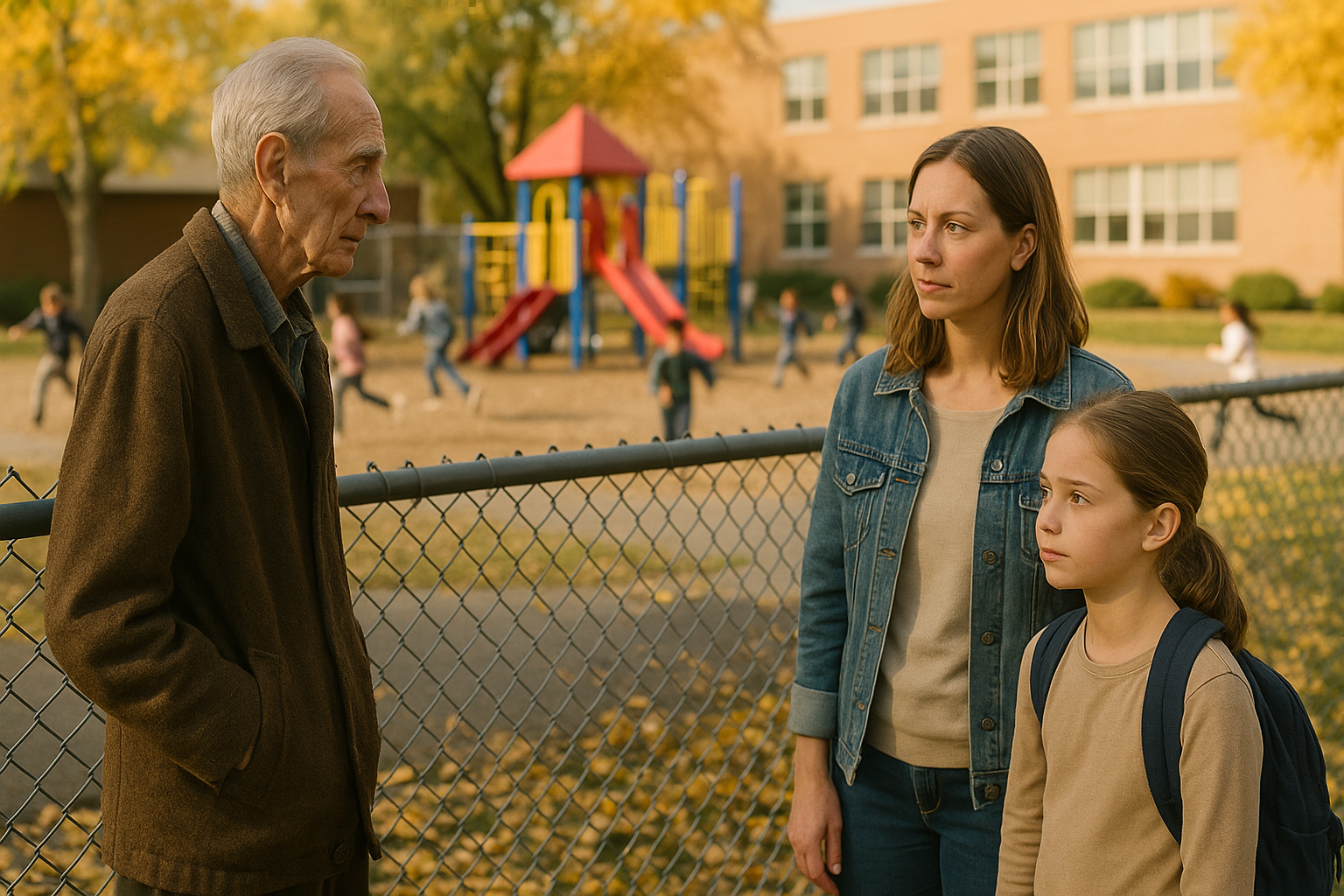
I first noticed him in early October. I was waiting in my car outside the elementary school, scrolling through work emails, when a thin figure by the far fence caught my eye. An elderly man, gray hair neatly combed, in the same worn brown coat, hands clasped behind his back. He stood completely still, watching the playground as if he were afraid to blink.
At first, I didn’t think much of it. Maybe he lived nearby and liked the noise of children. But he was there the next day. And the next. Always arriving a few minutes before the final bell, standing in the same spot, eyes searching the crowd with a kind of quiet desperation.
One rainy afternoon, as parents ran with umbrellas, he stood uncovered, getting soaked, his gaze fixed on the door where the kids came out. Something in his face made my stomach twist. It wasn’t the vague smile of a passerby enjoying the scene. It was longing. And grief.
“Mom, that man is here again,” my nine-year-old daughter Emma said one day, tossing her backpack into the car.
“You’ve seen him before?” I asked.
She nodded, buckling her seatbelt. “He’s here almost every day. He watches us at recess too, from the street. But he never comes inside. The teachers say he’s not allowed without a pass.”
A small alarm bell rang in my head. This was how all those scary news articles started. An unknown man, a school, children. I drove home with my jaw clenched.
That evening, over dinner, I mentioned it to my husband, Daniel.
“Maybe we should talk to the principal,” he said. “Just in case.”
I agreed. Not out of panic, I told myself, but out of responsibility. Still, when I tried to sleep, I kept seeing the man’s face under the rain.
The next day, I arrived early on purpose. The man was already there, fingers gripping the chain-link fence, his knuckles pale. He didn’t look dangerous. He looked… fragile. As if a strong wind could knock him over.
I watched him for a few minutes. He occasionally lifted his head at the sound of laughter, his eyes softening, then quickly clouding again when he seemed not to find what he was looking for.
I was about to get out of the car and go speak to him when the bell rang and children flooded the yard. Emma spotted me, waved, then suddenly turned and walked straight toward the fence.
“Emma!” I called, but she didn’t hear me.
She stopped in front of the old man, tilting her head the way she did when something puzzled her. They exchanged a few words. I saw the man’s hand fly to his mouth, his shoulders shaking. Then Emma reached into her backpack and handed him something small—her extra granola bar, I realized.
By the time I reached them, the man was wiping his eyes on his sleeve.
“Mom, this is Mr. James,” Emma said quietly. “He was looking for someone.”
The man straightened up, embarrassed. “I’m sorry,” he murmured. “I didn’t mean to cause any trouble.” His accent was local, his voice soft and hoarse.
I stood between him and my daughter, every protective instinct on high alert. “Do you have a child here?” I asked.
He swallowed hard. “I… I had a granddaughter. Lily. She used to go to this school.” His eyes moved over the building. “She would be in fourth grade now. Same as your girl.”
Emma glanced up at me, confusion in her eyes.
“What do you mean, ‘had’?” I asked cautiously.
He looked down at his shoes. “My daughter… her mother… they moved away after the accident. I wasn’t allowed to see Lily anymore. Lawyers, anger, all that nonsense. I thought it would blow over.” His voice broke. “Then I heard… that Lily didn’t make it. Car crash. Two years ago.”
He paused, taking a shaky breath. “But I keep coming here. This is where I used to wait for her. She would run out the door, her backpack half open, hair everywhere, and shout ‘Grandpa!’ so loud people stared.” A faint smile flickered, then died. “I thought if I came here, maybe… I don’t know. Maybe it would hurt less.”
The playground noise blurred behind his words. I felt something in my chest crack.
Emma was staring at him, eyes wide. “So you don’t have any kids now?” she asked, her voice barely above a whisper.
He shook his head. “No. Just an old man with too many memories.”
I realized I was still standing like a barrier between them. Slowly, I stepped aside.
“I’m sorry,” I said, and meant it. “We… we saw you here every day. We were worried.”
“You were right to be,” he replied gently. “The world is not always kind. But I just came to listen.” He gestured toward the playground. “To remember the sound of little feet. For a few minutes a day, it feels like I still have her.”

Emma looked at the granola bar in his hand, then at me. “Mom,” she said, tugging at my sleeve, “can he wait with us today? Just today?”
Every responsible-parent warning screamed no. We didn’t know this man. We had no proof of his story. But I also saw the way he stood, slightly hunched, as if he were apologizing for taking up space in the world. And I thought of my own father, sitting alone in his apartment three states away, calling once a week and pretending he wasn’t lonely.
“We can walk to the car together,” I said carefully. “That’s all.”
He nodded, grateful, and kept a respectful distance as we walked. He asked Emma about her classes, her favorite subject, her friends. She answered with the open honesty only children have.
At the car, he stopped. “Thank you,” he said. “You’ve given me more than you know.”
I found myself asking, “Do you live nearby?”
“A few blocks down,” he replied. “I’m Mark James. I was a mechanic for thirty-five years. Now I fix toasters for neighbors who still trust my hands.” He tried to smile.
I hesitated, then scribbled my number on an old receipt. “If you ever need help… groceries, anything… you can call. And if you want to just… talk, I guess that’s okay too.”
His eyes filled again. “People usually cross the street when they see an old man staring at a school,” he said. “You didn’t.”
The twist came a week later.
Emma came home, face pale, clutching a wrinkled piece of paper. “Mom,” she said, “the teacher gave us this in class.”
It was a newsletter from the school’s counseling office, about grief and loss. On the back was a small notice: “In memory of Lily James, former student of Maple Grove Elementary, who passed away in a car accident two years ago. Her grandfather, Mark James, has donated a bench for our playground.”
The picture showed the bench. I had passed it a hundred times. I had never read the little plaque: “For Lily, who ran faster than the wind. Love, Grandpa.”
My knees went weak. Emma gripped my hand. “So he was telling the truth,” she whispered.
That evening, I walked with Emma to the bench. The sun was setting, bathing the playground in a soft golden light. The plaque was cool under my fingers. I imagined a little girl with braids, running toward an old man at this very spot.
“Mom,” Emma said quietly, “can we invite him for Sunday dinner? So he doesn’t have to stand here alone anymore?”
I thought of all the ways life had hardened me—endless work emails, rushed mornings, the instinct to see danger before sadness. And I thought of Mark, standing in the rain because it hurt less to be near children than alone with his memories.
“We can try,” I said.
We walked to his small apartment building. My heart pounded as we climbed the stairs. At his door, we could hear faint sounds of a television and the slow shuffle of feet.
When he opened the door and saw us, something in his face lit up and broke at the same time.
“We were at Lily’s bench,” Emma blurted out. “We saw your name. We’re having spaghetti on Sunday. My dad makes too much sauce. You can help us eat it.”
Mark looked at me, as if asking for permission to hope.
“I make garlic bread too,” I added awkwardly. “If you like that.”
He pressed his hand to his chest. “I… I don’t want to be a burden,” he whispered.
“You won’t be,” I said. “We have space at the table.”
On Sunday, he came in his best shirt, hair carefully combed, carrying a small box of old toy cars wrapped in tissue paper. “For Emma,” he said. “I used to fix them for Lily.”
At the table, as Daniel joked, Emma talked, and Mark listened with shining eyes, I realized something simple and heavy: sometimes the people we’re most afraid of are just the ones who lost the most.
We didn’t replace Lily. No one could. But we gave her grandfather a place to sit where he didn’t have to stare through a fence anymore.
And on school days now, when the bell rings, Mark doesn’t stand alone in the rain. He waits beside me, under our umbrella, watching the doors. Emma runs out, backpack half open, hair everywhere, shouting, “Grandpa Mark!” so loud people stare.
This time, nobody asks him to move away from the fence.