The letter the nurse slipped into my hand at the hospice said my father had been looking for me for twenty years, but I was holding his signed refusal from the orphanage saying he never wanted to see me again.

My knees almost gave out right there in the corridor. The hospice smelled of disinfectant and boiled vegetables, and somewhere down the hall someone was coughing in a way that sounded like the end of something important.
“Ethan?” the nurse, a tired woman with kind eyes, repeated softly. “He kept your name on the wall. We thought… you should know before you go in.”
I looked down at the crumpled photocopy in my fist—an adoption file I’d begged from a bored clerk two weeks ago. At the bottom of the form, under a sentence that began, “The biological parent declares…”, there was a shaky signature: Daniel Harris. My father.
Next to it, a box was checked: “Refuses further contact.”
I had memorized every curve of that signature. I had hated every pen stroke.
“He said he refused me,” I whispered. “Now you’re telling me he was looking for me?”
The nurse nodded toward the door. “Room 14. You can ask him yourself. If you want.”
If I want. I had spent thirty-three years imagining what I’d say to the man who left me in that gray building with barred windows and a playground with no swings. I’d pictured screaming, spitting words, turning my back so he could see exactly how it felt.
Instead, I just pushed the door open.
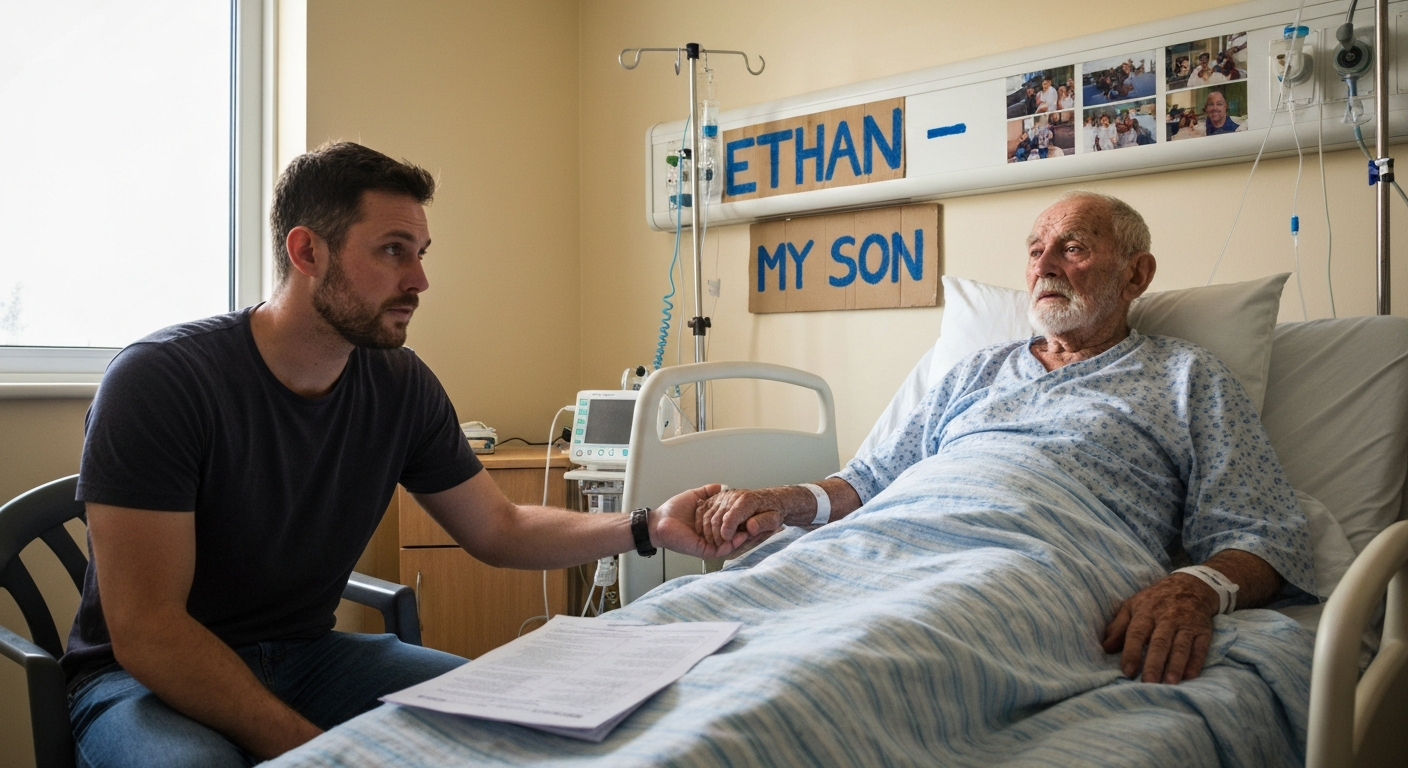
He was smaller than in my nightmares. Just an old man sinking into a too-big pillow, cheeks fallen in, gray stubble like frost on dead grass. Tubes snaked from his arms, machines hummed softly. On the wall above his bed, there were pictures: newspaper cutouts, children from brochures, a few faded photos. And in the middle of it all, in shaky blue letters on a piece of cardboard: “ETHAN – MY SON”.
Something tore inside me.
His eyes were closed. For a moment I hoped I’d got the wrong room, the wrong man, the wrong life. Then he coughed, turned his head, and I saw my own nose, my own stupid deep-set eyes, only duller.
“Mr. Harris?” I said. My voice didn’t sound like mine.
His eyelids fluttered. “You’re late with the mail again, Tom,” he muttered. “You boys never—”
“It’s Ethan,” I blurted out.
The room froze. He opened his eyes fully, and there was no dullness now, just a sharp, painful light.
“What did you say?” His fingers twitched on the blanket, searching for something to hold.
“Ethan,” I repeated, my chest tight. “You were looking for Ethan.”
He tried to sit up, failed, and grabbed at my wrist instead. His grip was surprisingly strong. “Don’t… don’t play with me,” he whispered, breath rattling. “Please. I’ve… imagined him so many times. Don’t let that be the last cruelty.”
I pulled the orphanage form from my pocket and threw it onto the blanket between us. “Cruelty?” I snapped, the years finally boiling through my throat. “You signed that. You refused further contact. Do you know what that means when you’re six and they read it to you like a verdict?”
He stared at the paper as if it were a snake.
“I never saw this,” he said hoarsely. “Never. They told me you… were adopted. That you’d gone to a family. I went back, I went back every month for two years, and they just… I never saw this.”
“You’re lying.” I wanted it to be a lie. I needed it to be simple, black and white, villain and victim. It had kept me warm in that cold dormitory, the idea that he was made of stone and I was made of something better.
He lifted a shaking hand to his face. “I signed one paper,” he whispered. “They said if I acknowledged I couldn’t care for you, you’d get on the list faster. I… I was drinking then. Your mother had left. I thought I was doing the only thing I could to give you a chance. Then the cancer came, and… twenty years ago I sobered up and went back. They said records were sealed. ‘No further contact from the child or parent permitted.’ I thought…” His voice cracked. “I thought you refused me.”
The words hit me like a physical blow. For a second, all I could hear was the wind whistling through the broken window of the orphanage stairwell, the voice of the director—cold, rehearsed—saying, “Your father signed that he doesn’t want to see you anymore.”
I sank into the chair by his bed. The plastic creaked under my weight.
“They told me you refused me,” I said slowly.
We stared at each other, two broken pieces that had been carefully turned in opposite directions by an efficient, faceless system.
“How did you find me?” he asked finally, his voice barely above a breath.
“I didn’t. They called me,” I said. “Some social worker found my file. Said you were in hospice, no family listed. I almost didn’t come.” I swallowed the lump in my throat. “I came to tell you I forgave you. I practiced it on the train, like a speech. It felt noble.”
He gave a weak, humorless laugh that turned into a cough. “You shouldn’t forgive a man you don’t know,” he said. “Ask first if he deserves it.”
The anger in me, that familiar hot coal, suddenly felt old and tired. I looked up at the cardboard sign with my name on it, traced over and over where the ink had bled.

“How long have you… been looking?” I asked.
“Twenty years,” he said. “At first I yelled at clerks. Then I wrote letters. Then I just… came here.” He gestured vaguely toward the wall with all the photos. “They bring in students, volunteers. I watch their faces. I imagine which one is you. I tell them stories about you, even though I don’t have any. I invented birthdays we never had.” His eyes shone with unshed tears. “I am so, so sorry, son.”
The word “son” cracked something in me that no file, no stamp, no signature had reached.
“I grew up thinking I was trash,” I said. “That you saw me, really saw me, and decided I wasn’t worth the trouble.”
“I saw you once,” he murmured. “You were wrapped in a blue blanket. You had this angry crease between your eyebrows. I thought, ‘He’s going to fight the world.’ I was the one who didn’t fight.”
We sat in a heavy silence, the machines ticking off seconds we didn’t have.
“I can’t give you a childhood back,” he said. “I can’t give you… a father. All I have is this bed and a drawer full of letters I never sent because I didn’t know where to send them.” He turned his head toward the small bedside table. “Top drawer. If you… if you never want to come back after today, take them and burn them. At least someone who’s real will have touched them.”
My hand shook as I opened the drawer. Inside were dozens of envelopes, some yellowed, some new, all addressed the same: “To my son, Ethan,” followed by blank space where an address should have been.
The top one was dated ten years ago. The last one, three days before.
“You wrote even last week,” I said.
“If I stopped, it would be like admitting you were really gone,” he replied.
I pressed the letters to my chest. They rustled like dry leaves.
“I don’t know how to do this,” I admitted. “I don’t know how to be your son for a day, or an hour.”
“Then just… sit,” he said. “Tell me about the man you became without me. Let me be proud of you for a little while, even if I don’t deserve it.”
So I told him. About the factory job, the nights studying accounting at a plastic table in a too-small apartment, the time I almost quit everything because the loneliness felt like drowning. I left out the worst parts—the panic attacks in supermarket aisles, the way I couldn’t look at playgrounds—but he seemed to hear them anyway.
“I’m sorry you had to be strong alone,” he whispered.
“And I’m sorry you had to be sorry alone,” I answered.
When the nurse came in to check his drip, she glanced at our joined silhouettes and smiled softly, as if she’d been waiting for this picture to exist.
Visiting hours ended, but no one hurried me. Outside, the sky was turning the soft orange of a day almost over. Inside, his breaths were getting shallower.
“Ethan,” he said suddenly, voice urgent and thin. “Promise me one thing.”
I leaned closer.
“Don’t let a stamp and a checked box decide what you are worth,” he murmured. “They lied to both of us. Don’t carry their lie longer than you carry me.”
Tears slipped down my face before I could stop them. I hadn’t cried like this since I was small enough to fit under a thin state-issued blanket.
“I promise,” I said.
His hand, cool and bony, tightened around my fingers for a moment, then relaxed.
He didn’t die that night. Not yet. Life, even at the end, is rarely that tidy. I left after midnight with a folder of letters against my heart and an old man’s apology echoing in my ears.
On the way home, I passed a small playground. The swings were empty, moving slightly in the wind. For the first time, I let myself stop and watch them.
Somewhere between the creak of chains and the distant sound of traffic, the story I’d told myself all my life—about the father who didn’t want me—finally loosened its grip.
In its place, another story began. Still painful, still full of holes, but human. A story of two people written out of each other’s lives by a checked box, who somehow found their way back just in time to say, “You mattered to me. You always mattered.”
I went back to Room 14 the next day.
This time, when I walked in, I didn’t come to forgive a stranger. I came to visit my father.