The old man kept sitting on the same park bench every day with a tiny blue backpack, until one rainy afternoon a stranger unzipped it and realized why he never let anyone sit beside him.

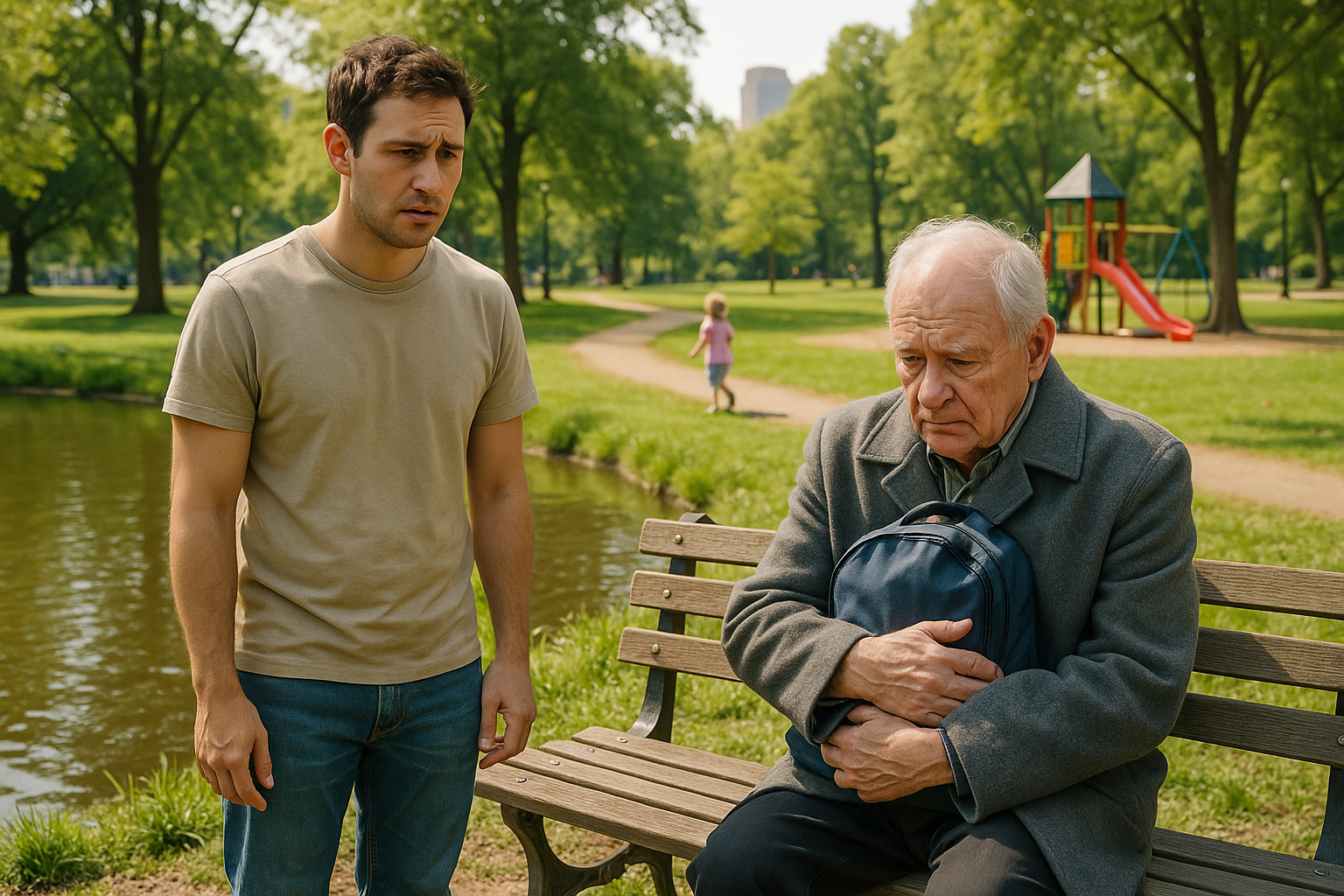
Noah first noticed him in early spring. The park was still half-bare, the trees unsure if winter was really over. Children raced along the paths on scooters, mothers shouted names, dogs barked. And on the far bench, near the pond, the old man sat perfectly straight, the small blue backpack placed carefully to his right, occupying half the bench as if it were a person.
He was always there at three in the afternoon. Always in the same gray coat, always staring at the playground, never actually watching the ducks or the sky. He never spoke to anyone. If someone came too close, he would move the backpack closer to himself, guarding the empty space.
Noah started bringing his own daughter, Lily, to the park every day after school. She was six, all missing teeth and tangled hair, loud in the way only children are allowed to be. While she played, Noah sat on a nearby bench with his laptop, pretending to work but always drifting into watching the old man.
“Why does he sit alone, daddy?” Lily asked one day, ice cream smeared across her cheek.
“I don’t know,” Noah said. “Maybe he’s waiting for someone.”
“Then why is no one coming?” she frowned.
He had no answer.
Days turned into weeks. Noah began to arrange his schedule so he could be in the park at three. Some part of him, the part that remembered sleepless nights in the hospital two years ago, watching monitors over a crib that stopped beeping too soon, felt pulled toward this stranger’s silent ritual.
Once, when a teenage boy tried to sit on the bench, the old man’s reaction made everyone turn. He clutched the blue backpack with both hands, pressing it tightly against his chest, his voice breaking.
“Please, not here. This place is taken. This is his seat.”
The boy laughed awkwardly and walked away. The old man kept his arms around the backpack for a long time, rocking slightly, lips moving in a whisper no one could hear.
That night, Noah couldn’t sleep. His mind replayed the old man’s trembling hands, the desperate way he said, “his seat.”
The next day, as Lily climbed the slide, Noah forced himself to walk closer.
“Good afternoon,” he said quietly, stopping a respectful distance away.
The old man flinched as if waking from a dream. Up close, Noah saw deep lines on his face, the kind that came from frowning more than laughing. His eyes were red-rimmed but alert.
“Is anyone sitting here?” Noah asked, nodding at the empty space to the left.
“Yes,” the old man said immediately, his hand tightening on the backpack. “My son.”
Noah’s chest tightened. “I see. Then I’ll stand.” He hesitated. “I’m Noah.”
The old man studied him, suspicion and exhaustion fighting in his gaze. “Daniel,” he said at last.
For three days, that was all. Names traded once, then silence.
On the fourth day, the weather turned. Dark clouds rolled over the park, but Daniel was already there when Noah arrived with Lily. Rain began to fall, scattering families, turning laughter into squeals and hurried footsteps. Lily dashed to her father, wet hair clinging to her forehead.
“Let’s go, sweetheart,” Noah said, stuffing the laptop into his bag.
Then he saw Daniel, still on the bench, rain soaking his coat. The blue backpack sat where it always did, now growing darker with water.
“Daddy, he’ll get sick,” Lily whispered, following his gaze.
Noah hesitated. He had learned that grief could be a private country, one where visitors were not always welcome. But he also remembered the emptiness of sitting alone in a hospital corridor while happy families walked past.
“Wait here under the tree,” he told Lily. “I’ll be right back.”
He ran through the rain toward Daniel. “Sir, there’s a gazebo over there. You’ll be drenched.”
Daniel didn’t move. “We can’t go,” he said. “He likes this bench.”
The rain intensified, drumming on the wooden slats, plastering thin white hair to Daniel’s forehead. Noah glanced back at Lily, then at the soaked backpack.

“May I help you at least cover your bag?” he asked, reaching into his pocket for a plastic folder.
“No!” Daniel’s shout was sharp, panicked. He caught the backpack, pulling it to his chest again, as if Noah had tried to snatch a child.
And then, as if the effort had stolen all his strength, Daniel’s eyes rolled back and his body slumped sideways. The backpack slipped from his hands and fell to the wet ground with a heavy, soft thud.
“Dad!” Lily screamed from under the tree.
Noah dropped to his knees. “Sir! Daniel!” He shook his shoulder gently. The old man’s lips moved, a faint whisper: “Ethan, don’t run into the street…”
Noah’s heart hammered. He checked Daniel’s pulse—weak but there. People gathered, someone called an ambulance. Rain pelted his neck, but his eyes were fixed on the blue backpack, lying open just enough for him to see something pale inside.
A folded piece of paper was sticking out, blurred by raindrops.
Without quite deciding to, with hands he forced to stay steady, Noah unzipped it.
Inside was a small pair of worn-out blue sneakers, children’s size, the soles smoothed by countless runs and jumps. A faded superhero sticker clung to one side. Next to them lay a toy car with chipped red paint, its wheels rusted. And beneath those, wrapped in plastic, was a photo.
A boy of about eight, dark hair sticking up in all directions, grinning with his arms thrown around Daniel’s neck. Behind them, unmistakable even in the small frame, stood the same park bench and the same playground.
On the back of the photo, in careful, shaky handwriting: “Ethan, 7. Our bench. 03:00 p.m. forever.”
The ambulance siren wailed in the distance. Noah felt the world narrow to the soggy backpack on his lap and the weight of his own memories. A crib. A tiny hospital bracelet. A smile that had barely learned to exist before it vanished.
He understood now why no one could sit there. That half of the bench was not empty to Daniel. It was full—of giggles only he could hear, of a small body that had once leaned against him, swinging legs that had tapped those now-silent sneakers against the wood.
“Daddy?” Lily’s voice was small, her shoes splashing as she came closer. “What’s in the bag?”
Noah looked at her, at the fear in her eyes, at the living, breathing child he still had. He swallowed hard.
“Memories,” he said softly. “Very important memories.”
The paramedics lifted Daniel onto a stretcher. As they carried him away, his hand searched blindly. Noah gently placed the photo in his fingers. Daniel’s grip closed around it with surprising strength.
“Will he be okay?” Lily asked as the ambulance doors shut.
“I hope so,” Noah said. He glanced at the abandoned bench, the empty space beside it suddenly unbearable.
The next day, the park felt wrong without Daniel. The bench looked wider, colder. The backpack was gone; the space to the right was just wood and rain stains.
Lily tugged his hand. “Can we sit there?”
He almost said no. Then he thought of Daniel, clutching the photo, whispering a boy’s name into the rain.
“Yes,” he said quietly. “But we’ll leave some room.”
They sat on the bench, side by side, leaving a small gap on the right. Lily swung her legs.
“Who is that space for?” she asked.
“For a boy named Ethan,” Noah said. “And for someone I loved very much too.”
He didn’t explain further. He didn’t need to. He just placed his hand gently on the empty space, feeling the rough wood under his palm, and for the first time in a long time, the weight of his own grief felt a little less like a prison and a little more like a shared language.
From that day on, every afternoon at three, Noah and Lily came to the park. Some days Daniel was there too, thinner but alive, the blue backpack still at his side. They didn’t talk much about the past. They didn’t have to.
Three o’clock became more than a time. It became a fragile bridge between what had been lost and what remained, between an old man with a backpack of memories and a father who finally allowed himself to sit down beside his own pain—and make room, just a little, for life to sit there too.