First, a shout broke through the corridor.
Then another one, already distorted, as if the person yelling hadn’t just witnessed a fight, but the collapse of the familiar order itself.
In cell 32-B, my cellmates almost forgot to breathe for a moment.
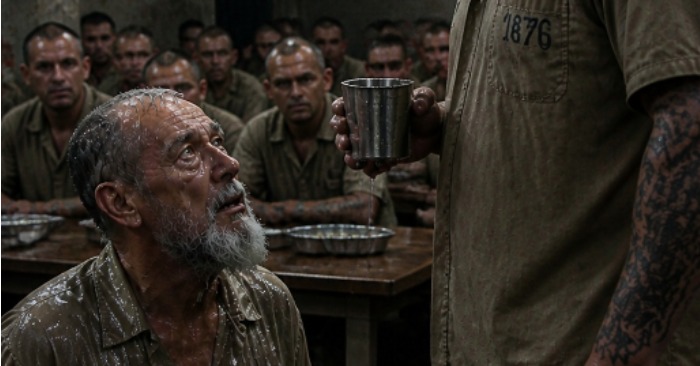
The old man sat motionless, the damp towel left beside him, listening to the sounds as if he had known their exact timing long ago.
Behind the walls, boots thundered.
Not the slow, lazy steps we had grown used to over months of routine. This time, they were fast, decisive — the kind of steps that carried authority, command.
Then two doors slammed shut loudly.
Someone shouted Wilson’s name. It was cut off immediately, as if they suddenly realized they weren’t calling out to a man, but to someone already as good as dead.
MY CELLMATES SLOWLY TURNED THEIR EYES TOWARD ME.
They weren’t pleading anymore, not worried. They looked at me the way children stare at an open door leading into a dark room.
“Was that you?”
The old man looked at them with tired eyes.
“No,” he said calmly. “I just arrived on time.”
Those words were quieter than the shout, yet far more terrifying.
Because in places like the most dangerous prison of the “Siberian Stone,” the greatest danger isn’t strength. The greatest danger is time — when it suddenly stops working in your favor.
A few minutes later, no one was running in the corridor anymore.
FOOTSTEPS THUNDERED. NAMES WERE BEING CALLED — NOT THE USUAL WAY, BUT FROM LISTS. AND THAT WAS WHAT SHATTERED THE PRISON’S NORMAL ATMOSPHERE THE MOST.
My cellmate ran a hand over his face.
He was one of those who stayed alive only because he learned early how to sense when power shifts.
“It came back to me,” he whispered. “Davies.”
The old man didn’t answer.
“Adam Davies,” he repeated, now only mouthing it. “Lawyer.”
The old man almost closed his eyes.
Once, that name had been spoken with mockery. Then in whispers. And eventually, not at all.
BACK IN THE NINETIES, HE WASN’T THE BIGGEST MAN.
He didn’t own restaurants. Didn’t station guards outside houses. Didn’t like posing for photos with expensive cars or important people.
He simply knew everything.
Who brought money to whom. Who offered protection to whom. Who signed what away. Who picked up the phone at night. Which prosecutor drank on Fridays with the very people he tried to send to prison during the day.
That’s why they called him “The Lawyer.”
He didn’t threaten. Didn’t slam his fist on the table. He simply reminded people of things they were already trying to forget.
After that, people didn’t always disappear.
Sometimes they went on living — but without jobs, without homes, without friends, stripped of the comfort that things could ever be forgiven.
FOR SOME, THAT WAS MORE TERRIFYING THAN DEATH.
For others, just slower.
My cellmate didn’t know this from rumors.
Twelve years earlier, he had worked with a crew and once saw a file with no date and no signature.
Just a single “D.”
Then the boss ordered everyone to stay silent, to destroy all old notes, and for two weeks they rotated security with a different crew.
A month later, the boss disappeared too.
Since then, the former bookkeeper had learned one thing for certain: there are men who do the work with their own hands. And there are those after whom others raise their hands.
ADAM DAVIES BELONGED TO THE LATTER.