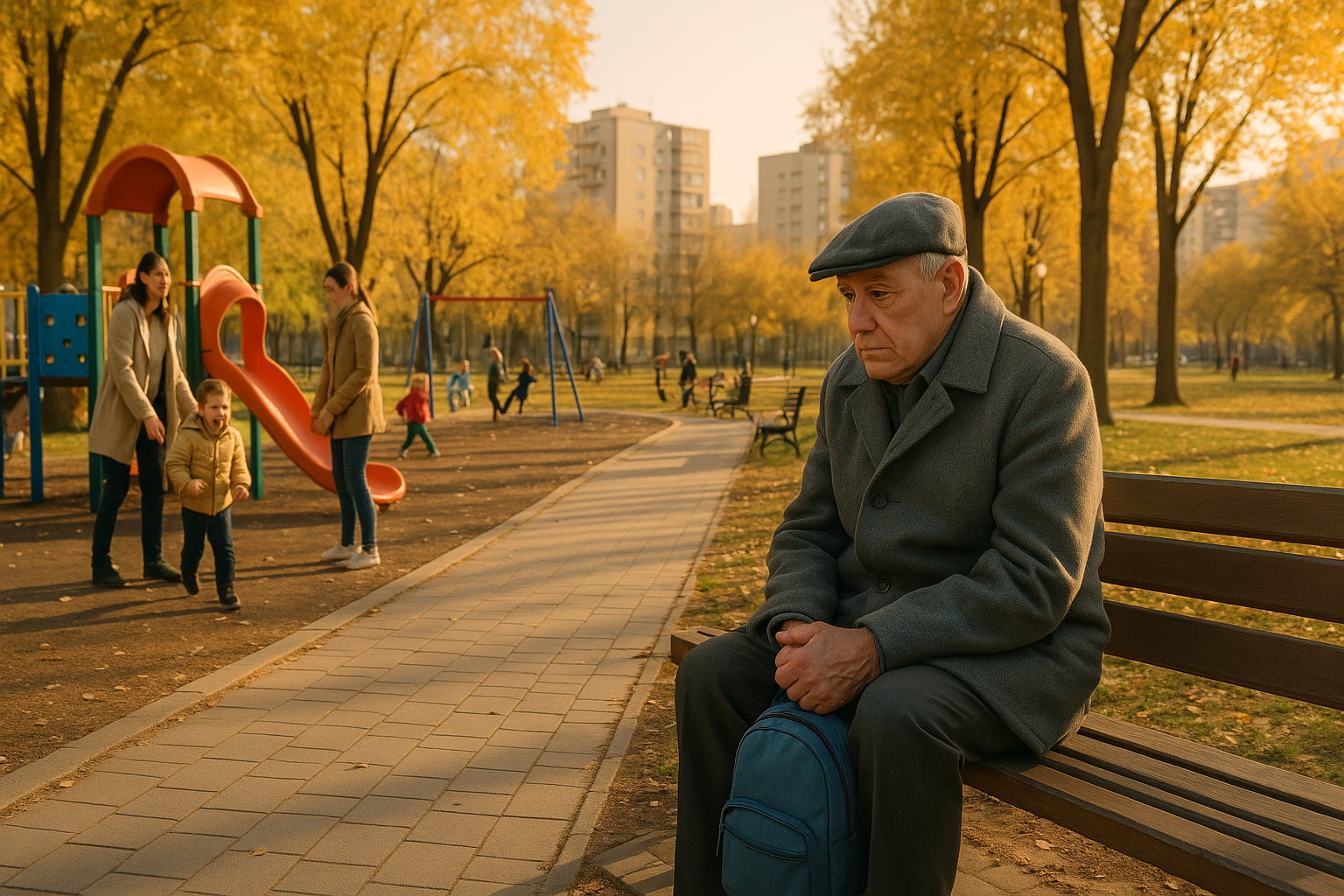
The old man kept sitting on the same park bench every evening, staring at the playground and whispering “Liam, it’s time to go home”, even though everyone in the neighborhood knew his grandson had died three years ago.

People tried not to look. Parents pulled their children a little closer when they passed him. Some shook their heads, others whispered. But every evening at six, Thomas was there: worn gray coat, cap pulled low, hands trembling slightly as he clutched a tiny blue backpack that no one had seen on any child for a long time.
Nina noticed him on her third day in the city. She sat on a different bench, her own son Oliver racing down the slide, cheeks red, hair messy. She had moved here after the divorce, hoping a new place would mean new memories, fewer questions from a five-year-old about why Daddy never stayed for breakfast.
At first, she thought Thomas was just another lonely grandfather watching other people’s kids. But then she heard the words. Soft, almost swallowed by the noise of the playground.
“Liam, come on now. We have to go. Your mom will worry.”
Nina turned. There was no child next to him. Only that little backpack on his knees, his knuckles white where he held the straps.
Oliver tugged on her sleeve later that week. “Mom, why is that grandpa always waiting? Who is Liam?”
Nina hesitated. “Maybe… someone he loved very much.”
That night, she couldn’t sleep. Her small apartment felt too quiet after Oliver drifted off. She kept thinking about the old man, about the way his eyes searched the playground like he was expecting a specific laugh, a specific pair of footsteps.
The next evening, she bought two cups of tea from the stand near the park. Her heart pounded as she walked toward his bench.
“Hi,” she said gently. “It’s cold. Thought you might like some tea.”
He looked up, surprised, as if no one had addressed him directly in a long time. His eyes were pale blue, rimmed with red, like he’d been crying for years and never really stopped.
“Thank you,” he murmured. “I’m Thomas.”
“I’m Nina. That’s my son, Oliver.” She nodded toward the playground.
Thomas’s gaze followed, softening for a moment. “He laughs like Liam,” he said quietly.
They sat in silence, sipping tea. When the sky began to turn orange, Thomas straightened with effort.
“I should go,” he said. “He’ll be tired. Liam doesn’t like walking home in the dark.”
Nina’s chest tightened. “Thomas… where is Liam now?”
He smiled, but it wasn’t a happy smile. “He’ll be here. I promised I’d wait. I’m his grandpa. That’s what we do. We wait.”
The next day, she asked a woman at the small grocery store about him. The woman’s face changed.
“Thomas? His grandson died in a car accident with his daughter. Three years ago. He never… accepted it. Comes to the playground every day. Same time. Same bench. Same words.”
The words hit Nina like a cold wave. She pictured Thomas sitting there the very next evening, and the next, and the next, while seasons changed and children grew and Liam never came.
For a week, Nina tried to keep her distance. She told herself it wasn’t her business, that she already had enough to handle with Oliver and the custody calls and the bills. But every time she passed the park and saw the old man’s hunched shoulders and the empty space beside him, something twisted inside her.
On Friday, she didn’t just bring tea. She brought a small paper bag.
“I made sandwiches,” she said. “Oliver helped.”
Thomas blinked. “You shouldn’t trouble yourself.”
“It’s no trouble,” Nina replied. “Besides, Oliver insisted.”
For the first time, a real smile flickered across his face.
As Oliver played, they talked. About the weather, the city, how expensive everything had become. Thomas clung to small, safe topics like a man afraid of deep water.
Then, one evening when the wind was sharper and most parents were hurrying their kids home, it happened.
Oliver was halfway down the slide when he called, “Mom! Can I show Grandpa Thomas my drawing?”
He ran over, clutching a crumpled sheet of paper. On it, in shaky child lines, two stick figures held hands in front of a big tree. Above them, a crooked sun.
“That’s me,” Oliver explained, pointing. “And that’s my grandpa. He lives far away now.” He lowered his voice. “Mom says he’s… tired of traveling.”
Nina swallowed. Her father was in another country, too busy starting a new life to call his grandson.
Thomas’s fingers trembled as he took the drawing. His eyes filled with tears.
“It’s beautiful,” he whispered. “Your grandpa must miss you very much.”

Oliver frowned. “Then why doesn’t he come?”
In the heavy silence, Thomas’s face crumpled. His gaze drifted to the playground, then to the small blue backpack on his lap. Slowly, as if it weighed more than he could bear, he opened it.
Inside was a child’s sweatshirt, faded and neatly folded. A small toy car with chipped paint. A photo: a boy with unruly hair and a gap-toothed grin, captured mid-laugh.
“This is Liam,” Thomas said hoarsely. “He was six. He loved the swings. He always asked for five more minutes. Just five. The day of the accident…” His voice broke. “I told his mom to drive carefully. I said I’d wait here, same as always. And then the phone rang.”
Oliver shifted closer, peering at the photo. “He looks fun,” he said simply.
Thomas nodded, a tear sliding down his cheek. “He was. I thought… if I kept coming here, if I waited hard enough, somehow time would go back. Or God would see how much I love him and change His mind.”
Nina’s own eyes filled. She thought of long nights explaining to Oliver why his father wasn’t coming back for dinner, how she’d sometimes set a place at the table anyway, just in case he changed his mind.
“Thomas,” she said softly, “Liam… he’s not coming back to the playground.”
“I know,” he whispered. “My head knows. But my legs… they bring me here.”
Oliver looked up at him with the brutal honesty only children have. “If Liam is in heaven,” he said, “he doesn’t want you to be cold and sad here every day.”
Thomas stared at the boy, as if the thought had never truly formed in his mind.
“What should I do then?” he asked, voice barely audible.
Oliver shrugged. “You can still be a grandpa. To someone who’s here.” He glanced at Nina, uncertain. “Mom, can Thomas be my park grandpa?”
The words knocked the breath out of her. Thomas’s shoulders shook.
“I’m not… I’m not the same,” he said. “I forget things. My hands hurt. Sometimes I call Oliver ‘Liam’ in my head.”
Nina wiped her eyes. “My son needs someone who will actually show up,” she said quietly. “And you… you need someone who will run back when you say it’s time to go home.”
The wind rustled the bare branches overhead. Somewhere, a dog barked. Life went on around them, indifferent.
Thomas looked at the playground, then at Oliver, who was already talking excitedly about teaching him the names of superhero characters. Slowly, painfully, the old man reached into the backpack and took out the little toy car.
He pressed it into Oliver’s hand.
“This was Liam’s favorite,” he said, voice breaking and steady all at once. “I think… he’d like you to have it.”
Oliver’s eyes shone. “Really? I’ll keep it safe. Promise.”
That evening, when the sky turned pink and the streetlights blinked on, Nina stood up.
“Oliver,” she called, “it’s time to go home.”
Oliver ran back, clutching the toy car, cheeks flushed.
Thomas remained seated, eyes distant. Nina hesitated, then held out her hand—not to touch him, but in a quiet invitation.
“Thomas,” she said gently, “it’s time to go home.”
He looked at her, at Oliver, at the empty swing gently moving in the breeze. For a second, she saw the war inside him: the habit of waiting, the terror of leaving this place without a small warm hand in his.
Then, with a shuddering breath, he stood. The blue backpack hung from his shoulder, suddenly too small for the weight of his grief.
He walked beside them out of the park, one slow step at a time. At the gate, he turned back for a moment, eyes glistening.
“Goodnight, Liam,” he whispered. “I’m going home now.”
Nina pretended not to hear. Oliver chattered about cartoons and school, filling the air with the wild, ordinary noise of a living child.
As they crossed the street, Thomas’s hand hovered for a moment before he placed it lightly on Oliver’s shoulder—not claiming, not replacing, just… being there.
For the first time in three years, the bench stayed empty at six o’clock.
And somewhere between the playground and Nina’s small apartment, an old man finally allowed himself to stop waiting for the boy who would never come back, and start walking beside the child who was still here.