On the third morning after my father’s funeral, I found an envelope taped to our old fridge with my name on it in his shaky handwriting, and my first thought was that someone was playing a cruel joke on a grieving daughter.

The tape was crooked, like it had been slapped on in a hurry. My brother Max was still asleep on the pull‑out couch in the living room, one arm over his eyes. The house smelled like stale coffee and lilies from the funeral home. My mother’s mug, with a chipped blue rim, stood in the sink—she had left for the hospital before dawn, her first shift without him waiting at home.
I stood there barefoot on the cold tiles, holding the envelope. The handwriting was unmistakable. Dad’s letters always leaned a little forward, like they were in a rush to get somewhere.
My chest tightened. We had buried him three days ago. I had watched the casket go into the ground. I had thrown in the handful of wet, dark soil with trembling fingers.
For a full minute I just stared. Then I slid my thumb under the flap.
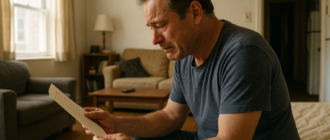
Inside was a single sheet of paper, folded twice. No date. No greeting. Just four lines:
“Check the attic.
You forgot something.
Don’t leave her alone again, Emma.
— Dad”
Her.
I read the word again and again, until the letters blurred. A wave of nausea rose up—because beneath the shock there was something else: recognition. A memory I had spent ten years forcing into the darkest corner of my mind.
“Em?” Max’s hoarse voice came from the doorway. “Why are you up so early?” He yawned, rubbing his eyes.
I crumpled the note in my fist before he could see it. “Couldn’t sleep,” I managed. “Coffee?”
He nodded and shuffled to the table, not noticing my shaking hands. While the kettle hissed, I slipped the note into my pocket, the paper crackling against my palm like a tiny, accusing voice.
All day, the attic door at the end of the hallway seemed to grow larger. Dad had nailed it shut years ago, after one of the roof beams started sagging. “Too dangerous,” he had said, smiling, but his eyes had flicked quickly to me, as if checking my reaction.
Now I understood that look.
By late afternoon, after Max had gone out to deal with paperwork and my mother had called from the hospital, her voice thin but determined, I couldn’t stand it any longer. I grabbed a hammer from the toolbox and went to the hallway.
My hand froze on the first nail. Ten years peeled away in a rush: a tiny hand in mine, warm and sticky from jam; a high, echoing giggle in this very house; a promise whispered into soft hair that smelled like baby shampoo.
“I’ll come back. I swear.”
I swallowed hard and yanked the first nail out. Then the second. The wood groaned as I pushed the door open. Dust danced in the strip of light.
The attic was exactly as I remembered: low ceiling, boxes piled like forgotten memories, the tiny round window blurred with cobwebs. The air smelled of dry wood and something else—faint, like old fabric and… lavender?
I stepped inside, ducking under a beam, heart pounding so loud it filled the silence. Toward the back, where the roof slanted down, stood an old wooden wardrobe, its door slightly ajar.
My legs felt numb as I crossed the floor. I pulled the door open.
Inside, on the lowest shelf, lay a small stuffed rabbit with one ear half torn, wearing a faded purple ribbon.
My breath caught.
“Lily,” I whispered.
The name tasted like salt on my tongue.
The attic blurred as tears welled up. I sank to my knees, hugging the toy to my chest. Dad’s note burned against my ribs. Don’t leave her alone again.
Ten years ago, I had been seventeen and angry at the whole world. Angry at our small house, at our empty fridge, at my parents’ exhausted faces. Angry at the tiny, unexpected baby who arrived when my mother was forty‑two and my father had just lost his job.
They named her Lily. She was born too early. Her lungs were weak. The doctors said she might not survive the winter.
I had promised to help. I had meant it, at first. I carried her up to the attic sometimes, away from the noise of the TV, and we would sit by the little round window. I would show her the stars and tell her all the places I would go one day.
And then I did go.
A fight with my mother over college, over money, over responsibilities. Harsh words. Doors slammed. I packed a bag that night and left a note that said I was sorry, that I would send money, that I just needed to breathe.
I never came back in time.
Two months later, Dad called me from this kitchen. His voice shook as he said the word I had feared and yet never truly believed I’d hear: “She’s gone, Emma.”
I didn’t come for the funeral. I told myself I couldn’t afford the ticket, that my exams were important. The truth was, I couldn’t face their eyes. Or her tiny grave.
Dad never mentioned Lily again after that. When I finally returned years later, she was a gap in our conversations, a silence we carefully walked around.
Until now.
The attic floor creaked behind me. I spun around, wiping my eyes with the back of my hand.
Max stood in the doorway, his face pale. “I heard noises. What are you doing up here?” His gaze dropped to the stuffed rabbit. He froze.
“You kept this?” he whispered.

“I didn’t,” I said hoarsely. “Dad did.” I pulled the note from my pocket and handed it to him.
He read it slowly, lips moving. When he finished, his jaw tightened. “He knew this would break you,” Max said softly.
“He should have,” I snapped, then heard my own voice—sharp, defensive—and flinched. “I mean… I left. I left her. I left all of you.”
Max leaned against a beam, suddenly looking older than his twenty‑six years. “You were a kid, Em.”
“I was seventeen,” I said. “Old enough to run. Old enough to stay.” The words tore out of me. “If I had been here… maybe she wouldn’t have—”
“Stop.” Max’s voice cut through the dust‑thick air. “You think you’re the only one who carries this? You think I don’t replay every night I slept instead of checking on her? Or every time I complained about the noise when she cried?”
My knees felt weak. I sank onto an old crate. The rabbit’s button eyes stared up at me.
Max walked over and crouched down, the floor creaking under his weight. “Dad didn’t leave you that note to punish you,” he said. “You know how he was. He spent the last year writing letters. To Mom. To me. To you. To himself, I think.”
I closed my eyes, imagining Dad at this very table downstairs, oxygen tube in his nose, shaking hand gripping a pen.
“He told me once,” Max continued, “that the worst thing isn’t dying. It’s leaving unfinished storms behind. He said he was afraid you’d spend your whole life outside this house, but still living in that night you left.”
A sob broke free. “He was right,” I whispered.
“So maybe,” Max said gently, tapping the rabbit’s ear, “this is him… trying to open the window. Let the storm out.”
We sat there in the fading light, two grown children in an attic that had once held a third. The house groaned softly around us, as if it, too, was tired of holding its breath.
“Come on,” Max said finally, standing up and offering his hand. “Bring her.”
I hesitated, then took his hand and the rabbit. We went downstairs together.
In the backyard, the sky was a pale blue bowl. The grass around the old apple tree was still flattened where people had stood after the funeral, whispering condolences that felt like cotton in my ears.
Max fetched a small wooden box from the shed, the one Dad used to keep nails in. We lined it with one of Dad’s handkerchiefs. I placed the rabbit inside, smoothing the purple ribbon.
“What are we doing?” I asked, voice trembling.
“Giving her a place,” Max said simply. “So she’s not just an attic ghost anymore.”
We dug a small hole under the apple tree, near where Dad had once built us a swing. The soil was softer than I expected. When the box was lowered in, my hands hovered above it.
“I’m sorry,” I whispered, not sure if I was speaking to Lily, to Dad, or to the frightened girl I had been. “I should have come back. I should have stayed. I… I never stopped thinking about you.”
The wind picked up, rustling the leaves. Somewhere, a dog barked. A car passed on the street. Life, indifferent and relentless, went on.
Max covered the box with soil, his movements steady. When he was done, we stood there in silence.
“Dad asked the neighbor’s son to tape that envelope up this morning,” he said suddenly. “He gave it to him weeks ago. Said he’d ‘know when.’”
“Of course he did,” I murmured, a wet laugh escaping me. Dad, planning his own ghostly intervention.
Max nudged my shoulder. “You’re here now, Em. That’s what he wanted. Not for you to live in the ‘what ifs.’”
I looked at the fresh patch of earth, at the house with its peeling paint and tired windows, at my brother’s tired but kind face.
“I don’t know how to fix any of this,” I admitted.
“Maybe we don’t fix it,” Max said. “Maybe we just… stay. Remember. Try again.”
The grief was still there, heavy and raw. But something had shifted, like a window cracked open in a long‑closed room.
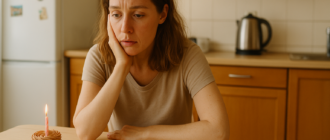
That night, I sat at the kitchen table with a blank notebook in front of me. My hand shook as I wrote the first line:
“Dear Dad, I went to the attic.”
The words came slowly, but they came. About Lily’s rabbit. About the makeshift grave under the apple tree. About the note he had left that had cracked my heart open instead of simply breaking it.
When I finished, my eyes burned, but my chest felt a fraction lighter.
I folded the letter and placed it next to his old mug on the table. Then I went to the hallway and looked up at the attic door.
It was still slightly ajar.
I didn’t close it.