When Marta adopted Misty, a scrappy gray rescue cat, she thought she’d found the perfect companion. Misty was sweet, calm, and fearless. She padded after Marta from room to room, perched on her lap when she read, and curled against her legs at night.
But from the very first week, Marta noticed something strange.
Misty refused to go near the basement door.
Whenever Marta carried laundry down, Misty bristled, clawed at her arm, and yowled until she set her down. At night, Marta would sometimes wake to find Misty sitting rigid at the top of the stairs, ears flat, eyes fixed on the dark crack under the door, as if waiting for something to emerge.
At first, Marta laughed it off. “Cats are dramatic,” she told her friends. “She probably smelled mice.”
But weeks passed, and Misty’s behavior grew worse. She no longer slept through the night. Instead, she stalked the hallway, her tail puffed, hissing at the basement door whenever the house creaked.
One night, Marta woke to the sound of growling. Misty was crouched low, her gaze locked on the door — and from the other side came a faint scrape, like something dragging across the concrete floor.
Marta’s blood ran cold.
The next morning, determined to prove it was nothing, she armed herself with a flashlight and went down.
The basement was ordinary enough: old boxes, a broken chair, tools hung neatly on the wall. But when her light swept across the far corner, she froze.
The stone wall was covered in scratches. Deep, frantic grooves gouged into the rock. She stepped closer, heart pounding.
Among the scratches, words began to take shape.
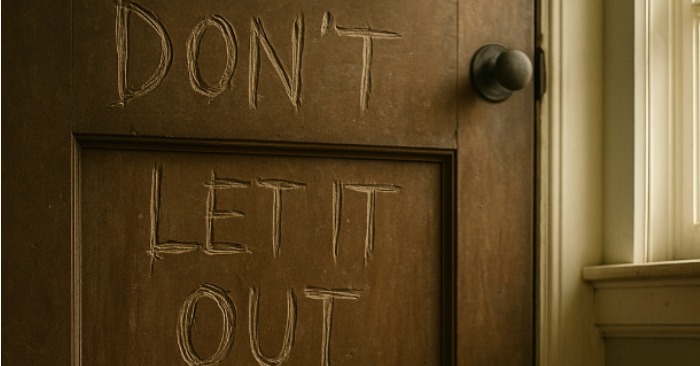
“DON’T LET IT OUT.”
The letters were jagged, uneven, carved by desperate hands.
Marta stumbled back, the beam of her flashlight shaking. The air down there felt heavier, colder, as if something invisible had stirred awake. She thought she heard a whisper — faint, almost like breath against her ear.
She bolted up the stairs, slamming the door behind her.
Misty was waiting at the top, fur standing on end, eyes blazing. She didn’t relax until Marta turned the key in the lock.
The following day, Marta called a contractor to inspect the basement. When the man arrived, he frowned as soon as he saw the far wall.
“This isn’t original construction,” he said, tapping the stone. “Looks like this was built to cover something. Could be another room behind it.”
Marta felt the blood drain from her face. “Another room?”
The contractor shrugged. “Houses this old, you never know. Could’ve been a root cellar. Or… something else.”
Marta told him to leave it alone.
That night, the noises returned. A slow drag, then three distinct knocks against the stone.
Misty hissed and fled to Marta’s bedroom, refusing to come out until morning.
Over the next week, Marta tried to ignore it. She avoided the basement, told herself it was pipes, shifting earth, imagination. But Misty never stopped guarding the door.
One evening, Marta woke to find the cat pawing frantically at her arm. Misty led her into the hall, sat before the basement door, and let out a low, guttural growl.
And then Marta heard it too.
From the other side of the door came a voice. Faint, rasping, but unmistakable.
“Let me out.”
Her hands shook as she backed away. She spent the rest of the night locked in her room, Misty pressed against her side, both of them trembling.
The next morning, Marta sealed the door with heavy boards and nails. She considered selling the house, but something deep inside told her the basement was not her burden alone. It had been waiting long before she arrived — and it would still be waiting long after she left.
Now, every night, Misty sits in front of the boarded-up door. Silent. Watching.
And Marta knows the truth: the cat isn’t guarding her from what’s inside. She’s guarding it from the world outside.
Because some doors aren’t meant to be opened.
Ever.