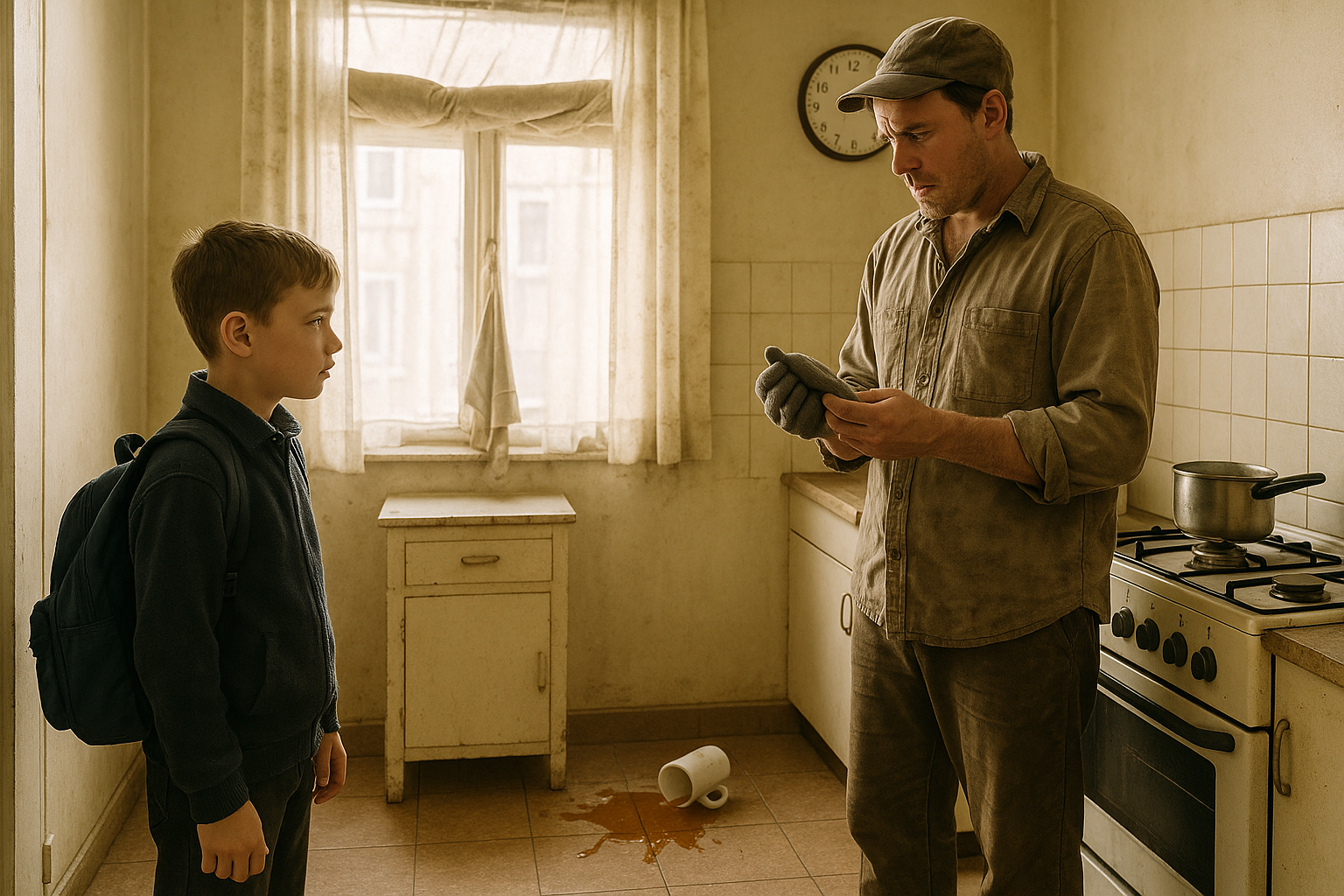
The boy who kept bringing home lost gloves in December and the one pair that made his father drop the mug on the floor.

Every winter, nine-year-old Alex came back from school with something in his pocket that didn’t belong to him: a single mitten, a worn beanie, a child’s scarf. His father, Mark, used to joke that the whole town would be naked by spring if Alex kept “rescuing” clothes from the bus seats and playground benches.
But this December, money was worse than usual. The rent had gone up, Mark’s second shift at the warehouse had been cut, and the heater made that scary clicking sound whenever it tried to start. They lived in a one-bedroom apartment, cold even with all towels stuffed into the window gaps. Alex slept on the sofa under two blankets and an old coat that still smelled like his mother’s perfume.
She had died two winters ago. Since then, Alex always checked the bus carefully before getting off. He couldn’t explain why he did it; he just felt like lost things looked too lonely. His teacher once told him, “You have a soft heart, Alex.” Mark had only sighed, rubbing his tired eyes.
That day, Alex came in later than usual. Mark was in the tiny kitchen, stirring instant soup. His hands shook from exhaustion; he hadn’t eaten lunch to save money for bread. He heard the door creak and raised his voice, trying to sound brighter than he felt.
“Hey, champ. You’re late. Bus trouble?”
Alex didn’t answer right away. He shuffled into the kitchen, backpack hanging open, his cheeks red from the wind. He held something in his small, gloveless hands.
“Dad,” he said softly. “I found another pair. But these are… different.”
Mark turned, ready to say his usual “We can’t keep everyone’s stuff, Alex,” when he saw them. Simple gray gloves. Nothing special, just a bit too big for a child, with a small tear on the left thumb. But Mark froze. The wooden spoon slipped from his fingers and clattered in the pot. His hand, holding the mug, began to tremble.
For a second, he couldn’t breathe. Those gloves. His mind jumped years back, to a brighter kitchen, to Emma’s laughter as she waved the same gray gloves in the air.
“You always lose yours,” she had teased, sliding them onto his hands. “So now we share. If you lose them, you owe me a hot chocolate.”
She’d worn them that last day. The day of the accident. They’d never found her coat, her bag… or the gloves.
“Where… where did you get those?” Mark whispered, his voice suddenly rough.
“On the bus,” Alex replied, confused by his father’s face. “They were on the seat by the window. I thought someone forgot them. I wanted to bring them to Lost and Found tomorrow but… I don’t know. I just felt like I had to show you first.”
The mug slipped from Mark’s hand and shattered on the floor, tea splashing over his worn shoes. The sound made Alex jump.
“Dad? I’m sorry! I didn’t mean—”
Mark barely heard him. He reached out, fingers trembling, and took the gloves. The fabric was colder than he expected, but the way the tear pulled at the seam, the faint stain near the cuff—he remembered sewing that tiny tear one night while Emma watched some silly show.
“This can’t be,” he muttered. “It’s impossible.”
Alex’s eyes filled with fear. “Did I do something wrong? Should I have left them?”
Mark finally looked at his son. Alex’s ears were red, his hands raw from the cold, sleeves too short on his only winter jacket. The boy who brought home strangers’ lost things because he couldn’t stand to see anything abandoned.
Slowly, Mark sank into the chair, still holding the gloves as if they might vanish. “No, buddy. You didn’t do anything wrong.” His voice broke on the last word.
The room seemed even colder now, but something hot burned in his chest. Two winters he had spent avoiding Emma’s drawer, her box of small memories, pretending that moving forward meant erasing anything that hurt too much.
“Dad, why are you crying?” Alex whispered.
Mark swallowed hard. “These… these belonged to your mom.”
Silence fell so heavy that even the cheap clock on the wall sounded too loud. Alex stared at the gloves, then at his father.
“That’s not possible,” the boy said, echoing his father’s thought. “Mom’s… Mom’s gone.” His voice shook over the last word.
“I know,” Mark answered. “But I’d know these anywhere.”
Alex stepped closer. “So… does that mean she was on my bus?”
The question sliced through Mark. He shook his head quickly. “No, no. It just means… people keep things. Maybe someone bought them in a thrift store. Maybe they were in storage for years. There’s an explanation.” He said the words, but he didn’t believe them.
Alex’s eyes shone with sudden, desperate hope. “Maybe it’s a sign,” he whispered. “Like… like she’s saying she’s still with us. Maybe that’s why I always look for lost things. Maybe Mom is helping me find them.”
The boy’s voice broke, and Mark realized with a sharp ache that this was the first time Alex had ever said “Mom” and “still with us” in the same sentence.
The heater clicked and failed to start again. The cheap soup on the stove had begun to boil too hard, the smell of overcooked noodles filling the room.
Mark looked at his son, at the thin wrists, at the hopeful, scared eyes of a child who carried strangers’ scarves but had only one picture of his mother next to his bed.

He stood up suddenly. “Go put on your warmest socks,” he said.
Alex blinked. “Why?”
“Because we’re going out.”
“It’s freezing,” Alex protested, then stopped. “Do we have money for the bus?”
Mark hesitated only a second. He reached into the jar above the fridge—the one labeled “Electricity”—and took out a few crumpled bills and coins.
“We’ll walk,” he said. “I want to show you something.”
Twenty minutes later, they were standing in front of a small, almost hidden shop with a crooked sign: “Second Chance Store – Clothes & More.” Mark had passed it a hundred times, never going in.
Inside, it was warm and smelled of old fabric and cinnamon air freshener. Racks of donated clothes lined the walls, and a tired woman with kind eyes sat behind the counter, knitting.
“Can I help you?” she asked.
Mark placed the gloves on the counter. “These. Do you remember who donated them?”
The woman adjusted her glasses, then smiled sadly. “Hard to say, sir. We get so many boxes. Sometimes from the storage company when nobody claims things for years. Sometimes from families…” Her eyes flicked to Alex. “From families who are moving on.”
Alex clung to his father’s sleeve. “Do you throw things away if nobody wants them?” he blurted.
“Never,” she said. “We try to give everything a second life.”
Mark watched Alex study the shelves of mismatched shoes, the boxes of toys, the rack of winter coats. Suddenly, the boy looked smaller than ever.
“Dad,” Alex whispered, “are we like those gloves? Lost?”
The question hit harder than anything Mark had heard in two years. He crouched down so they were eye to eye.
“Listen to me,” he said firmly, his throat tight. “We’re not lost. We’re just… trying to find our second chance. Just like all these things.” He glanced at the gloves. “Like Mom’s gloves.”
Alex’s lips trembled. “Can we keep them?”
Mark looked at the woman behind the counter. She nodded gently. “They look like they’ve found their home.”
On the way back, Alex wore the gloves even though they were too big. He kept lifting his hands, staring at them, as if he expected to see his mother’s hands instead of his own.
“Dad?” he said quietly as they walked past the bus stop where he’d found them.
“Yeah?”
“I think I know why I bring home lost things now.”
“Why, buddy?”
“Because I don’t want anyone to feel forgotten. Not scarves, not gloves… not us. If we remember them, they’re not really gone. Right?”
Mark’s vision blurred. The December air bit his face, but something warm finally pushed against the constant cold inside him.
“Right,” he said. “As long as we remember, they’re not gone.”
That night, back in their freezing apartment, Mark opened the box he had avoided for two years. Together, they laid out Emma’s photos, her old hairbrush, a faded concert ticket, a recipe in her handwriting. And in the middle, they placed the gray gloves.
The heater still clicked and failed. The soup was still cheap. Nothing about their poverty changed. But for the first time in a long time, as Alex fell asleep clutching one glove like a small, soft promise, the apartment didn’t feel quite so empty.
They were still poor. Still tired. Still hurting. But they were not lost.
They were a family, gathering every small, forgotten piece of love they could find, and learning, slowly, painfully, to give themselves a second chance.