The boy at my door called me “Dad” – but I’ve never had children, and then I saw what he was holding in his shaking hands.

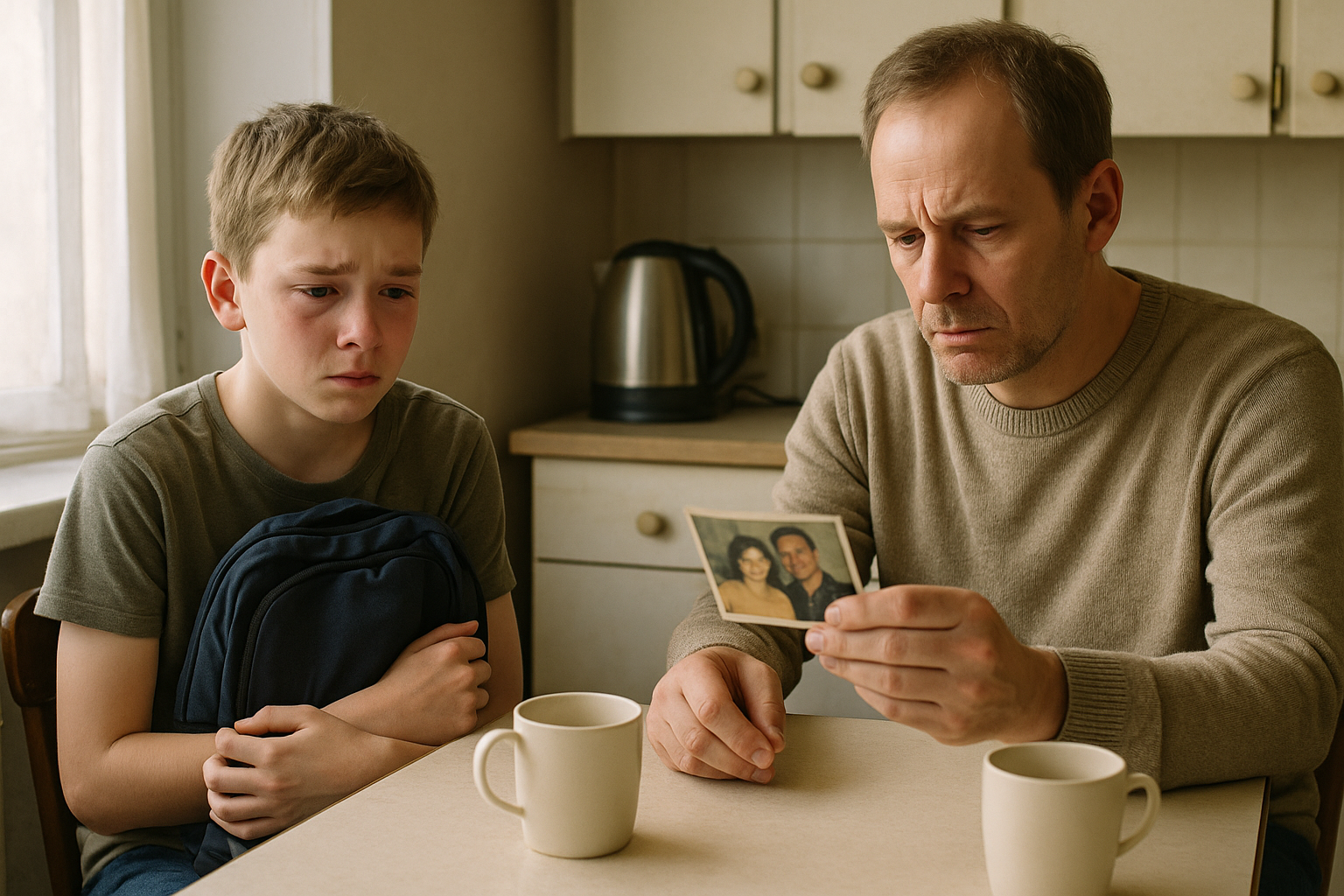
It was a crumpled photograph, edges torn, the ink faded from being held too many times. In the dim hallway light I saw my own face staring back at me from the picture, younger, thinner, wearing the same crooked smile I still saw in the mirror on good days.
“I’m Liam,” the boy said, chest rising too fast. He was maybe twelve, with tired brown eyes and a backpack that looked heavier than he was. “My mom said… if anything happens… I should find you.”
My first instinct was to laugh it off, say he had the wrong person, close the door and go back to my quiet apartment and my even quieter life. But the photo in his hands wouldn’t let me. I reached out and took it.
There I was, an arm around a woman I half-remembered from a summer so long ago it felt like it belonged to someone else. Her name surfaced slowly, like something from the bottom of a muddy river: Emma.
I swallowed. “Where is your mom now, Liam?”
He tried to answer, but his lip quivered instead. The hallway suddenly felt too cold.
“Come inside,” I said quickly. “We’ll talk inside.”
He stepped over the threshold like he was entering a stranger’s church. He wiped his shoes carefully, eyes darting everywhere, memorizing the exit, the windows, the distance between us. I recognized the look. I’d worn it myself, years ago, in places I didn’t like to remember.
I made tea because I didn’t know what else to do, my hands clumsy with the cups. Liam sat at the small kitchen table, backpack on his knees like a shield.
“So,” I began, sitting opposite him. “Your mom is Emma?”
He nodded slowly.
“And she sent you to me?”
Another nod. His fingers tightened on the backpack straps.
“Why?”
He looked up then, the answer in his eyes before it reached his mouth. “She’s in the hospital. They said…” He blinked hard. “They said she might not wake up.”
The cheap clock on the wall ticked too loudly. “What happened?” I asked, my voice rough.
“Her heart,” he whispered. “She was fine and then she wasn’t. They called it… sudden something. I don’t remember.”
My throat burned. “And your father?”
“You,” he said, like it was the simplest thing in the world. “She showed me the photo. She said your name is Daniel. She said if she couldn’t… if she…” His voice broke. “She said you’d know what to do.”
All the air left the room. I stared at the photograph again, at my younger self with an arm around Emma at some beach, our feet half buried in sand, the sky enormous behind us. A weekend that wasn’t supposed to mean anything.
I had left for another city the following week, chasing a job and a lie that I was meant for something bigger. Emma had called once, maybe twice. I remembered ignoring the last call, too busy, too important.
I never heard about a pregnancy. I never asked.
“Liam,” I said carefully, “I… I didn’t know. No one told me.”
He watched me quietly, like he was weighing that sentence in his hands. “You didn’t know about me?”
I shook my head. “If I had, I—” I stopped. The truth was, I had no idea what I would have done. Back then, I could barely take care of myself.
He looked down at the table, tracing a scratch in the wood with his finger. “She said you changed. She said you stopped drinking. That you have a real job now. She found you on the internet, but… but she didn’t want to disturb your life.” He swallowed. “She said I shouldn’t be a burden.”
A burden.
The word landed like a stone between us. I thought of my empty apartment, my microwave dinners for one, the way no one would notice if I didn’t show up to work for a day or two.
“Did she say that exact word?” I asked.
He nodded. “But then she got sick. She wrote your address on a paper and put it in my backpack. She said if she didn’t… didn’t wake up after the operation, I should find you, because you’re still my dad… even if you don’t want to be.”
There it was. The twist I had earned years ago and never saw coming.
I stood up too fast, my chair scraping the floor. I wanted to pace, to argue with a ghost, to shout at the version of myself that walked away from that beach, leaving a life behind without even knowing it.
Instead, I sat back down.
“Listen to me,” I said quietly. “You are not a burden. Not to her, and not to me. Do you understand?”
He shrugged one shoulder, an answer learned from too many adults who didn’t stay.
“How long have you been going to the hospital alone?” I asked.
“A few days,” he said. “They let me sleep in a chair, but last night the nurse said I couldn’t anymore. She called social services. I… I left before they came.” His voice dropped. “I didn’t want to go to some place. Mom said you were my place.”
Something inside me cracked then, a soundless breaking I felt in my bones. A boy running from social workers to find a stranger with his face.
“Do you have anyone else? Grandparents? Friends of your mother?”
He shook his head. “She said everyone left when I was little. She worked nights. I stayed with neighbors sometimes.” He looked at me like he was confessing a crime. “I can cook pasta. And eggs. I don’t need much. I can sleep on the floor.”
I thought of the second bedroom in my apartment, empty except for boxes I hadn’t unpacked in three years.
“You’re not sleeping on the floor,” I said. “You’re staying here. In the spare room.”
He stared, as if waiting for the catch.
“If… if she wakes up?” he asked.
“Then we’ll go to her together,” I said. “And if she doesn’t…” The words burned. “…then we’ll figure it out. But you’re not doing it alone. Not anymore.”
For the first time, something like hope flickered in his eyes, fragile and frightened.
That night I changed the sheets in the spare room, put away the boxes, found an old lamp that still worked. Liam stood at the door, backpack hanging from one arm, like he was afraid if he stepped fully inside it would all disappear.
“You can unpack,” I told him. “This is your room as long as you need it.”
He sat on the edge of the bed, testing the mattress with his hand like he wasn’t used to something that soft. “At the hospital,” he said quietly, “my chair made my back hurt. This is… different.”
I turned away under the pretense of adjusting the curtain, swallowing down the tightness in my chest.
Later, when he finally fell asleep, curled up with his backpack at his feet, I sat alone at the kitchen table with the old photograph in front of me. I traced Emma’s smile with my thumb.

“I’m sorry,” I whispered to the empty room. “I’m so, so sorry.”
The next morning we went to the hospital together. Liam walked half a step behind me, like he wasn’t sure he was allowed to walk beside me yet.
In the intensive care unit, Emma lay small and pale under too-white sheets, machines breathing a rhythm that didn’t sound like life. Liam’s hand trembled at his side.
I didn’t take it. I wanted to, God I wanted to, but I was afraid to scare him away. Instead I stood close enough that our shoulders almost touched.
“Talk to her,” I said softly. “She can hear you.”
He stepped closer to the bed. “Mom,” he whispered, his voice cracking. “I found him. I found Dad.”
The machine beeped steadily, indifferent.
I moved to the other side of the bed, looking at the woman I once almost loved and then abandoned. Lines of pain were etched into her face now, lines I hadn’t been there to see form.
“I’m here, Emma,” I said, my voice shaking. “I’m here. And I’m not going anywhere this time.”
Her eyelids flickered, just once. Maybe it was nothing. Maybe it was everything.
Days passed. We split ourselves between the hospital and my apartment. I learned how Liam liked his toast, how he lined up his pencils by color, how he flinched at sudden loud noises. He learned that I snored a little, that I talked to the old plant on the windowsill, that I checked his bedroom door twice every night to make sure it was closed the way he liked.
One afternoon, a woman from social services came. She looked at me over her glasses, at the boy nervously twisting his fingers in his lap.
“You understand,” she said, “that if his mother doesn’t recover, there will be a process. Forms, home visits, evaluations.”
“I understand,” I said. “Whatever it takes.”
“And if she does recover?”
I glanced at Liam. “Then we’ll talk. All of us. But I’m not letting him go through this alone.”
After she left, Liam stood in the doorway of the kitchen. “Do you really want me here?” he asked. “Or are you just… being nice because Mom asked you to?”
I wiped my hands on a towel and sat down so I was at his eye level.
“I’m here because I should have been here twelve years ago,” I said. “I can’t change that. But I can choose what I do now. And right now, I want you here. Not as a favor. As my son.”
The word felt strange and perfect in my mouth.
His eyes filled with tears he tried very hard not to let fall. “What if she… doesn’t wake up?”
“Then we’ll cry,” I said honestly. “We’ll be angry. We’ll miss her. And then… we’ll keep going. Together.”
He nodded slowly, as if trying on the idea.
A week later, at the hospital, as Liam told Emma about a math test he’d somehow managed to take, her fingers twitched around his.
“Mom?” he gasped.
Her eyes opened, unfocused at first, then slowly finding his face. “Liam,” she breathed, voice hoarse.
He almost climbed onto the bed in his relief, stopping himself at the last second. “I found him, Mom. I found Dad. He came.”
Emma’s gaze drifted past him to me. Recognition slammed into her features, followed by something like shame, like fear, like hope she didn’t dare believe in.
“Daniel,” she whispered.
“I’m here,” I said, stepping closer but not too close. “I’m so sorry I wasn’t before.”
Tears slid down her temples. “He… he found you?”
“He did,” I said. “And I’m not letting him go. Not if you’ll let me stay in his life.”
She looked between us, at the boy holding her hand and the man standing awkwardly at the foot of her bed.
“I didn’t tell you,” she said weakly. “I was scared. You were finally… better. I didn’t want to ruin your life.”
“You didn’t ruin anything,” I said, voice thick. “I did that all by myself. But you gave me something I didn’t know I had. Someone.” I glanced at Liam. “If you’ll trust me, I want to be there. Really be there. For him. For you, if you’ll let me.”
Liam held his breath, as if the whole world balanced on her next word.
Emma closed her eyes for a moment, then opened them again, clearer now.
“Don’t disappear this time,” she whispered.
“I won’t,” I said.
Months later, when Emma was finally strong enough to walk around the small park near my apartment, Liam ran ahead of us to the swings. She leaned on my arm—not because she had to, but because it made the steps easier.
“You really changed,” she said quietly.
“I had to,” I answered. “I met my son at my door, calling me Dad with no idea who I was. That kind of thing… fixes your priorities.”
She smiled, tired but real. “He keeps your photo on his bedside table now, you know. The new one.”
I looked at Liam, laughing as he kicked higher, sunlight catching in his hair.
“Good,” I said softly. “I want him to know I was there this time.”
Emma glanced at me. “And next time?”
I met her gaze. “I’ll be there, too. Every time.”
Across the park, Liam waved both arms, calling out for us to watch how high he could go.
We both raised our hands and waved back.
For the first time in a very long time, I didn’t feel like my life was something I had to apologize for. It was still messy, still uncertain, but there was a boy with my eyes and a woman with a second chance, and a promise I intended to keep.
And this time, when someone called me “Dad,” I answered without hesitation.