My name is Bella, and there are exactly two things in this world that I would protect with everything I have. The first is my mind. The second is the pottery collection my mother left me when she passed away five years ago.
My mom was a ceramic artist. She had her studio in our garage, with a kiln she had saved up for three years to buy. Every piece she made told a story. The sea-green vase she shaped the day after her first chemotherapy session. The coffee mug with the tiny heart she pressed into the handle, which I grabbed every morning with my six-year-old fingers. The bowl with her thumbprint still visible in the clay to this day.
When she died, I wrapped everything in bubble wrap and tissue paper and then placed it in a tall glass display case in our living room. I hadn’t moved back in with Dad after Mom’s death because I couldn’t afford my own apartment, but because the silence in his house could swallow a person whole. We needed each other.
It worked for a while.
Then Dad met Karen at a work conference. She was everything Mom wasn’t. Perfectly manicured nails, professionally styled hair, designer outfits. Two years after Mom’s death, they got married.
I tried to adjust. But after only a few weeks, I realized that Karen and I would never be friends.
Karen hated Mom’s pottery.
“This is so cluttered,” she said one morning. “You should really think about reducing. Clean lines look much more elegant.”
I looked at the cabinet. “This isn’t cluttered. These are memories of my mother.”
She smiled with a polished look but without warmth in her eyes. “Of course, sweetie. I just mean… it looks a bit rustic, don’t you think? Like something from a flea market.”
“My mother made this.”
“I know,” Karen said with feigned patience. “I’m just saying, maybe you could store some of it away?”
Every few days, there was a new comment. “This really doesn’t fit the aesthetic I envision.” Or, “Don’t you think it’s about time to let go of the past?”
Then, one afternoon, when Dad was at work, Karen cornered me in the kitchen.
“I’ve been thinking. You have so many of these ceramic pieces. Would it be so bad if I took a few? Some of my friends love handmade things. I’d save so much money on gifts.”
I couldn’t believe what I was hearing. “Excuse me?”
“Just a few. You wouldn’t even notice.”
“I have 23 pieces. And no, you’re not getting any.”
Her expression changed in an instant. The friendly mask cracked. “Don’t be so selfish, Bella. They’re just sitting there collecting dust.”
“This is all I have left of Mom.”
Karen’s eyes narrowed. “Fine. Keep your little precious pots. But if you don’t want to share nicely, you’ll regret it.”
She walked away, her heels clicking like gunshots.
“You’ll see,” she called over her shoulder.
Three weeks later, my boss sent me to a three-day conference in Chicago. I didn’t want to go, but I had no choice.
WHEN I WAS DONE, I TOOK A LATE FLIGHT BACK ON SATURDAY NIGHT.
When I was done, I took a late flight back on Saturday night. When I got home, it was almost 11 p.m. The house was dark, only the porch light was on.
I quietly unlocked the door, took off my shoes.
And then I noticed that something was wrong. Our house always had this smell – Dad’s coffee, Mom’s lavender soap, which somehow still lingered in the air, and the earthy clay scent from the ceramics. But now the clay smell was gone.
My heart sank into my stomach.
I went into the living room. When I turned the corner and saw the cabinet, my brain refused to accept what my eyes were seeing.
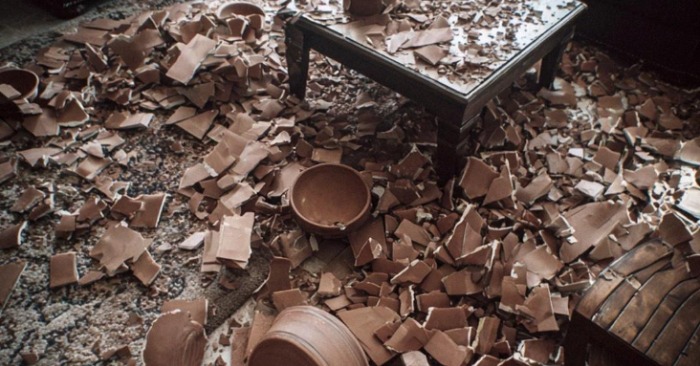
The glass door was hanging open. The shelves were empty. And on the floor lay clay pieces. Shards in every color Mom had ever used, scattered like cruel confetti.
“No… no, no…” I fell to my knees, my hands hovered over the chaos as if I was afraid to touch anything and destroy it completely.
Then I heard the heels.
CLICK. CLICK. CLICK.
Click. Click. Click.
Karen appeared in the doorway, in a silk pajama. Her hair was perfect. She was wearing makeup, even though it was almost midnight. She looked at me, then the floor, and smiled.
“Oh!” she said, bright and sweet like poisoned honey. “You’re back early.”
“What have you done, Karen?”
She looked at her nails – bright red, freshly manicured. “I told you I didn’t like how cluttered it looked. I dusted, and the shelf was unstable. So everything… just fell.”
She lied. I saw it in the way her mouth cornered upwards, that tiny flicker of satisfaction in her eyes.
“Total accident!” she added, her smile getting wider.
Something inside me snapped. “You’re a monster.”
HER FACE HARDENED IMMEDIATELY.
Her face hardened immediately. “Watch how you speak to me, Bella. Your father won’t appreciate it if you insult me. And honestly: They were just pots. You’re being dramatic.”
“Just pots? My mother made them. Her hands shaped every single one. Her fingerprints were in the clay.”
Karen shrugged. “Were. That’s the keyword.” She turned to leave, then stopped. “And you’d better clean it up before your father sees. He’ll be so disappointed that you were so careless with your storage.”
She walked off, humming to herself, while I stayed alone with the shattered remnants of my mother.
I sat there on the floor, tears streaming down my face, anger and grief twisting my chest until I didn’t know what was what.
But beneath it all, something else took shape. Something cold, sharp, crystal clear.
Because Karen had made a crucial mistake.
She had assumed I was stupid.
“YOU HAVE NO IDEA WHAT YOU JUST DID,” I WHISPERED INTO THE EMPTY ROOM.
“You have no idea what you just did,” I whispered into the empty room.
Because what Karen didn’t know was this:
About two months ago, I had become suspicious. The way she sneaked around the cabinet like a shark. How she constantly found reasons to “dust” exactly there. How she kept talking about the space and the “aesthetics.” I’m not paranoid, but I’m not an idiot either.
So I did two things.
First, I bought a hidden camera. One of those plant cameras that looks like a harmless little succulent pot but records everything in HD. I placed it on the bookshelf across from me, at just the right angle, and I didn’t say a word to anyone. Not Dad. Not my best friend. No one.
Second — and this is the part where I still feel like a criminal genius — I swapped out the ceramics.
Every single piece in that glass cabinet was a fake.
It took me three weekends to find cheap ceramics at flea markets and estate sales that were close enough. Nothing was identical, of course not, but the shapes and colors were similar enough. In total, it probably cost me 50 dollars. At home, I rubbed the pieces with coffee grounds and dust to make them look older, and placed them exactly where Mom’s originals had been.
The real collection was locked in a cabinet in my bedroom, in the closet — wrapped in the same bubble wrap and tissue paper as five years ago.
SO WHEN KAREN BROKE EVERYTHING, WHEN SHE DESTROYED WHAT SHE THOUGHT WAS MOM’S LEGACY, SHE WAS REALLY JUST DEMOLISHING REPLICAS.
So when Karen broke everything, when she destroyed what she thought was Mom’s legacy, she was really just demolishing replicas.
But I wasn’t going to tell her. Not yet.
I was still sitting on the floor between the shards, pulling out my phone. In the camera app, the footage was already saved, with a timestamp from earlier in the evening.
I watched Karen walk into the living room around 7 p.m. She looked around, checked if she was alone. Then she marched straight to the cabinet, yanked open the door, and began pulling the pieces off the shelves. She took the fake sea-green vase and threw it with such force onto the floor that I even heard the impact through the speaker.
Piece by piece, she destroyed everything. Mugs, bowls, plates. She even stepped on larger shards with her heel to break them even smaller.
And then — God, that was the best part — she stared directly at the empty cabinet and said, loudly and clearly: “Let’s see how much you love your precious mommy now, you pathetic little girl!”
I watched the video three times to make sure it was saved. Then I called Dad.
“Hey, sweetheart,” he answered sleepily. “Everything okay?”
“I’M HOME. CAN YOU COME DOWN?”
“I’m home. Can you come down? We need to talk.”
“It’s almost midnight…”
“Now, Dad. Please.”
He came down in his bathrobe, Karen behind him, annoyed.
They froze when they saw me sitting on the floor between the shards.
“What happened?” Dad turned pale.
Karen immediately jumped in. “Oh Dave, it’s awful. I just wanted to get a glass of water and I heard a crash. The cabinet must’ve been unstable… everything just fell down.”
“That’s not true,” I said.
I HANDED DAD MY PHONE.
I handed Dad my phone. “You should take a look at this.”
Karen’s face flickered. “Look at what?”
Dad pressed play.
I watched his face change as Karen systematically destroyed every piece. His jaw clenched as she stepped on the shards. He flinched at her last sentence.
When the video ended, the silence was deafening.
“Dave,” Karen began, “I can explain…”
“Explain what?” Dad said quietly but dangerously. “Explain why you deliberately destroyed my late wife’s art and then tried to blame Bella?”
“I… that’s not…” She turned to me. “That’s fake. You edited it.”
I LAUGHED. “YOU DID IT ALL ON YOUR OWN.”
I laughed. “You did it all on your own.”
Her face twisted. “Fine. I’m tired of living in a shrine for a dead woman. She’s gone, and you both need to move on.”
Dad’s hands were trembling. “Out.”
“What?”
“Out. Pack a bag and go. Tonight.”
“You can’t be serious!” Karen screamed.
“Actually,” I said, “I have a better idea.”
They both looked at me.
“You’re going to make it right.”
Karen’s eyes narrowed. “Excuse me?”
“You broke it, so you’re going to glue every single piece back together. Every shard. Every fragment.”
She laughed. “You’re crazy.”
“Maybe. But you have two choices. Either you fix what you broke, no matter how long it takes, or I file a report. I’ve got video evidence of property damage. A criminal report. And I’ll make sure everyone in your book club and volunteer work sees exactly what you’ve done.”
The color drained from her face. “You wouldn’t.”
I opened my email, typed in the police address, and held the phone out to her. “Try it.”
Her mouth opened and closed. Finally, she hissed, “Fine!”
The next morning, I brought all the shards downstairs and spread them across the dining table. Karen sat there for weeks. Her nails were ruined. She missed the salon, the book club, Pilates, and a spa trip.
Every time she wanted to stop, I walked by and lifted my phone. “Should I call the police now?”
Dad barely spoke to her anymore. When she begged him to stop me, he just said, “You brought this on yourself.”
The pieces didn’t fit together properly because they were random ceramics from random sources. But she kept going, getting increasingly frustrated and exhausted.
Twenty-eight days later, she called me.
“Here,” she said, her hands shaking. “Done. Everything is… glued. Are you satisfied now?”
I looked at her work. The “vases” were bulky. The “mugs” had visible seams. Colors that should never have been together were glued in odd combinations.
“Wow. You really went through with it.”
“Can we finally move on?”
I smiled. “Sure. Just one more thing.”
I opened the wooden cabinet in the corner and pulled out the real sea-green vase. Perfect. Unscathed.
Karen’s face went blank. “What… how…?”
I pulled out another piece. And another. All 23 originals, completely intact.
“I swapped them out two months ago,” I said calmly. “What you destroyed were replicas from the estate sale. Cost me about 50 bucks.”
Her mouth hung open, but no sound came out.
“So you spent four weeks gluing together trash that was never worth anything.” I placed Mom’s real pieces on new shelves. “Almost poetic. You wanted to destroy what mattered most to me — but all you destroyed was your own time and your own mind.”
Karen’s face went from white to red to purple. “You set me up.”
“I protected what belongs to me. You chose to be cruel. I just made sure your cruelty cost you something.”
She grabbed her handbag. “I’m leaving. I’m going to my sister’s, and I won’t come back until you’re gone.”
“Drive safely!”
She stormed out. A week later, Dad told me she’d demanded a separation. She wanted him to choose.
He chose me.
“Good riddance,” Dad said, putting his arm around my shoulders.
It’s been three months since Karen left.
Dad and I installed a new cabinet with a lock and reinforced glass. Mom’s real ceramics are in there, each piece exactly where it belongs. Sometimes, when the afternoon sun falls in, the glazes catch the light and glow.
Karen is still with her sister. She tried to come back once, claiming she wanted to “repair our relationship.” Dad told her that ship had sailed and sunk long ago.
Next month, the divorce papers should be final.
Last week, a friend from Karen’s book club came over with a casserole. Word had spread about what had happened.
“I always thought something was off about her,” she said. “Too perfect, like she was always playing for the cameras.”
I showed her Mom’s ceramics. She stood in front of the cabinet for a long time and cried. “This is extraordinary. Your mother was an artist.”
“Yeah,” I said. “She really was.”
Dad is doing better. He laughs more. Last Sunday, he asked if I wanted to take a pottery class with him at the community center.
I said yes.
I still think about that night — coming home, seeing the shards on the floor, and believing my world was over. The grief was real, even though the ceramics weren’t.
But that’s what happens when someone tries to destroy your memories: it doesn’t work. You can break objects, but the love behind them runs deeper than any cabinet could ever reach.
Karen spent a month gluing together something that was never truly whole. She exhausted herself trying to fix something without realizing the real damage was done to herself.
My stepmother thought she could erase my mother by destroying her art. Instead, she erased herself from our lives — and spent her last days in our house gluing trash together while the real treasures were safely locked away.
Mom’s ceramics are back where they belong. And Karen? She’s exactly where she belongs… gone, forgotten, and for the rest of her life, knowing she was outsmarted by a daughter who loved her mother more than Karen could ever understand.