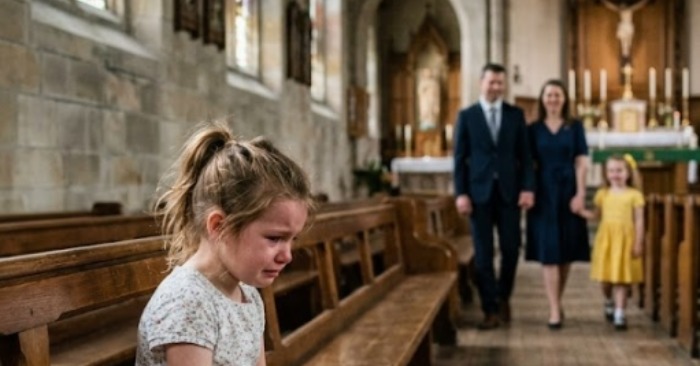
I was four years old when my mother led me into a quiet church and sat me down on a simple dark wooden bench. Colored light from the tall stained-glass windows spilled across the floor in broken patches, while she calmly adjusted the collar of my small navy coat as if she were preparing me for something ordinary. Then she leaned down close to my face and whispered softly:
“Stay here, my child. God will take care of you.”
After that, she stood up without hesitation, took my father’s hand, and my sister stepped beside them. All three of them walked down the rows of pews as if nothing unusual had happened. And I stayed behind, swinging my legs, too shocked to cry and too small to understand that in that moment my life had split in two.
I remember the smell of melted wax, the musty scent of old hymn books, the distant murmur of prayers. But what I remember most clearly is the way my mother looked back one last time. There was a faint smile on her face. Even then I didn’t understand it, and I understand it even less now. There was no pain in it. No doubt. It was the smile of someone who had already decided I no longer belonged to her.
When the heavy church doors opened and the cold air swept in, they disappeared together into it, still a family, while I remained behind like something forgotten.
Back then, it didn’t feel like a dramatic moment. Children often accept silently what they are given, even when it is unbearable. And yet, that became the quiet beginning of everything.
At first, it was a nun who found me. Then a priest. Later a social worker. No one immediately knew who I was, because they left no note, no name, no explanation. But from the careful, broken fragments spoken by adults, the truth slowly came together: my family had vanished, leaving no trace that could be easily followed.
After a few months of temporary placement, I was taken in by a woman named Margit. She was nearly sixty, living alone in a modest house filled with books and the gentle scent of lavender. She worked as a church pianist even when her fingers stiffened with pain. But there was something unshakably calm about her. A rare, quiet presence that made a child feel seen without needing grand gestures.
SHE NEVER TRIED TO REWRITE WHAT HAD HAPPENED. SHE DIDN’T TELL ME COMFORTING LIES. SHE BELIEVED TRUTH HAD TO BE GIVEN IN PIECES, JUST ENOUGH FOR A YOUNG HEART TO CARRY. OVER TIME SHE EXPLAINED THAT THERE ARE PEOPLE WHO LEAVE BECAUSE THEY ARE COWARDS. OTHERS BECAUSE THEY ARE CRUEL. AND SOME BECAUSE THEY CANNOT FACE THEMSELVES. BUT NONE OF THOSE REASONS BELONG TO THE CHILD WHO IS LEFT BEHIND.
“What they did says something about them,” she would often say softly. “Not about you.”
And she stayed. In every sense.
She packed my lunches. Attended school meetings. Patiently learned to braid my hair. Sat with me in the evenings when too many questions filled my mind. Slowly, very slowly, the memory of the church bench faded, and something steadier took its place.
As I grew, I learned that a life can be built without it being defined by what was taken from you. Margit taught me that stability is not something you wait for, but something you practice through small, consistent choices every day.
I studied. I lived simply. Eventually, I earned a scholarship to a small Catholic college. There I learned that returning to the same church did not have to mean reopening old wounds. For me, the place that once held loss slowly became something closer to refuge.
By the age of twenty-four, I was coordinating the parish’s community programs. I organized food drives, helped families with paperwork, and assisted with Sunday children’s activities. When Margit’s hands became too stiff for early services, I played the piano in her place.
It was not a glamorous life. Not one others envied. But it was stable. And for the first time, I truly understood what it meant to belong somewhere without having to earn it through fear or silence.
ON A RAINY THURSDAY IN OCTOBER, EXACTLY TWENTY YEARS AFTER THEY LEFT ME, THE DOORS OF ST. BRIGID’S CHURCH OPENED AGAIN. THREE FIGURES STEPPED INSIDE. TIME HAD CHANGED THEM, BUT SOMEHOW I RECOGNIZED THEM IMMEDIATELY IN THAT PLACE WHERE MEMORY DOES NOT ASK PERMISSION FROM REASON.
They looked straight at me, as if they had rehearsed the moment.
There were tears already forming in my mother’s eyes, but they felt prepared, almost arranged in advance. She said:
“We are your parents. We’ve come to take you home.”
For a second, the world narrowed, and I was again that four-year-old sitting on a bench, watching the same people who once walked away now pretending they had never left.
Then Margit’s voice echoed inside me, calm and clear: not everyone returns because they have found love in themselves. Some return only because they need something they cannot get anywhere else.
When I looked at them again, I knew that was exactly what this was.
I didn’t answer right away. My silence unsettled my mother more than anger ever could. She had likely expected tears, collapse, or at least a reaction she could immediately shape into her own narrative.
MY FATHER CLEARED HIS THROAT.
“You’ve become a remarkable young woman,” he said.
My sister stood slightly behind them. Her posture was tight, her expression a mix of curiosity and discomfort. She looked at me like someone who remembered more than she was willing to admit.
“Why are you here?” I asked quietly.
My mother stepped closer.
“We regretted it every single day,” she said. “Every day.”
Her words carried no weight. Real regret does not arrive already trying to take control of the story.
A moment later she reached into her bag and pulled out a photograph. A small boy with a pale but peaceful face lay in a hospital bed.
“THIS IS YOUR NEPHEW, OLIVÉR,” SHE SAID. “HE NEEDS HELP.”
In that instant, everything became clear. Not from what she said, but from what she showed.
“You want me to get involved,” I said calmly.
Her face softened, as if relieved I had named it for her.
“We want our family back.”
“No,” I looked her in the eyes. “You want something from me.”
The atmosphere shifted immediately. Subtle, but undeniable. As if I had interrupted a scene that had been carefully scripted.
When the discussion moved to the priest’s office, it became obvious this meeting had not been spontaneous. Documents had already been prepared. Arrangements made in the background before they even entered the church.
IN THOSE PAPERS, I WAS DESCRIBED AS SOMEONE WHO HAD BEEN “PLACED OUTSIDE THE FAMILY HOME DURING A DIFFICULT PERIOD.” THE LANGUAGE WAS SO STERILE IT ERASED REALITY, TURNING IT INTO SOMETHING DISTANT AND HARMLESS.
The priest, who never needed to raise his voice to be heard, asked quietly:
“Why is the full history missing from the file?”
No one answered.
Because it was not an accident.
It was deliberate.
They had chosen a place where people expect forgiveness, where saying no feels like a flaw in character rather than self-respect. And in doing so, they made it clear this was not about rebuilding family. It was pressure.
I agreed to the evaluation. Not for them. For the child. His situation had nothing to do with what those people had done years ago.
I made it clear:
“I will help as far as humanly possible. But I will not pretend this is something else.”
A few days later, the results arrived.
I was not a suitable donor.
Not even close.
When my mother called to tell me, I didn’t pick up.
I listened to the voicemail.
She didn’t start with the child. Not with regret. Not with how difficult things must have been for me. She spoke of her disappointment. Of how differently everything might have turned out if I had stayed in contact. As if the past had been a misunderstanding I had personally chosen.
That message clarified more than anything else ever had.
A few weeks later, I quietly attended the boy’s funeral mass. I stood at the back, where I could remain unseen. He deserved to be remembered for who he was, not for what others tried to make him represent.
After the service, my sister approached me alone. Her posture, once rigid and controlled, had finally cracked.
“I should have stayed with you that day,” she said softly. “But I didn’t.”
She didn’t excuse herself. She didn’t soften it. She didn’t reshape the truth. And for the first time, I saw not only who she had been, but who she might have become if things had been different.
I nodded once.
Not because I forgave her.
NOT BECAUSE I WANTED TO OPEN DOORS THAT TIME HAD ALREADY SEALED.
But because truth still matters, even when it arrives too late.
Then I turned and walked away.
Because there are distances we keep not out of hatred, but because we finally learned how to protect ourselves.
They believed time alone would repair what had been broken. They thought returning with the right words could restore what they had once discarded. But they never understood that home is not built on blood or memory alone.
Home is where people stay.
By the time they came back for me, I was no longer the little girl on the bench.
Someone else had already taken my hand.
AND TAUGHT ME HOW TO BUILD A LIFE THAT DOES NOT DEPEND ON WHETHER THOSE WHO ONCE LEFT EVER DECIDE TO RETURN.