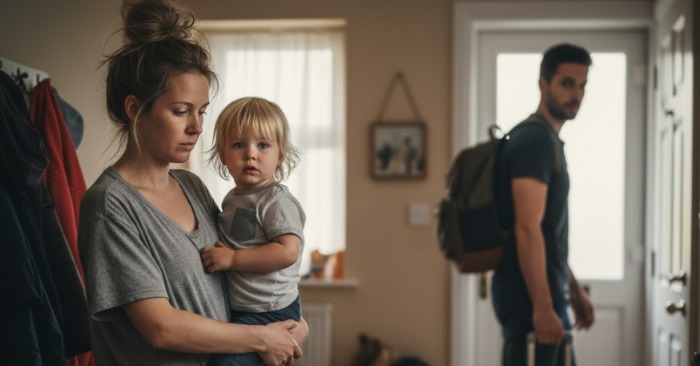
When I saw him standing in the doorway with a suitcase, for a moment I thought it was some stupid joke. That maybe he was going on a business trip, maybe to take care of something, maybe we had just argued and he needed space. But his face was too serious. Too closed off. As if he had made the decision much earlier, and I was only finding out about it last.
The children were running around the hallway, unaware of anything. One was tugging at my sleeve, another was asking whether there would be dinner, and the youngest was holding onto my leg so tightly, as if he sensed that something was wrong. I was looking at that suitcase as if it were a bomb about to explode.
I asked him where he was going, but he shrugged and said that he “needs to rest.” That I had “changed too much.” That he “no longer recognizes me.” Each subsequent word sounded like an accusation, even though I didn’t yet know of what. I stood there paralyzed, trying to understand what he was talking to me about
When he finally said that it was about the fact that I had gained weight after giving birth to the children, I felt as if someone had torn the air out of me. He said it as if he were talking about something trivial. As if a “change in appearance” were a reason to break up a family. As if four pregnancies and years of sleeplessness were my fault.
I tried to say something, but the words got stuck in my throat. I thought about the nights when I fed the children while he slept. About the mornings when I got them ready for kindergarten, working at the same time so we could pay the bills. About the moments when he said that he loved me regardless of everything. And now he stood here and said that I was “no longer the same person.”
He looked at me as if I had failed some exam whose existence no one had warned me about. He said that he wanted to “rethink everything from scratch,” that “this is not how he imagined his future.” He didn’t think about how I imagined it — together, as a family that nothing would tear apart.
Then the children ran up to me, asking whether dad was coming with us to the table. He looked away. He didn’t want to look them in the eyes, and I knew what that meant — he would do it even if they cried.
I asked whether I had done anything else. He said no. That he “just wants to have his old wife back.” Those words were like a cold knife straight to the heart.
I stood there, trying not to cry. I saw a stranger in his face — someone who had stopped seeing me as a partner and started perceiving me as a burden. The children were holding my hand, not understanding anything, and I suddenly felt as lonely as never before.
He zipped the suitcase, adjusted the backpack, and said that “it’s for the good of us all.” It was the most absurd sentence I could have heard then. How can leaving a family be “for the good”?
When he opened the door, a draft swept through the house — cold, as if he were taking the last remnants of warmth with him. I wanted to stop him. To tell him that it’s just a phase, that we’ll get through it together. But I knew that nothing would reach someone who had made a decision based on my appearance.
He left. He just left. He left me with the children, with the mess, with the exhaustion, with a body that had done everything to bring our children into the world. And he considered that a flaw.
When the door closed, my older daughter asked whether dad would come back for bedtime. I looked at her, trying to smile, but I had tears in my eyes. Because then I still didn’t know what I should tell them. I didn’t know what would happen next.
I knew only one thing — that this decision broke something bigger than my heart.
I survived the first night on autopilot. The children asked about dad, and I repeated to them that he “needs to rest,” even though inside I was screaming. When they fell asleep, I sat on the bathroom floor and cried in silence so as not to wake them.
The next day he sent a message — short, cold, drained of emotion. That he “needs space,” that he “didn’t marry such a woman.” As if being the mother of four children was supposed to mean that I would still look like I did when he first saw me.
I remembered all the moments when I supported him. When he lost his job. When he was ill. When he doubted himself. I never thought that I would leave because he “changed too much.” I saw a human being. He — only kilograms.
A few days later he came back for his things. He didn’t look sad. More determined. Like someone who had decided to clean his life of everything that didn’t fit his vision. The children stood in the hallway and looked at him, not understanding why he wasn’t picking them up.
He said that “it will be better this way.” For whom? Certainly not for them. Certainly not for me. But he was convinced that he was doing the right thing.
When he closed the door behind him for the second time, a silence settled in the house that hurt. After a moment the children began to ask when he would come back. This time I couldn’t answer.
A few days later I woke up with the thought that since he had left, I had to learn to stand on my own feet. Maybe broken, but still standing. For them. For myself.
I understood something else — his leaving said more about him than about me.
That he couldn’t love a woman who stopped being perfect.
And I don’t want to be with someone who loves me only as long as I look the way he wants.
It was a moment that hurt like nothing before, but at the same time opened my eyes wider than I wanted. That sometimes someone leaves — and only then do you see how little they were truly present in all of this.
If you made it to the end of this story, write whether YOU also had a moment in your life that forced you to look at yourself differently.