My grandmother has been cleaning the floors of my high school for years – invisible to all those who considered themselves important. But that night after the talent show, a conceited mother in expensive boots decided to show her “place.” What happened next proved: Sometimes it’s the smallest voices that give the biggest lessons.
I’m 16, and I’ve learned: Money doesn’t define dignity – but it makes many people act like it does.
We never had much. My mom works at the city library, surrounded by books she can barely afford. She catalogs bestsellers all day and comes home too tired to read a single page. My dad left when I was eight. Two years later, the calls stopped altogether, as if he deleted us from his contact list – along with his conscience.
So it was just the three of us. Me, Mom, and Grandma Martha.
Grandma has worked at Scottsville High for as long as I can remember. She’s a janitor. She sweeps the hallways when the last bell has long rung, empties overflowing trash cans, and scrubs away the carelessness of a thousand teenagers who don’t even look her in the eye.
And somehow, after all that, she still has enough energy to make me pancakes every Saturday morning – always with extra chocolate chips because she knows exactly how I like them.
When I was little, I loved that she knew every corner of my school. She told me about the secret water cooler that was always the coldest, or the locker that got stuck and needed a trick. She knew which bathroom had the best lighting and which staircase echoed the most. It felt like having an insider guide to my own world.
But in fourth grade, everything changed.
SUDDENLY, KIDS STARTED WHISPERING.
Suddenly, kids started whispering. “Your grandma’s the janitor, right?” they asked, and in their voices, there was something I couldn’t name at the time – but I instinctively knew it was cruel.
Some deliberately dropped trash next to my desk, laughed, and said, “Well, your grandma will clean that up later!” Others made a show of avoiding her in the hallway while she cleaned – as though just passing her by would ruin their image.
It hurt every single time.
But I was never embarrassed about her. Not once. Because shame would have meant her cruelty had a reason – and it didn’t.
Grandma was the kindest person I knew. She knew every birthday, brought homemade cookies to the crossing guard, and once stayed late to help a teacher search for her lost wedding ring in a bin. On weekends, she helped at the community center. And sometimes, even though she had hardly anything herself, she donated to the food bank at Thanksgiving.
That’s who she was. That’s who she is. But some people didn’t see that.
“Don’t let it show that it bothers you, sweetheart,” she always said when I came home angry, my backpack heavier than just homework. “People who mock others for honest work are only showing their own emptiness.”
I nodded, but inside I was furious. Furious at her – and at a world where she had to comfort me, even though she was the one being disrespected.
“YOU WORK HARDER THAN THEIR PARENTS,” I ARGUED ONCE.
“You work harder than all their parents,” I argued once.
“Maybe,” Grandma said, brushing my hair from my face. “But hard work isn’t always what people want to see.”
Last week, the annual talent show took place at Scottsville High. It’s the biggest event of the year – the kind of evening where parents dress like they’re going to a gala, not a school auditorium. Designer handbags, perfume clouds that take your breath away, and camera flashes bouncing off jewelry that probably costs more than our rent.
It was all so over the top. Mothers compared outfits in the lobby. Fathers glanced at their watches like they had more important things to do. And everywhere, kids in costumes that were more expensive than my entire wardrobe.
I sat in the audience, watching kids sing off-key and dance more or less in sync. Somehow, everything felt like a show – not just on stage, but all around.
When it was over, the students disappeared backstage to change, while the parents stayed in the hallway, gathered in groups discussing whose kid was the most talented and who supposedly “deserved a standing ovation.”
I went home early. I had homework, and honestly, I couldn’t stand watching people pose in outfits that probably cost more than what Grandma makes in a month.
Later that evening, when Grandma was making tea, she told me what happened.
“I started at seven,” she said quietly, as she poured hot water over the teabag. The kitchen smelled like chamomile with that hint of lemon she always adds. “I wanted to finish the main hallway early so I could catch the 7:30 bus.”
I watched her face. She didn’t look hurt. If anything… a little amused.
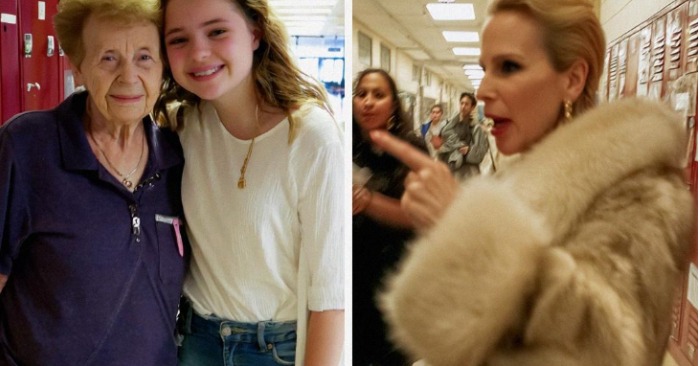
“I was just wiping by the lockers when this woman stopped right in front of me,” Grandma continued, sitting at our little kitchen table. “Tall. Perfect hair, like she’d just come from the salon. Fur coat, even though it wasn’t cold enough for that. And those boots… Kate, those boots looked like they cost a fortune.”
“What did she say?” I asked, although my stomach was already tightening.
Grandma smiled – but it didn’t reach her eyes. “She said, ‘Well, isn’t this cute?’”
The way Grandma mimicked the sweet tone made me burn with anger.
“She said it loud enough for her friends to hear,” Grandma went on. “Then she looked down at me like I was dirt beneath those boots and said, ‘You better watch out, okay? My boots probably cost more than you make in a year.’”
My fingers clenched around my cup. “She didn’t really say that.”
SHE DID,” GRANDMA SAID CALMLY.
“She did,” Grandma said calmly. “And then she gave me that look – you know, that fake smile while she cuts you down at the same time. She said, ‘Must be nice, huh? Still hanging around here after graduation.’”
I felt sick. “And her friends?”
“They laughed,” Grandma said. “Little sharp laughs like they were part of an inside joke. Like my existence was the punchline.”
“And then?”
Grandma gently set her cup down. “She looked around to see if she had an audience. She played, Kate. A little performance. And then she said, ‘At least you get a discount on cleaning supplies? Seems fair if you practically live here.’”
I could have screamed. I wanted to find this woman and tell her what I thought of her boots and her cheap soul. I wanted to know when she decided that cruelty was a luxury she deserved.
“What did you do?”
“I kept wiping,” Grandma said. “Eyes down, face calm. Because people like her want a reaction. That’s what they live for. The moment you show them that they’ve hit you, they win. I wasn’t going to give her that satisfaction.”
BUT THAT’S NOT FAIR, GRANDMA.
“But that’s not fair, Grandma. You shouldn’t have to just swallow that.”
“I know,” she said softly. “But in that moment, it felt stronger to stay calm. Let her have her moment, I thought. Let her feel big.”
I shook my head, tears of anger in my eyes. “She doesn’t deserve to feel big.”
“No,” Grandma said. “She doesn’t. But listen. Because what happened next, I’ll never forget.”
She paused for a moment – and I saw a real smile return.
“Suddenly it got quiet,” Grandma said. “Those sharp little laughs… they just stopped. Like someone flipped a switch. And when I looked up, there was a boy a few feet away. Maybe eleven or twelve. He was holding a small trophy from the talent show and still wearing his costume… a little suit jacket that was too big for him.”
“A boy?”
“Her son,” Grandma said, her voice softening. “He’d come back from backstage looking for his mom. And Kate… the look on his face when he heard what she’d just said…”
HOW DID HE LOOK?” I ASKED SOFTLY.
“How did he look?” I asked softly.
“As if someone had snapped his heart,” Grandma said. “As if he suddenly didn’t recognize someone he loved. He went right up to her and said – loud enough for everyone to hear: ‘Mom, why are you being mean to her? You always tell me to respect people who work hard. She cleans here, she doesn’t hurt anyone.’”
My mouth dropped open. “He said that? To his own mother? In front of everyone?”
“In front of everyone,” Grandma confirmed. “The whole hallway was silent. You could hear a pin drop.”
“The woman tried to laugh,” Grandma said, mimicking that fake chuckle again. “’Oh, sweetie, I was just having fun…’”
“But he didn’t let her finish. He looked her straight in the eye and said: ‘That’s not funny. You’d be mad if someone talked about my grandma like that.’”
I got goosebumps. “And what did she do?”
“Her face turned bright red,” Grandma said. “Just like her lipstick. And people were staring everywhere, whispering behind their hands. Even a teacher stopped. This woman looked like she wanted the ground to open up and swallow her. Which – after I’d just wiped – would have been pretty inconvenient.”
I HAD TO LAUGH DESPITE IT ALL.
I had to laugh despite it all. “Grandma!”
“What?” she grinned. “I’m allowed a little humor in my own story.”
“And then?” I pressed.
Grandma’s face softened again. “The boy turned to me. He held the trophy so tightly his knuckles were white. Then he put it on the ground and said: ‘I’m sorry about my mom. She was wrong. I’ll talk to her at home, I promise.’”
“He… apologized for her?”
“Yes,” Grandma said quietly. “So seriously. Like a little man in the body of a child. As if he understood what his mother had lost somewhere along the way… something like decency.”
She paused, and I saw her eyes well up.
“And then someone started clapping,” Grandma said. “First one person. Then another. And suddenly the whole hallway was clapping for that boy, who had just stood up for a janitor. For me. For someone no one else noticed.”
“And the woman?”
“She grabbed her son’s hand and left,” Grandma said. “Without a word. Just left, quickly, her face burning, those expensive boots clicking on the floor I had just cleaned. A few friends followed her – embarrassed. Others stayed, and some even came to apologize to me later.”
“Really?”
“Yes,” Grandma nodded. “One woman said her son had been at the talent show too, and she was ashamed she hadn’t said anything. Another said she always appreciated how clean I kept the school. Little sentences – but they mattered.”
We sat in silence for a moment. The tea had gone cold. Outside, I heard traffic, somewhere a dog was barking – normal sounds on a night that suddenly didn’t feel normal anymore.
“You know what’s the strangest thing?” Grandma said finally. “I’m not even mad at her. I’m grateful.”
“Grateful?” I stared at her. “Grandma, she humiliated you.”
“She tried,” Grandma corrected. “But she failed. And I’m grateful for that boy. Because that woman raised him, you see? With all her harshness and this urge to put others down… and yet, she raised a child who knows better. Who sees better. That gives me hope, Kate. Maybe the next generation will be kinder than ours.”
TEARS STUNG IN MY EYES.
Tears stung in my eyes. “I’m so proud of you, Grandma. But you shouldn’t have to put up with that. No one should.”
Grandma nodded slowly. “You’re right. And maybe next time, I’ll be the one who speaks first. Maybe I’ll find my voice before someone else finds it for me.”
“What would you say?” I asked.
She thought for a moment. “Maybe something like: ‘I’m sorry you measure your worth by the price of your boots. I measure mine by the kindness I bring to the world. And on that scale, Ma’am, you’re failing miserably.’”
I grinned. “That’s perfect.”
“I had a few hours to think it over,” she admitted. “In the moment, I might have just said something about respect and honest work. But anyway – next time, I won’t stay silent.”
I squeezed her hand. “And I’ll stand by you.”
Grandma smiled. That smile that has seen too much and still chooses hope. “I know, sweetheart. You always do.”
GRANDMA CLEANS FLOORS, EMPTIES TRASH CANS, AND SCRUBS AWAY THE MESS LEFT BY OTHERS WITHOUT THINKING ABOUT IT.
Grandma cleans floors, empties trash cans, and scrubs away the mess left by others without thinking about it. She works late and early. And she comes home with a sore back and rough hands from the cleaning supplies.
But she also makes pancakes with extra chocolate. She remembers birthdays, searches for wedding rings in containers, and is ready to raise her voice for others – even when she hasn’t raised it for herself.
And that boy, whoever he is, saw the person behind the mop and uniform. I hope he never forgets what he did that night. And I hope his mother never forgets it either.
Because in the end, boots wear out. Fur coats go out of style. But the memory of a child putting compassion above cruelty? That echoes through hallways long after the floors have been cleaned.