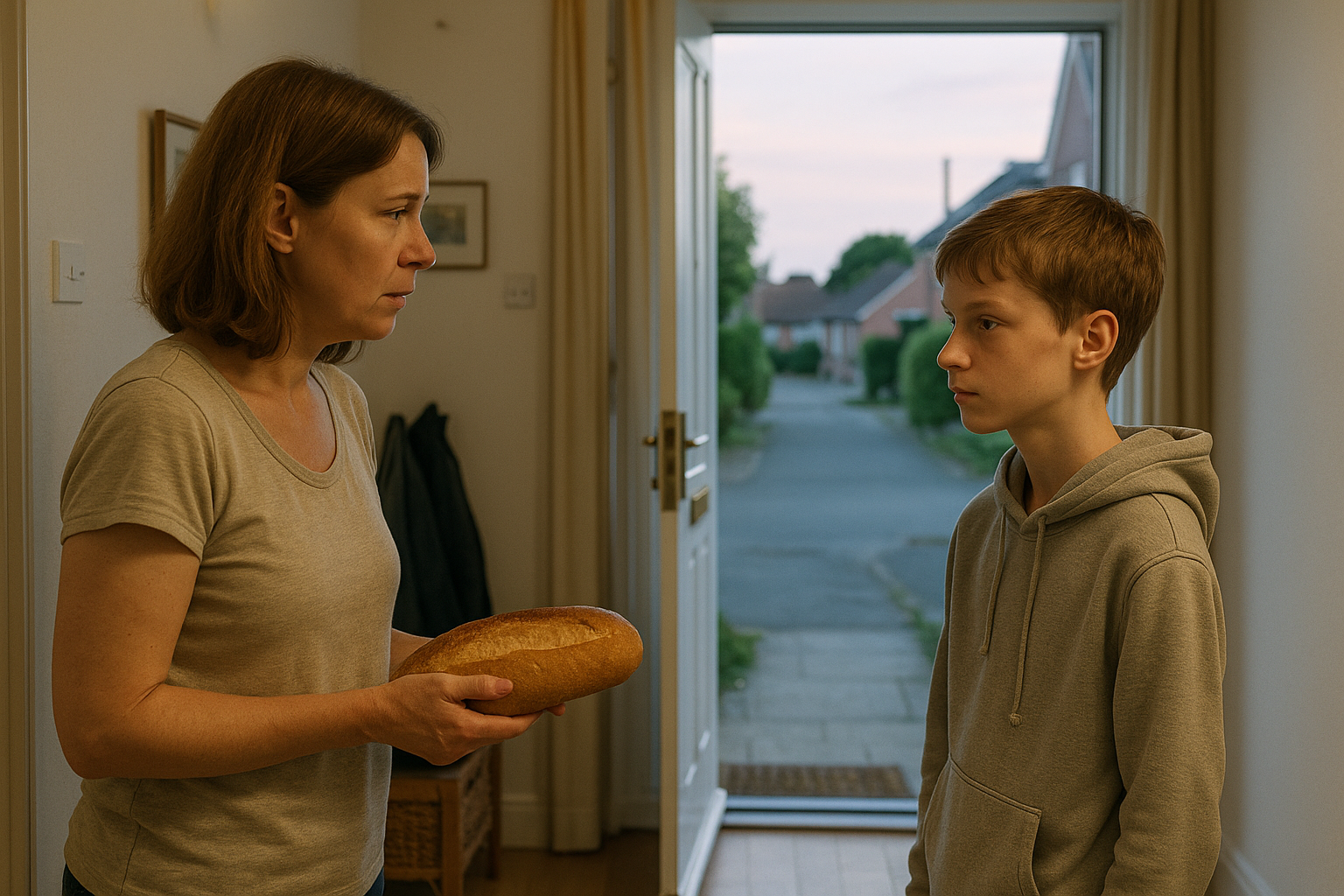
The boy who rang my doorbell every Sunday at 6 PM and asked for bread turned out to be the reason my son was still alive.

At first I thought it was just another neighbor’s kid. Skinny, in an oversized gray hoodie, hair falling in his eyes. He never looked straight at me. Just stood there shifting from foot to foot and mumbled, “Do you maybe have… some bread?”
I am Emma, fifty-eight, and my house had become painfully quiet since my son Daniel left two years ago. We hadn’t spoken since the fight. He slammed the door, and in my pride I pretended I didn’t care. The silence that followed grew heavier with every month.
So when the boy appeared that first Sunday, I was more annoyed than curious.
“Where are your parents?” I asked, holding the door only half open.
He shrugged. “They’re… busy.”
“Busy with what?”
He stared at my shoes. “Just… busy.”
There was something in the way his shoulders hunched that made me swallow the next questions. I went to the kitchen, cut half a loaf, wrapped it in a paper towel, and handed it to him.
“Thank you,” he whispered and almost ran away.
The next Sunday he came again. Same time, same timid knock, same question.
Bread.
The third Sunday I was waiting with a fresh loaf already on the counter. When he rang, I opened immediately.
“You’re very punctual,” I tried to joke.
He flinched like he’d done something wrong.
“Sorry. I can come later.”
“No,” I said quickly, too quickly. “It’s fine. What’s your name?”
“Lucas,” he said after a pause, like he had to remember it.
“Lucas, do you only eat bread?”
He gave a tiny shrug. “Bread is… enough.”
It wasn’t.
That evening I couldn’t stop thinking about his thin wrists and hollow cheeks. The next Sunday I sliced some cheese, added an apple, and tucked everything into a small paper bag.
He froze when he saw it.
“I can’t pay,” he murmured.
“It’s not a store,” I replied. “It’s just… dinner.”
He looked up at me for the first time. His eyes were a washed-out blue, too old for his small face. “Thank you,” he said again, but this time his voice cracked.
Sunday after Sunday, he kept coming. I stopped asking about his parents when I saw how his jaw tightened at the word “home”. Instead, I asked about school, about the stray cat he mentioned once, about the video games his classmates played but he didn’t.
I never invited him inside. Somehow the threshold felt like a fragile line I was afraid to cross—for him, for me. So we stood in the doorway, me holding bags of food, him holding a backpack that looked almost empty.
One rainy evening I couldn’t hold the question back anymore.
“Lucas, do your parents know you come here?”
He hesitated, then shook his head.
“Do they know you’re… hungry?”
He pressed his lips together so tightly they turned white.
“They’re tired,” he said finally. “They work at night. They sleep in the day. Sometimes there’s no time for… shopping.”
It sounded rehearsed, like something he’d said to teachers before. Something practiced and never believed.
I wanted to call someone. A social worker, the school, anyone. But a part of me was terrified he would never come back if I did. And those ten minutes every Sunday were the only moments in my week when the house felt almost alive again.
He started staying a little longer. Asking small questions.
“Do you live alone?”
“Yes.”
“Don’t you get scared?”
“I used to have a son,” I told him one evening, words stumbling out before I could stop them. “Daniel. The house didn’t feel so big then.”
“Where is he?”
“We… argued.” I stared at the tiles. “He left. I thought he would call. I thought I would call. We both waited too long.”
Lucas was quiet for a long time.
“Sometimes adults are stubborn,” he said quietly. “Sometimes kids are too.”
He said it like he knew.
The twist came on a Thursday.
I was at the grocery store, comparing prices of pasta, when I heard my name from behind.
“Emma?”
I turned. A woman around my age, hair tied back in a tired ponytail, eyes lined with something more than sleeplessness.
“Sophia?” I frowned. We’d worked together at the library years ago.
She smiled weakly. “I thought it was you.”
We exchanged the usual phrases, the little lies of “I’m fine” and “You look great.” Then her phone buzzed. She glanced at the screen and her face changed.
“I’m so sorry, I have to go. My son’s at the hospital… again.” Her voice trembled on the last word.
“The hospital?”
She nodded, already pushing the cart toward the exit. Then she stopped, turned back.
“It’s… complicated. He was very close to…” She swallowed. “To doing something terrible two years ago. A stranger stopped him. Since then it’s been up and down. I’m just grateful he’s still here.”
A chill ran down my spine.
“What do you mean, a stranger?”
“They never found out who it was. A young man at the bridge. He talked to my son for an hour. Called the ambulance. Then disappeared.” Her eyes filled with tears. “My son still writes letters to him he can’t send.”
The world around me blurred. A bridge. A stranger. Two years ago.

“Which bridge?” I asked, though I already knew.
She named it. The one near the river. The one Daniel had always gone to when he needed to think.
I grabbed the edge of the shelf to steady myself.
“Your son’s name,” I whispered. “What’s his name?”
“Lucas,” she said. “He’s twelve now.”
The cereal box slipped from my hand and hit the floor.
Twelve now.
Two years ago, he would have been ten.
A boy on a bridge. A young man talking him down. A son who never came home.
When I got back to my house that day, I went straight to the drawer where I kept the newspaper clippings I pretended I didn’t have. The article was still there, yellowed, folded.
“UNIDENTIFIED MAN PREVENTS CHILD SUICIDE, LEAVES BEFORE POLICE ARRIVE.”
They’d published a blurry photo from a distance. Two figures on the bridge. One tall, one small.
I traced the taller silhouette with my fingertip.
Daniel.
My hands shook so badly I had to sit down.
All this time I had hated him for leaving, for not calling, for choosing some nameless city over his own mother. I had imagined him in bars, with friends, in noisy apartments.
Not on a bridge, pulling someone else’s child back from the edge.
Sunday came like a storm.
At 5:55 PM I was already standing behind the door, bread cut, hands clammy. The bell rang exactly at six.
I opened the door before the second chime.
Lucas blinked in surprise. “Hi,” he said softly.
“Hi,” I answered, then took a breath so deep it hurt. “Lucas… do you remember the man on the bridge?”
His fingers tightened around his backpack strap.
“I’m not supposed to talk about that,” he whispered.
“Please,” I said. “I think I know him.”
He looked up at me, searching my face.
“He had brown hair,” Lucas said slowly. “Messy. He kept making stupid jokes so I’d get mad instead of… jumping. He gave me his jacket because I was shaking. He smelled like… coffee and rain.”
Coffee and rain. My kitchen at six in the morning, Daniel late for work, grabbing his cup, kissing the air near my cheek in a half-goodbye.
“Did he tell you his name?”
Lucas shook his head. “I asked. He said it didn’t matter. That I’d forget him anyway. But I didn’t.” His voice cracked. “I wrote him a letter every week for a year. My mom put them in a box. She said maybe one day we’d find him.”
I couldn’t see him clearly anymore. Tears blurred everything.
“Lucas,” I whispered, “his name is Daniel. He’s my son.”
For a second he just stared at me. Then his lower lip trembled.
“Your son saved me,” he said.
I nodded, because I couldn’t speak.
“And you…” He looked at the bag in my hand, the doorway we stood in every Sunday. “You saved me too. A little bit. Every week.”
The sob tore out of me before I could stop it. I covered my mouth with my hand, but it was useless. All the held-back words, all the unsent messages to Daniel, all the lonely dinners—they crashed over me.
“I don’t know where he is,” I cried. “I don’t know why he never came back. But he loved kids. He… he always stopped when he saw someone crying. Of course he would stop for you.”
Lucas stepped back, eyes wide, as if he’d broken something inside me.
“Sorry,” he whispered. “I didn’t mean to make you—”
“No,” I said, wiping my face clumsily. “No, Lucas, you did the opposite. You gave me back a part of him I didn’t know. I thought he left because he stopped caring. But he left because he cared too much. Even for strangers.”
We stood there in the doorway, two people tied to the same invisible boy on a bridge.
“Can I…” Lucas hesitated. “Can I bring you something next Sunday? My letters. The ones I wrote to him. Maybe you could… read them. So he’s not so gone.”
The idea hit me like a beam of light.
“I would like that,” I said.
The next Sunday, he came with a shoebox held like a treasure. We sat at my kitchen table for the first time. I made tea. He unfolded the letters with trembling hands.
They were messy, full of misspellings and drawings in the margins. But through them, a child’s fear slowly turned into gratitude, then into something like hope.
He wrote about bad days at school, about nightmares, about how he tried not to go near bridges. About how he wanted to grow up and find the stranger who told him that even the darkest night eventually turns into morning.
My son’s words, through someone else’s memory.
By the time we finished the last letter, the kitchen was filled with something that wasn’t exactly joy but wasn’t pure grief anymore either. Something in between. Something livable.
Lucas looked at me carefully.
“Maybe,” he said, “someday he’ll come back. And you can show him these. And tell him his mom fed the boy from the bridge.”
I smiled through the tears.
“And maybe,” I answered, “someday he’ll see a boy standing at a familiar door and recognize the woman behind it.”
Until then, every Sunday at 6 PM, I slice bread, boil water for tea, and set two plates on the table—one for the boy whose life my son saved, and one for the empty chair where my son should be.
It hurts. But it hurts in a way that finally makes sense.
Because now, when the doorbell rings, I don’t just hear a stranger asking for bread.
I hear my son’s silent apology.
And with every loaf I pass into those thin hands, I send a forgiveness into the world I hope will find him, wherever he is.