I am seventy years old. I no longer sought out the noise of the world, but rather hid from it. I painted to survive. I thought that was all there was left. Then one autumn afternoon, the cry of a strange child triggered something much greater.
I didn’t always have a paintbrush in my hand. I worked as an electrician for thirty years. Cables, fuses, unhappy customers – the normal, two-handed version of life. My wife, Marlene, and I built a modest house, with a vegetable garden in the back and wind chimes under the eaves, which she loved.
I used to laugh at them when they got tangled in a storm. Now I admit: I miss that sound more than anything.
He passed away six years ago. Lung cancer. He had never smoked in his life. At the time, I thought it couldn’t get any worse.
I was wrong.
Three years ago, our daughter Emily—then thirty-three—was hit by a drunk driver. She was on her way home from the store. The man ran a red light. Emily’s body was completely shattered. A spinal cord injury, two broken legs, internal injuries. She survived. Somehow. But she hasn’t walked since.
Insurance covered what it could. But the rehabilitation that would have given her a real chance—specialized neurotherapy, robotic walking aids—was out of reach for me. I didn’t have any money saved up for miracles. Everything I had went to surgeries. I moved her in with the rest of the money and tried to save some. Not for a living. Just for a rainy day.
Emily needed full-time care. And I needed something to keep me alive.
I didn’t start painting because I thought it would solve everything. It was because I didn’t know what else to do. One night, after she was asleep, I sat down at the kitchen table with some printer paper and an old set of oil paints that we had found among Emily’s childhood boxes. I drew a barn—a memory from Iowa when she was seven.
I thought, Who would trust me with a paintbrush?
It wasn’t anything special. But I had painted when I was young, I just needed to dust my hands.
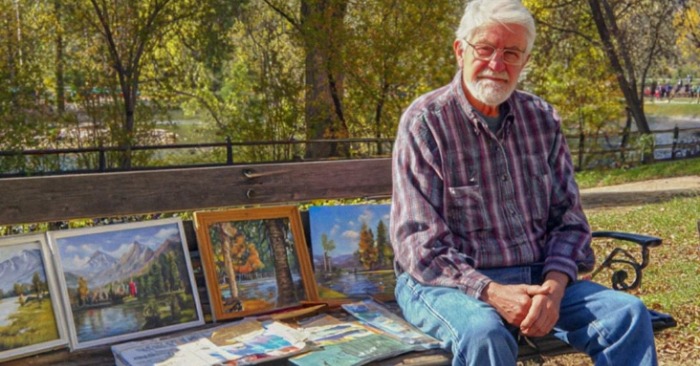
I started watching videos, learning techniques. I worked with oils—it felt heavy, real. I painted at night when Emily was asleep. Then one day I plucked up the courage and took a few canvases out to the park.
I painted memories. Country roads, buses in puddles, foggy cornfields, rusty mailboxes. Places that you miss, but you don’t know when they were yours.
People stopped. They smiled. Sometimes they bought. Sometimes they just nodded. I always thanked them for stopping. Those few seconds of connection… kept me going.
Last winter almost ground me down. I couldn’t afford not to go outside. My hands would cramp, the paint would harden, the brush would stick. There were days when I made twenty dollars. Other days, nothing. I went home with numb fingers, looked at the bills, then at Emily. She was always smiling.
“Dad, someone is going to feel what you do,” she said.
I pretended to believe him. He knew I was just trying. But he let me.
The worst part of getting older isn’t the pain. It’s the feeling that you’ve given everything you had. That the world is slowly forgetting. That’s how I felt. It was like my daughter was sinking and I was trying to drain the water with a leaky bucket.
Then the day came.
It was an early fall afternoon. I was painting two children feeding ducks when I heard a soft cry. A little girl was standing by the sidewalk. She was maybe five years old. A pink coat, too big for her. Two slanted pigtails. She was clutching a stuffed bunny.
“Are you okay, honey?” I asked.
She nodded and shook her head at the same time.
“I can’t find the teacher.”
I sat her down next to me, covered her with my coat. She was shivering. I started telling her a story—the same one I’d told Emily long ago. About a brave princess who followed the colors of the sunset home.
She started laughing, even through her tears.
I called the police. Fifteen minutes later, a man in a suit came running toward us, panting.
“Lila!”
“Dad!”
He hugged her. That voice… wasn’t just relief. Fear, too.
“Did you find her?” he asked.
“She found me, more like.”
We talked. I told Emily’s story. The painting. He listened carefully, then gave me a business card.
The next morning, I was woken up by a honking horn.
I looked out the window. A pink limousine was parked in front of the house.
“Emily,” I said, “I think Cinderella has come for breakfast.”
A man in a suit rang the doorbell.
“Mr. Miller? You’re not going to the park today. Come with me.”
I was skeptical. But I went.
Lila was sitting in the limo with the bunny. Her father was next to her.
“I really want to thank you,” she said.
She handed me an envelope. I opened it. Inside was a check. The amount would cover Emily’s entire rehabilitation.
I protested.
“This is not a donation,” he said. “I’m going to buy your paintings. All of them. I’m going to open a community center. Your paintings will be on the walls.”
“These are homes,” he added. “People need this.”
Six months have passed. Emily has finished therapy. She’s standing. She’s walking. She’s in a walker now.
I paint. I have a studio. I get paid. I don’t worry about the store.
But I still go out to that bench on the weekends.
I kept one painting. A little girl in a pink coat with a bunny on the waterfront.
Because that day wasn’t just Emily’s life that changed.
Mine too.