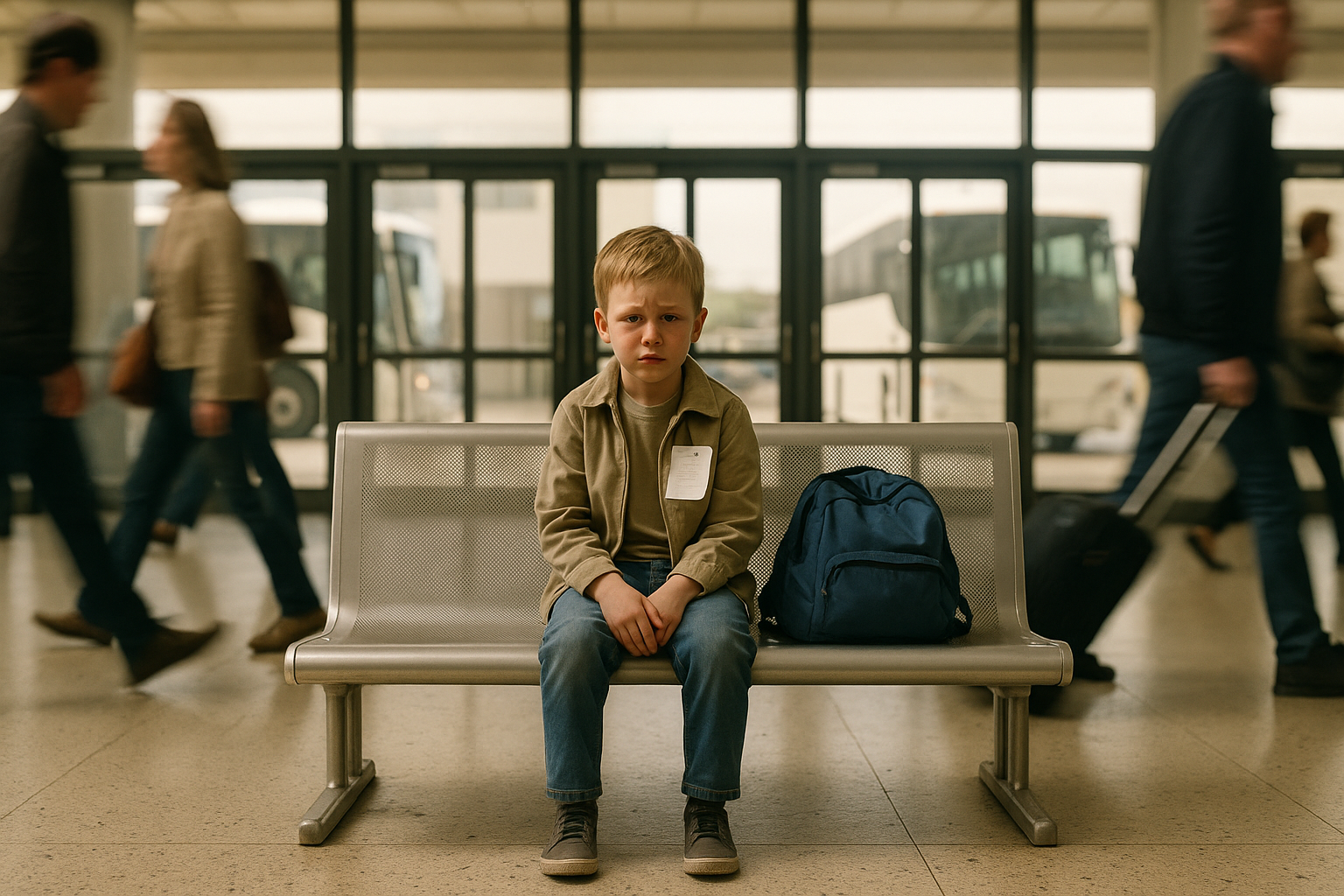
On the day Liam turned seven, his mother left him at the bus station with a blue backpack and a note pinned to his jacket, telling him to sit still and be brave, then walked away without looking back.

He watched her red coat disappear between the people, expecting at any moment that she would turn around, laugh, and run back to him. She did not. The metal bench was cold through his jeans. His legs dangled, not reaching the dirty floor. He pressed his palms on the backpack, feeling the hard edges of the lunchbox inside, the only birthday gift he had received that morning.
The note scratched against his chin when he breathed. He knew there were words on it, because his mother had held it for a long time, her hands shaking, before pinning it to his jacket. But Liam could only read simple words, and the letters swam together when he tried to look down.
People came and went. Announcements echoed above him, calling out cities he had never heard of. A baby cried somewhere. A man laughed too loudly. No one stopped. No one asked why a small boy was sitting alone, his feet not touching the floor, his eyes fixed on the glass doors where his mother had vanished.
When the woman from the kiosk finally noticed him, the sky outside had turned the color of dirty cotton. She walked over, wiping her hands on her apron.
“Where are your parents?” she asked gently.
Liam lifted his chin so she could see the note. She frowned, unpinned it, and read silently. Her lips tightened. She did not read it out loud. Instead, she took a deep breath and said, “Stay here, okay? I’ll call someone who can help.”
He did not understand. He only knew that if he moved, his mother might not be able to find him again. So he sat very still, even when his legs began to tingle, even when the woman came back with a man in a dark jacket and a kind face.
The man knelt to Liam’s eye level. “My name is Daniel,” he said. “I help children who get lost.”
“I’m not lost,” Liam answered stubbornly. “I’m waiting. She said to wait.”
Daniel looked at the note again. Something in his eyes changed, like a door closing quietly.
Years passed. The memory of the bus station became a frozen picture in Liam’s mind: the red coat, the smell of diesel, the sticky feeling of fear in his throat. He moved from one foster home to another, always with the blue backpack, even when it was too small for his schoolbooks.
Some families were kind. Some were not. One family, with a woman named Grace and a man named Mark, kept him the longest. They had a dog named Lucky who slept at Liam’s feet. Grace put his drawings on the fridge. Mark taught him how to ride a bike in the park.
Still, every time a car door slammed outside or the phone rang in the evening, a small, stupid part of Liam thought: Maybe it’s her.
By the time he turned eighteen, the backpack was frayed and the note was locked in a folded plastic sleeve, yellowed and fragile. He had finally asked to see it when he was twelve. Daniel, who had stayed in his life like a quiet, steady star, had brought it in a folder, his eyes searching Liam’s face.
The note was short.
“This is Liam. I can’t take care of him anymore. He is a good boy. Please find him a better life.”
There was no “I’m sorry”, no “I love you”, no name at the bottom. Just those hard, blunt sentences that had cut into his skin for years.
When he aged out of the system, Grace and Mark asked him to stay, to call their house his home. He did, because he loved them, because Lucky was old now and followed him with cloudy eyes. But the empty place where a mother’s face should have lived inside him never stopped aching.
The twist came on a Tuesday afternoon, in the middle of a shift at the small bookstore where he worked. A woman walked in, leaning on a cane, her hair streaked with gray but still long, still the color of autumn leaves.
Liam was restocking a shelf when he felt the world tilt. The scent of cheap floral perfume hit him first, dragging him backward through time. She looked thinner, older, but the sharp line of her jaw, the way she held her shoulders as if bracing for invisible blows — he knew.
“Can I help you find something?” he asked, his voice scraping in his throat.
She looked up. Her eyes were tired, ringed with shadows. For a second, they slid over him as if he were no one, just another stranger in a quiet shop. Then they froze.
“Liam?” she whispered.
The air between them went silent. He felt his heart slam so hard it hurt.
“You remember my name,” he said. He didn’t know he was going to say that until the words were already falling.
She gripped the cane tighter. “Of course I do. You think I could forget my own son?”
The word son cracked something open in him and filled it with anger. Not hot, shouting anger, but a cold, deep one that made his fingers tremble.
“You left me,” he said quietly. “At a bus station. On my birthday. With a note like I was… a suitcase.”

People nearby slowed their browsing, sensing the invisible storm. The soft music playing in the store suddenly felt too loud.
Tears welled in her eyes. “I was sick,” she said. “I had nothing. No money, no home. I thought… I thought someone else could do better. I thought I was saving you.”
“You didn’t come back,” Liam answered. “You didn’t check if they did better. You didn’t ask. Not once.”
She opened her mouth, closed it again. Her shoulders shook. “I was ashamed. And then it was too late. For years I tried to find you. The note… it didn’t have my name. They wouldn’t tell me where you were.”
He remembered Daniel’s eyes, the way he had folded the note, the quiet anger in his jaw. Someone, somewhere, had decided she wasn’t safe. Someone had drawn a line.
“I’m dying,” she said suddenly, the words falling heavy between them. “My heart. The doctor says… I don’t have much time. I wanted to see you. Just once. To say I’m sorry. To know if… if your life was better without me.”
Liam’s first instinct was to turn away, to protect the scar that had never fully healed. But behind his anger there was a boy on a cold bench, waiting, waiting, waiting.
He saw Grace’s hands, warm around a mug of tea, the way she had said, “You don’t have to forgive anyone until you’re ready. And maybe you never will be. But don’t let anger be the only thing you carry. It’s too heavy.”
“I have a family now,” he said slowly. “People who stayed. A dog who snores too loudly. I go to the park on Sundays. I… I wasn’t always okay. But I’m better now.”
She nodded, a sob escaping her. “Then I did one thing right,” she whispered. “Even if it was the cruelest way.”
Silence stretched. He realized his hands were still holding a stack of books. He put them down carefully, as if they might break.
“I don’t know if I can forgive you,” he said. “Not today. Maybe not ever.”
She flinched, but did not look away. “I understand.”
“But,” he added, the word tasting strange in his mouth, “I can get you a chair. And a glass of water. And you can tell me who you were. Not the woman who left me. The woman before that. The one who named me.”
Her face crumpled. She nodded, pressing a trembling hand to her lips.
Liam led her to the small table by the window, where sunlight spilled in bright rectangles on the floor. She moved slowly, each step careful. He brought water. He sat across from her, the table between them like a thin border between two countries that had been at war for too long.
They talked. She told him about the tiny apartment that smelled of mold, the man who hit when he drank, the nights she held baby Liam and promised him things she could not give. She told him about the bus station, how she had walked around the block three times before she could force herself to leave.
“I watched you through the glass,” she said hoarsely. “Until someone came. A woman in an apron. When I saw she was talking to you… I ran. If I stayed, I would have taken you back. And I was so afraid that meant hurting you more.”
He listened. It didn’t erase the bench, or the years, or the note. But it colored the empty spaces around them.
When she finally stood to go, leaning on her cane, she looked smaller than when she had walked in.
“Thank you,” she said. “For letting me see you. For letting me know you lived.”
“I did more than live,” he replied quietly. “I learned how to stay.”
Her eyes shone. “Then maybe,” she said, “you broke the thing I couldn’t.” She hesitated. “If… if you ever want to see me again, the nurse wrote my address here.” She slid a folded paper onto the table. “But if you don’t… I’ll still be grateful for today.”
He didn’t pick up the paper until after she had left. Outside, he watched her move slowly down the sidewalk, swallowed by the bright afternoon.
That night, sitting on the couch with Lucky’s old head on his lap and Grace knitting beside him, Liam looked at the note from long ago and the new paper with the shaky address.
The hurt was still there. The anger, too. But for the first time, they weren’t alone. There was also a thin, fragile thread of something else.
Not forgiveness. Not yet.
But maybe — someday — a different ending than the one that began on a cold metal bench with a blue backpack and a boy told to sit still and be brave.