The letter arrived on a Tuesday morning, addressed to my eight-year-old son from the grandfather he never knew, and the postmark was from the nursing home that had sworn to me my father did not remember any of us.

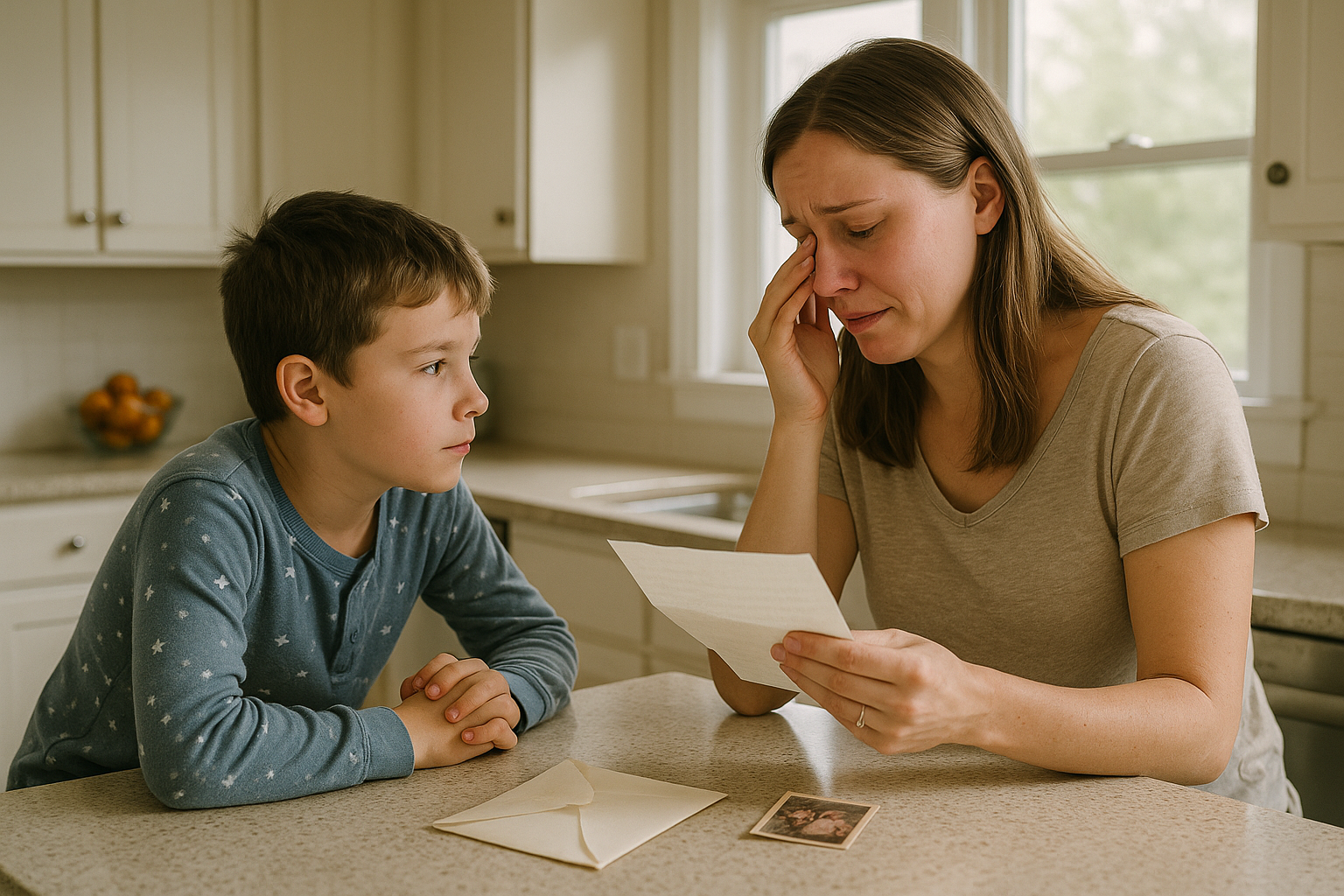
I stood over the kitchen counter, fingers trembling around the thin white envelope. On the front, in shaky blue ink, was written: “To Liam, from Grandpa Mark.” The handwriting was crooked, but I would have known it anywhere. I had watched those same letters form notes of anger, apologies, grocery lists, and once, a birthday card that arrived three days late when I was ten.
“Mom, is that for me?” Liam’s voice was small but excited. He was still in his pajamas, hair sticking up, a spoonful of cereal halfway to his mouth.
I swallowed. “Yes,” I managed. “It’s… from your grandfather.”
His eyes widened. He had seen my father only once, through a window at the nursing home, when we dropped off some clothes. My father hadn’t looked up. Liam had waved anyway.
“But I thought…” Liam frowned. “You said he forgets people.”
“That’s what they told me,” I said, more to myself than to him.
The last time I had visited, the nurse had gently explained that my father’s memory was like a torn book—missing pages, broken sentences. He had stared at the TV, at the wall, at his own hands, but not at me. When I said, “Dad, it’s Anna,” he only smiled politely, the way you do at strangers.
I had driven home with my chest hollow and my eyes burning, promising myself I wouldn’t drag Liam through that kind of pain.
“Can I open it?” Liam asked now, already reaching.
Something inside me twisted. For years, I had carried anger like a stone—anger at the father who had drunk himself through my childhood, who had missed school plays, who had forgotten to pick me up from birthdays. I had been sixteen when my mother left, and I stayed, because someone had to make sure he ate something more than canned soup.
We hadn’t spoken for five years before the diagnosis. Then suddenly, the hospital called: “You’re his only contact.” Alzheimer’s, they said. Early, then not so early. The stone of anger turned into something heavier, something that felt a lot like guilt.
“Go ahead,” I whispered.
Liam tore the envelope with the careful clumsiness of small hands. A single sheet of lined paper slid out, folded twice. There was something else inside, a small, crumpled photograph.
He unfolded the paper, then looked up at me. “Can you read it, Mom?”
My throat tightened. “Sure.”
I took the letter. The handwriting drifted across the page, letters uneven, some words pressed too hard, leaving grooves.
“Dear Liam,
I am writing this with the help of a nurse, because my hands shake and my head is not what it used to be. They tell me you are eight. I do not deserve to know you, but I am selfish and I want to try.
Maybe you know that I was not a good father to your mom. I don’t remember everything, and maybe that is a kindness. But I remember her small hand on my sleeve when she was little, and I remember pulling away to reach for a bottle. I remember her crying in the hallway while I pretended not to hear.
I forgot her piano recital. I forgot to come to the hospital when she broke her arm. I forgot so many things. Now my brain is forgetting for me, taking pieces whether I want it to or not. I am losing days, faces, names. One day I will lose you, even before I meet you.
But last night, something strange happened. I woke up in the dark and saw a little boy standing by my bed. He had your mother’s eyes when she was your age. He was holding a toy car. He didn’t say anything, just looked at me like he was waiting.
I think it was you, or the memory of what I stole from myself.
I have missed everything that mattered, Liam. Not just for your mom, but now for you too. I won’t be at your school concerts. I won’t teach you how to ride a bike. I won’t remember your birthday. It hurts to write this, but I want you to know the truth: it is not because you are not worth remembering. It is because I wasted my mind on the wrong things, and now it is leaving me.
If you are reading this, it means your mom was kind enough to put my mistakes aside for a moment. Please be kinder than I was. Hold her hand when she is old, even if she forgets your favorite stories. Don’t do what I did and wait until it’s too late to say I’m sorry.
There is a picture in this envelope. It’s the only one I have of your mom smiling at me. She is six. I am holding her, and for once, I was sober. I looked at this picture yesterday, and for a moment, I knew her name, the sound of her laugh. Then it slipped away again.
Before it goes for good, I want you to have it.
Love, even if I don’t remember the word when I see you,
Your Grandpa Mark.”
By the time I reached the end, my voice was breaking. Liam sat very still, his cereal forgotten, his eyes fixed on the paper.
“Can I see the picture?” he asked softly.
I slid the worn photograph out. There I was, six years old, sitting on my father’s shoulders in a sunlit park. My hair was in messy braids, my arms flung wide, laughing at something out of frame. My father’s hands were wrapped firmly around my legs, his face tilted up, squinting against the sun. He looked tired, older than he should have, but there was something undeniable in his expression: pride. Pure, simple pride.
“I didn’t know he ever…” I started, then stopped. I had spent so long telling myself I had never really had a father that I had erased this, too.
“He looks happy,” Liam said.
I nodded, tears spilling over. “Yeah. He does.”
Liam traced my face in the photo with one finger. “Mom, can we go see him?”
The question slammed into me. The last visit had been brutal. My father had asked me if I was the new volunteer. He had called me “dear,” the way you do when you don’t know a name. I had driven home furious, at him, at the disease, at myself for still wanting him to know me.
“He might not remember us,” I warned.
“But he wrote my name,” Liam said. “He tried, right? You always say trying matters.”
The simple truth of that made my chest ache. I looked down at the letter again, at the shaky lines of regret. For years, I had waited for an apology that never came. And now, when it finally arrived, it was wrapped in forgetting.
“Okay,” I whispered. “We’ll go.”
The nursing home smelled like disinfectant and something sweet and stale. Nurses moved quietly through the halls, their shoes soft against the linoleum. Liam clutched the photograph in one hand and my fingers in the other.
My father was by the window of the common room, in the same beige chair as always. The TV murmured in front of him, but he wasn’t watching. He was staring out at the thin strip of lawn and the parking lot beyond, eyes unfocused.
“Dad,” I said, my voice catching.
He turned slowly. His gaze slid over me, polite, empty. Then it landed on Liam.
For one suspended second, something flickered. His eyes sharpened, lines on his forehead deepening.
“Liam,” he said, the name careful on his tongue.

My heart stopped.
“You remember me?” Liam asked, stepping closer.
My father’s lips trembled. “You… you’re the boy from… from the paper.” He tapped his temple, as if trying to knock something loose. “From… the letter. I wrote… you.”
His gaze moved to me. He stared, confusion clouding his face, then sorrow, then something I couldn’t name.
“Anna?” he whispered.
The room tilted. I gripped the back of a chair. “Yes,” I choked.
A tear slid down his cheek, startling on that weathered face. “I’m… I’m sorry,” he said, each word heavy, dragged up from somewhere deep. “I… forget the bad things. People say that’s mercy. But I remember just enough to know I hurt you. And now I’m losing even the chance to fix it.”
Liam held out the photograph with both hands. “We brought this,” he said. “You can keep it, if you want.”
My father took it carefully, as if it were glass. His fingers traced the tiny version of me on his shoulders.
“I remember this day,” he whispered. “You ate ice cream. You got it… all over your face.” He gave a broken little laugh. “I… I washed it off with my shirt because I forgot napkins.”
He looked up at me, and for a flicker of a moment, I saw my father—the man from that photo, not the stranger from the last visit.
“I thought you didn’t remember,” I said.
“I don’t,” he answered, voice shaking. “Not always. It comes like… like lightning. Then it’s gone. I wrote that letter on a good day. I was afraid… I wouldn’t get another.”
Silence settled over us, full and fragile.
Liam pulled a chair closer, sitting down near his knee. “We can visit on bad days too,” he said matter-of-factly. “Mom says family is for all the days.”
My father looked at him, then at me. “You taught him that,” he murmured. “You did better than me.”
I sank into the chair beside Liam. For a long time we just sat there, three generations in a small, over-bright room that smelled wrong but held something almost like peace.
Eventually, my father’s gaze drifted back to the window. “What was your name again, dear?” he asked, glancing at me.
The knife twisted, but it didn’t cut as deep this time.
“I’m Anna,” I said gently. “Your daughter.”
He smiled, a little lost, a little content. “Nice to meet you, Anna.”
Liam looked at me, worried.
“It’s okay,” I whispered to him. “He knew. For a moment, he knew.”
On the drive home, the letter lay on Liam’s lap, the edges already soft from being held.
“Mom?” he asked quietly. “Are you still mad at Grandpa?”
I watched the road blur through my tears. The anger was still there, but it was smaller now, drowned by something heavier, sadder. Pity, maybe. Or just the understanding of a person who had run out of time to become better and was trying anyway, from the ruins of his own mind.
“I think I’m mostly sad,” I said. “Sad for what we didn’t have. And sad for what he’s losing now.”
Liam nodded, thoughtful. “I’m sad too,” he said. “But I’m also glad he remembered my name. Even just once.”
I reached over and squeezed his hand. “Me too.”
At home, I pinned the photograph to the fridge. A tiny girl, a tired man, and a happiness I had forgotten. Next to it, with a magnet shaped like a crooked heart, I placed the letter.
The words wavered when I looked at them, but one line stood out, steady as a promise: “Please be kinder than I was.”
I wasn’t sure if forgiveness could come after so many years of hurt. But as Liam stood in front of the fridge, reading the letter out loud to himself with his careful eight-year-old voice, I knew one thing for certain: the forgetting would win, sooner or later. The least I could do—for him, for my father, for myself—was make sure that, in our house, we remembered differently.
Not just what he had done wrong.
But that, even at the end, he had tried to say he was sorry before his own mind took that chance away.