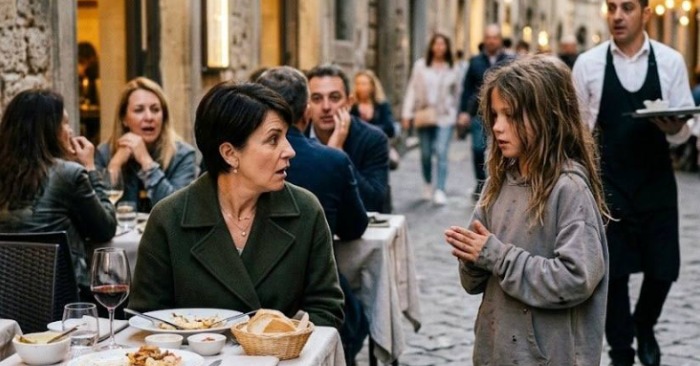
In the middle of a quiet afternoon, in one of the city’s most elegant restaurants, an unexpected moment unfolded.
A small barefoot girl, whose clothes were worn and dusty from the street, appeared beside a table where crystal glasses sparkled, and polished silver reflected the sunlight streaming through the tall windows.
With her chin raised, she looked straight at the woman sitting there.
Her voice trembled slightly, but her words rang clear.
“Excuse me… may I eat what you don’t eat?”
For a brief moment, it seemed the entire restaurant fell silent.
None of the nearby guests could have guessed that this simple question would soon change two lives in a way neither of them could have imagined.
Victoria Harrington was a woman accustomed to attention.
SHE ENTERED ROOMS THE WAY SHE HAD LEARNED OVER DECADES WHILE BUILDING HER SUCCESS — CALMLY, CONFIDENTLY AND COMPOSED, WITH THAT QUIET AUTHORITY THAT CHARACTERIZES A PERSON WHO RARELY HAS TO EXPLAIN HERSELF.
That afternoon, she stepped into the restaurant with the same effortless confidence.
The head waiter recognized her immediately and greeted her. She chose a secluded corner table, briefly glanced through the menu, then ordered grilled sea bass with a glass of champagne.
Every detail of the scene spoke of control, wealth, and elegance.
In another part of the city, however, ten-year-old Maya Alvarez walked barefoot on the scorching asphalt.
Her feet were cracked from months of going without shoes, her skin covered in dust from the nights spent in alleys, abandoned stairwells, and doorways where she found temporary shelter.
Her tangled dark curls framed a face drawn thin by hunger.
She could no longer remember when she had last eaten a proper meal.
OVER THE PAST YEAR, SHE HAD SLOWLY LEARNED HOW TO SURVIVE THE RHYTHM OF THE STREETS — WHERE BAKERIES THREW OUT UNSOLD BREAD AT NIGHT, WHICH MARKETS LEFT REMAINS AFTER CLOSING, AND WHICH CORNERS WERE THE SAFEST WHEN NIGHT FELL.
Even with these small strategies, hunger was never far away.
The restaurant stood like a boundary between two completely different worlds.
Inside there were gleaming floors, cool air, and people who never had to worry about their next meal.
Outside was the life Maya knew.
But hunger can erase invisible boundaries.
When the glass doors opened and the cool air touched her face, Maya paused only for a moment before stepping inside.
The sudden silence of the dining room was overwhelming.
CONVERSATIONS SLOWED. SOME GUESTS LOOKED WITH DISAPPROVAL. OTHERS COMPLETELY AVOIDED HER GAZE.
Maya moved carefully between the tables until she reached Victoria’s table.
She nervously clasped her hands and lowered her gaze.
“May I eat what you don’t eat?” she asked quietly.
She did not raise her voice.
She did not beg loudly.
She simply told the truth.
Victoria looked up.
AT FIRST, ANNOYANCE FLASHED ACROSS HER FACE.
Such an interruption did not belong in a place like this. She could have easily called the manager, asked security to escort the girl out, and continued her meal as if nothing had happened.
But then she truly looked at her.
At the thin shoulders trembling from effort.
At the dust covering her bare feet.
And at the quiet dignity with which she had brought herself to ask for help.
Something deep within Victoria stirred.
Many years earlier, she herself had been a hungry child.
SLOWLY SHE SET THE CHAMPAGNE GLASS DOWN ON THE TABLE.
“Sit down,” she said.
Even she herself was surprised by the gentleness in her voice.
Maya blinked, unsure if she had heard correctly.
Victoria reached across the table and pulled out the chair opposite her.
“I said, sit down.”
The little girl carefully sat down, still not sure whether the moment was real or would soon disappear.
Victoria signaled to the waiter.
“ANOTHER PLATE, PLEASE,” SHE SAID CALMLY. “AND SOMETHING SIMPLE.”
Whispers spread through the restaurant. Some guests watched curiously, others with open disapproval.
Maya ate slowly, carefully, as if every bite might disappear if she moved too quickly.
There was no greed in her movements — only quiet hunger.
Under the table, Victoria quickly sent a message to her assistant.
Bring clean clothes. For a child.
When the meal ended, Victoria stood up.
“Come with me,” she said gently. “I want to help you.”
THE HEAD WAITER WATCHED SILENTLY AS THE TWO OF THEM WALKED TOGETHER TOWARD THE DOOR.
Some guests even began to clap quietly, though they themselves did not know exactly why the moment felt so powerful.
Outside, the driver opened the car door.
Maya sat beside Victoria, keeping her hands tightly in her lap.
“Where are we going?” she asked quietly.
“To my home,” Victoria replied. “But you can leave at any time if you feel uncomfortable.”
The word “home” sounded strange to Maya.
Soon they arrived at tall iron gates that slowly opened, revealing a vast mansion surrounded by gardens.
AT THE ENTRANCE, CLAIRE, VICTORIA’S IMPECCABLY DRESSED ASSISTANT, WAS WAITING FOR THEM.
“Is this the girl?” she asked coolly.
“Yes,” Victoria replied calmly. “She needs a shower, clean clothes, and dinner.”
Within an hour, Maya experienced something she had not felt in months.
Warm water ran over her skin.
Soft pajamas.
The scent of shampoo instead of dust.
Meanwhile, Victoria sat alone in her study with a glass of whiskey in her hand, which she did not touch.
MEMORIES OF HER CHILDHOOD RETURNED.
Selling candy at bus stops.
Being sent home from school when tuition was not paid.
Nights when hunger would not let her sleep.
And the stranger who once bought her a meal when she had nothing.
A kindness she had never forgotten.
Claire broke the silence.
“You’re bringing a street child into your home?” she asked skeptically. “What if she steals?”
VICTORIA DID NOT EVEN LIFT HER HEAD.
“She won’t,” she said quietly.
“And even if she did, I wouldn’t care. I didn’t bring her here for things.”
That evening, Maya ate two plates of food in the kitchen.
“Tomorrow,” Victoria said gently, “we’ll go to a doctor. And if you’d like, we’ll enroll you in school.”
Maya hesitated.
“What if I’m bad at school?”
“Then we’ll learn together,” Victoria replied. “But the street doesn’t have to be your only future.”
FOR THE FIRST TIME IN MONTHS, MAYA SMILED.
The following weeks were difficult.
Reading seemed hard. Numbers confused her. Sometimes the classroom felt like too much.
But she did not give up.
A girl named Lily became her first friend.
A private tutor stayed late into the evening to help her learn to read.
Victoria shortened her business trips and canceled meetings to spend more time helping Maya.
However, Claire grew colder and colder.
FINALLY, SHE CROSSED A LINE.
One afternoon, she accused Maya of stealing an expensive bracelet, which she had secretly hidden in the girl’s drawer.
For a brief moment, doubt flashed across Victoria’s face.
That moment broke something inside Maya.
But that night, Victoria reviewed the security camera footage.
The recording clearly showed that Claire had hidden the bracelet.
The next morning, Claire was dismissed immediately.
She did not leave quietly.
SOON VICTORIA’S COMPANY BECAME THE TARGET OF INVESTIGATIONS. ACCOUNTS WERE FROZEN. RUMORS SPREAD THAT SHE HAD LOST CONTROL OF HER COMPANY.
Claire had been planning her revenge for years.
To protect Maya from the chaos, Victoria temporarily placed her with foster parents.
But Maya ran away and came back.
“I don’t want safety if it means losing you,” she cried.
Victoria then understood that protecting Maya meant more than wealth.
So she made a decision that shocked everyone.
She left the mansion.
The luxury.
The boardrooms.
They moved into a small downtown apartment.
Two bedrooms. No fountains. No staff.
But there was peace.
Maya started attending a public school and later began helping at a small neighborhood bakery owned by a kind man named Daniel.
She learned how to knead dough.
How to laugh again.
MEANWHILE, VICTORIA’S FINANCIAL PRESSURE GREW. HEADLINES QUESTIONED HER JUDGMENT.
Then one day, Maya posted a simple message online about the afternoon when she asked a stranger for leftover food — and found something much greater.
The story spread quickly on the internet.
Public support grew rapidly.
The investigations revealed Claire’s manipulations, and she eventually confessed.
Victoria cleared her name.
But she no longer wanted her old life.
Instead, together with Maya, she founded a nonprofit called Second Chance House — a place for girls who have nowhere to go.
LAUGHTER SLOWLY RETURNED TO THEIR HOME.
One afternoon, while sorting through old papers, Victoria discovered a letter written by her late father.
The letter revealed a secret.
Years earlier, Victoria’s estranged sibling had a daughter, Maya, who disappeared as a child.
DNA tests confirmed the truth.
The homeless little girl she had helped was not a stranger.
She was her family.
A lawyer later revealed that Victoria’s father had left part of his fortune to an unknown granddaughter — if she were ever found.
MAYA LISTENED QUIETLY WHEN SHE HEARD THE NEWS.
“What should I do with it?” she asked.
Victoria smiled gently.
“Use it wisely,” she said. “So that no one can ever push you down again.”
Maya showed her a drawing she had made.
It depicted a bright building filled with light.
At the top she had written:
Second Chance Home.
“I DON’T WANT A MANSION,” MAYA SAID QUIETLY. “I WANT OTHER GIRLS TO FEEL WHAT I FELT THAT DAY.”
Victoria embraced her — not as a benefactor, but as an aunt.
The miracle was never the inheritance.
But the courage of a hungry little girl who dared to ask a simple question.
And from that moment on, neither of them had to face the world alone anymore.