For eleven years I ignored my grandpa’s birthday calls, while convincing myself: I am too busy for his old-fashioned, “a little too much” habits. Then one day in June the call didn’t come. When I finally got into the car and drove to him, the smoke-blackened walls and the broken windows told a story that made my heart skip.
Hello, I’m Caleb, 31 years old. It’s hard to write this, but I have to get it out of me, because maybe someone else is making the same mistake that I made.
My grandpa, Arthur, raised me after my parents died in a car accident when I was seven years old. I barely have any memories of my parents.
I only remember the smell of my mother’s perfume and my father’s deep laughter filtering out from the garage when he was working on old cars.
But Grandpa Arthur? He became everything to me.
He was a reserved, firm-handed, old-fashioned man who believed in a firm handshake, in work, and in a man keeping his word. Yet… he was the center of my childhood.
Every morning I woke up to the strong smell of black coffee drifting into our little house. He sat on the porch in his favorite wooden chair and waited for me to shuffle out in my pajamas.
“Good morning, sleepyhead” — he said, ruffling my hair. — “Ready for today’s adventure?”
AND THERE REALLY WERE ADVENTURES.
And there really were adventures. He taught me to fish in the creek behind the house and to take care of the vegetable garden.
“Plants are like people, Caleb” — he said while kneeling into the soil beside me. — “Each of them longs for something different so that it can grow. Your job is to pay attention and give them what they need.”
But what I remember most vividly are his stories.
After dinner we sat out on the same porch, and he told me about our family, about his own childhood, and about what adventures he had when he was young.
That was the golden age of my life. I felt safe. Loved. As if that little house with the creaking floor and the faded wallpaper had been the most stable place in the world.
Then I turned 17, and something changed.
Maybe it was simple teenage rebellion, but it could also be that I began to see how different our life was compared to my friends’. Their parents were younger, drove newer cars, and lived in houses that did not smell like “old wood” and mothballs.
Over time… I began to feel ashamed.
WHEN MY FRIENDS WANTED TO COME OVER, I SUGGESTED WE MEET SOMEWHERE ELSE.
When my friends wanted to come over, I rather suggested we meet somewhere else. If Grandpa came to pick me up from school with that ancient pickup truck of his, I asked him to drop me off a block away.
When I graduated and went to university, I told myself: this is natural. Children grow up and move away… that’s how life goes, right?
But deep inside I knew that I was running from something. I was running from the shame I felt because of our simple life. I was running from his old-fashioned rules. I was running from the house that suddenly seemed too small and too outdated for the “big man” I imagined myself to be at that time.
That was when I started to refuse his birthday invitations.
Every year, on June 6, exactly like clockwork: my phone vibrated.
“Caleb, my son, it’s your old grandpa here” — he said. — “I’d like to invite you to a birthday dinner. I made your favorite roast beef. It would be nice if you came.”
And every year I pulled out some excuse. Exam period. Deadline. Program with friends. My girlfriend’s party. There was always something that became “more important” than one evening with the man who raised me.
“Sorry, Grandpa” — I wrote back. — “I have an insanely busy weekend. Maybe next time.”
ELEVEN YEARS. ELEVEN BIRTHDAYS.
Eleven years. Eleven birthdays. Eleven missed opportunities that I convinced myself did not matter, because life moves forward and I am building my future.
Meanwhile university ended, I got my diploma, I got a decent job in the city, I dated a few women, and I built what I thought was a “successful adult life.”
But every June 6, when I saw his name on the display, my stomach tightened.
“Hi, Caleb, it’s your Grandpa Arthur. I hope you’re well, my son. Today I became a year older again. Can you believe that it’s 78? I made that roast beef that you loved so much as a child. The house is quite quiet these days… it would be nice to see you if you can manage it.”
His voice sounded a little more tired every year. A little more hopeful… but at the same time more and more resigned. And I produced more and more elaborate excuses.
“I can’t come, Grandpa, I have a huge presentation.”
“Unfortunately I’m not even in the city this weekend.”
“I wish I could, but I’m helping Sarah move.”
TWO MONTHS LATER SARAH AND I BROKE UP.
Two months later Sarah and I broke up. I did not tell him about it.
But the guilt always sat inside me like a stone in my chest. I became so practiced at suppressing it that I almost automatically repeated to myself: missing one birthday is not the end of the world.
And Grandpa surely understands. He has to understand. After all, I am building a career.
Then a few months ago something changed. June 6 came and went — and my phone remained silent.
At first I felt relief, because I did not have to invent a new excuse. I did not have to play through that awkward conversation.
But as the days passed, the relief turned into something else.
Panic.
What if he is sick? What if something happened? What if he finally got tired of my excuses and decided not to try anymore?
FOR WEEKS THE THOUGHT HAUNTED ME.
For weeks the thought haunted me. I picked up the phone to call him… then put it down. What should I say?
“Hi, Grandpa, I’m just curious why you didn’t call me on your birthday this year?”
How pathetic would that sound?
But the feeling did not disappear. It gnawed at me during work, kept me awake at night, and followed me every day like a shadow.
Finally, at the end of July, on a Saturday morning, I could not take it anymore. I threw a few clothes into a bag, got into the car, and set off.
I did not warn him in advance. I did not plan. I just drove the two hours back to the small town where I grew up, along roads that my body knew but I had not traveled for years.
When I turned onto the dusty road that led to the house, nostalgia suddenly collapsed over me. I remembered how I rushed down this road on my bicycle and Grandpa waited on the porch with a glass of cold lemonade. I remembered coming home from summer camp, when I saw the house and knew: I am almost home.
Then the house appeared after the bend, and my eyes widened.
THE WHITE SIDING WAS BLACK FROM SMOKE.
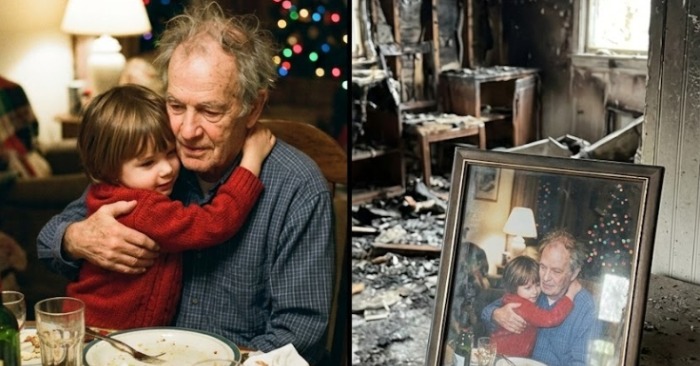
The white siding was black from smoke. The windows broken, the glass shards scattered across the yard like some dangerous confetti. Part of the roof collapsed, the beams pointing toward the sky like broken ribs.
With trembling hands I pulled into the driveway and for a while I just sat there, staring at the ruins of my childhood.
This cannot be true.
I got out and walked with uncertain legs to the porch. The steps were burned and partially collapsed. The rocking chair where he sat in the mornings… nowhere.
As I got closer, the smell hit me: ash and burned wood. Beneath it some metallic, sharp smell that made my throat tighten.
“Grandpa?” — I shouted, my voice cracking. — “Grandpa, are you here?”
Only the wind answered as it blew through the broken windows.
Carefully I stepped onto the remaining porch, testing every board. The front door hung half open, twisted on its hinge.
INSIDE COMPLETE DESTRUCTION.
Inside complete destruction.
“Grandpa!” — I shouted louder. — “Where are you?!”
Nothing. Only the echo of my own voice.
Then a hand gently rested on my shoulder. I spun around, my heart almost jumping out.
“Calm down, son” — said a calm, familiar voice.
It was Mrs. Harlow, the neighbor.
She seemed older than I remembered. Her hair had become completely white, but her eyes were just as kind.
“Mrs. Harlow…” — I gasped. — “What happened? Where is Grandpa? Is he…?”
HE IS ALIVE, DEAR” — SHE SAID QUICKLY, SEEING MY FACE.
“He is alive, dear” — she said quickly, seeing my face. — “But you didn’t know, right? About the fire?”
I shook my head.
“It was three months ago. Probably an electrical fire. It started around midnight in the kitchen. Your grandfather… almost did not make it out.”
My knees almost collapsed.
“But he is okay? He is okay, right?”
“He has been in the hospital since then. He inhaled smoke, his hands and arms were burned. He is healing… but slowly. He is no longer as strong as before, Caleb.”
When she said my name, shame squeezed my chest. How long had it been since I spoke with him? How long since I spoke with anyone from this part of my life?
“The hospital tried to reach you” — she continued quietly. — “They called several times. Your grandfather gave you as the emergency contact. When no one answered…”
THE UNKNOWN NUMBERS.
The unknown numbers. Those many calls that I automatically sent to voicemail because “surely it is advertising” or “I don’t have time.”
The hospital was calling while my grandfather was fighting for his life, and I was too busy to answer.
“My God…” — I whispered, burying my face in my hands. — “I… ignored it.”
Mrs. Harlow did not judge. She just looked at me with understanding.
“He never stopped asking about you. Even when he was barely conscious he kept saying your name. The nurses said he always asked if his grandson was coming.”
I suffocated from guilt. The eleven missed birthdays suddenly seemed like nothing compared to almost missing this. The moment when he truly needed me.
“Can I see him?” — I asked, barely audible.
“Of course, dear. He has been waiting for that.”
BEFORE WE LEFT FOR THE HOSPITAL, MRS.
Before we left for the hospital, Mrs. Harlow led me through the remains of the house. Inside it was even worse.
The kitchen where so many meals were prepared… destroyed. The living room where we watched old westerns together… bare frame, charred furniture, melted belongings.
But in the back bedroom something survived.
In the corner, under the partial protection of a collapsed beam, there was a small wooden box that I immediately recognized. Grandpa’s memory box. Old photographs and letters.
Mrs. Harlow carefully lifted it.
“He asked the firefighters to save this” — she said. — “He said this is the most important thing in the house.”
It was full of photos. Pictures of my parents that I had never seen. Pictures of me as a child, with a toothless grin while Grandpa teaches me to ride a bicycle. Photos of fishing, gardening, baking pies.
And at the bottom… birthday cards.
My cards to him.
All that I sent over the years instead of visiting. Even the most meaningless, hastily signed cards he kept.
“He reads these when he misses you” — Mrs. Harlow said quietly. — “Which is most days.”
Twenty minutes later we were already walking through the sterile corridors of the hospital. The smell of disinfectant could not suppress that smoky feeling that seemed to have come with me from the house.
Room 237.
Mrs. Harlow knocked gently.
“Arthur? Someone came to visit.”
I stepped in.
My grandfather, who in my childhood seemed invincible, now looked small and fragile in the bed. He was thinner than I remembered.
But when he saw me… his eyes lit up. There was such pure joy in them that it almost broke my soul.
“Caleb” — he whispered hoarsely. — “You came. You really came.”
I rushed to the bedside and tears fell from my eyes.
“Grandpa, I am so sorry. I should have answered. I should have been here. I…”
With his unbandaged hand he squeezed mine.
“You are here now” — he said simply. — “That is what matters.”
During the next week I hardly moved from his side. I listened to his stories about how my parents met, about his childhood during the Great Depression, and about what dreams he cherished for our family.
I learned that for years he had been writing a diary, collecting family history and memories that he wanted to leave to me.
“There are things that must be preserved” — he said one afternoon. — “Stories, memories, love… these are what truly matter. A house can be rebuilt, but if a story is lost…”
He did not finish, but I understood.
I almost let his stories disappear forever. I almost let the man who loved me unconditionally slip out of my life without ever knowing how much he meant to me.
Now Grandpa Arthur lives in a small apartment near the hospital. I visit him every weekend. And we are not only rebuilding our relationship — we are also rebuilding our family’s story, story by story.
And every June 6 I am there on his birthday.
There are people who die twice. Once when their body gives up, and once when their story fades into oblivion. I almost let my grandfather die a second time — through negligence, distance, and foolish pride.
But it is not too late. It is never too late to go home, to listen, and to love those who shaped us.
And whenever I smell smoke or see a burned building, I remember the lesson that almost took everything from me: that those who love us do not wait forever… but sometimes, if we are lucky, they wait long enough.
I was lucky. My grandfather waited. And I realized in time how much he is worth.