The nurse pushed an old man’s empty wheelchair into the corridor and told Leo to pack his father’s things, but when he opened the closet, he realized his father had been preparing to leave long before the heart attack.

Leo stared at the half-open closet in the small nursing home room, his throat tight. Just an hour ago, his father Viktor had been alive, grumbling about the overcooked soup and the noisy TV in the common room. Now the bed was stripped, the air smelled of disinfectant, and the silence was so heavy it almost rang.
“Take your time,” the nurse said softly and stepped out, closing the door.
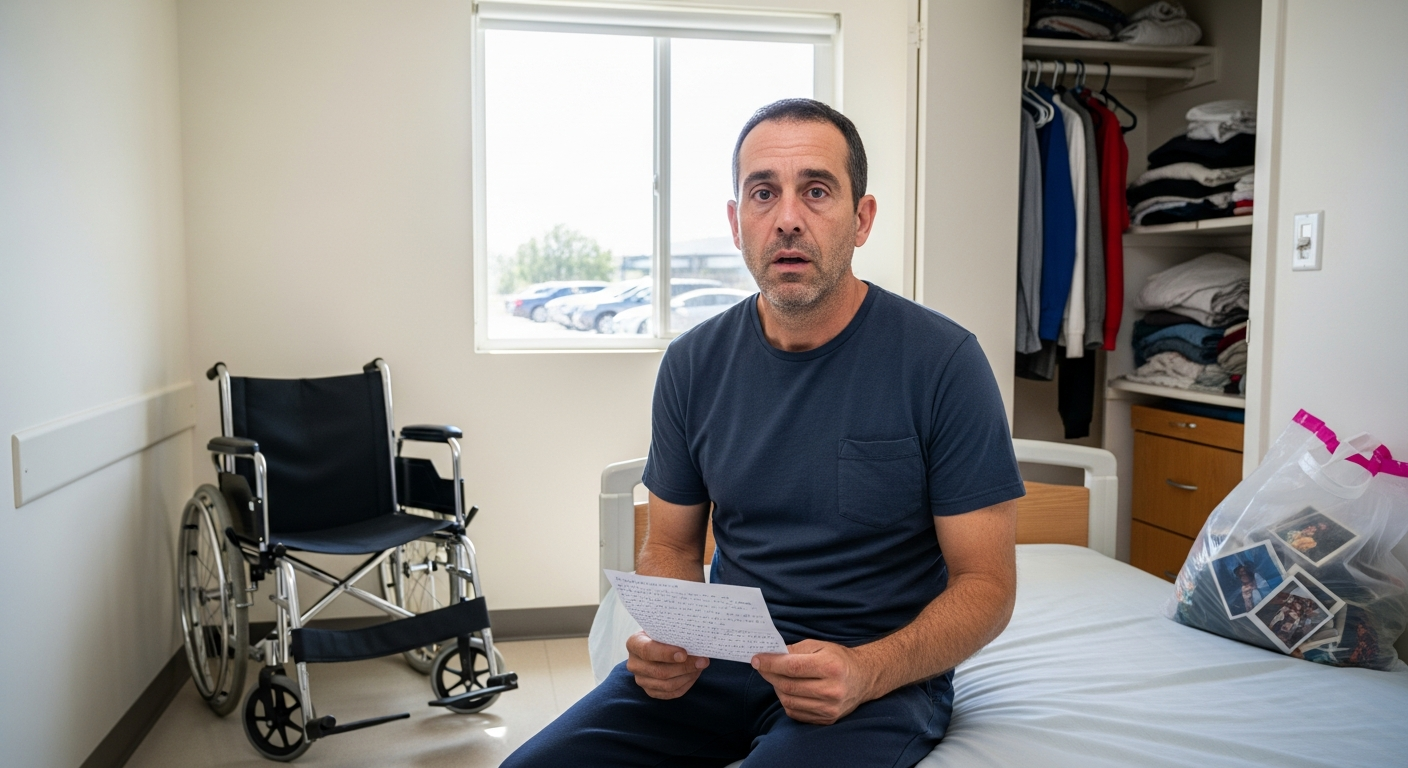
Leo swallowed and pulled the closet door wider. On the top shelf, instead of the usual mess of sweaters, everything was neatly stacked: three shirts folded with military precision, a pair of worn trousers, a small bag with toiletries. Next to it lay an envelope with his name, LEO, written in his father’s clumsy, trembling letters.
His hands shook. For a moment he hated that envelope, hated how thin and light it was. It felt like his father had shrunk into paper.
He didn’t open it yet. He picked up the trousers, recognizing the ones his father always called his “lucky pants”—the ones he wore when he took Leo fishing as a boy, when they’d sit on the riverbank in silence, the only sound the water licking the shore.
Then he saw the plastic bag on the floor of the closet. Inside were four small, carefully wrapped packages, each tied with a rubber band. Leo knelt down and pulled them out. Old bus tickets, worn photographs, a faded children’s drawing of a house and a stick-figure man with a huge smile, holding the hand of a smaller stick figure.
On the back of the drawing, in blue marker, someone had written: “For Daddy. Leo, 7 years old.”
Leo’s chest tightened. He had no memory of giving his father this drawing. He barely remembered being seven at all—only his mother’s tired face, the slammed doors, the shadow of a man coming and going like a storm.
He finally tore open the envelope.
“Son,” the letter began, the handwriting shaky but painstakingly careful, “if you are reading this, it means I did not say enough while I could still talk without that stupid oxygen tube hissing in my ear.”
Leo sat down on the edge of the bed, the mattress dipping under his weight, the paper trembling in his hands.
“You think I left you when you were a boy. I know that. Your mother told you I chose drinking and gambling instead of you. Some of that is true. More than I want to admit. I was a coward. But there is something else you never knew.”
He stopped, his eyes burning. This was the part of the story he had carried like a stone for thirty years: his father walking out with a suitcase and a careless shrug, his mother whispering, “He doesn’t love us enough.”
Leo forced himself to keep reading.
“The night I left, your mother gave me a choice. She said she was tired of my temper, my late nights, my promises. She said: either you leave now and never come back, or I take Leo and disappear. She had already packed your things. I saw your school backpack by the door. I saw your favorite car toy in her bag.
“She wanted to start a new life with a man who had real money, a car, a house. I was the drunk who fixed roofs. She said I would drag you down. She said you deserved better than me.
“She told me: if you love him, you will let him go. You will look like the bad guy so he can grow up without watching his parents tear each other apart.”
The words on the page blurred. Leo blinked hard, his heart pounding in his ears.
“I chose to be the villain in your story,” the letter went on. “I signed the papers. I left so you could stay in that house, in your school, with a full fridge. I left so you could hate me instead of living in war. I thought… I thought when you grew up, you might understand. Or at least, you would be safe enough to hate me.”
Leo pressed the letter to his chest, a sound escaping his throat that was almost a sob, almost a laugh. All these years he had imagined his father walking away because he simply didn’t care. All these years he had rehearsed speeches he would never deliver: I got married without you. I had a son you’ve never met. You missed everything.
“When I saw you again at the hospital last year,” the letter continued, “you stood by the door like a stranger. You didn’t hug me. You didn’t call me Dad. I deserved that. But I also saw something else in your eyes: you looked tired the way I used to look. Like you were carrying too much.
“I wanted to tell you everything then. But you only stayed fifteen minutes. You said you were busy. You said your job was killing you. Funny, isn’t it, how we both let life kill what mattered.
“These past months, I have been packing slowly. I sold my watch to pay the nurse to call you if something happened. I kept your drawing by my bed. I told the other old men here about my son Leo, who is smart and stubborn and better than me in every way.

“If there is anything I can ask, it is this: don’t leave your boy the way I left you, even if you think it will protect him. Sit with him when he is angry. Stay when it is uncomfortable. Tell him the truth, even when it hurts your pride.
“And if, someday, you find it in your heart to forgive the coward who chose to be the bad guy so you could have a room of your own and a full plate—then I will die twice. Once in this bed, and once as the man you hated. Let the second death be mercy.
“Your father, whether you want me or not,
Viktor.”
Leo lowered the letter and stared at the bare wall, the small window with its view of the parking lot. A sparrow hopped on the sill, pecking at a breadcrumb someone had left.
He remembered his mother’s new husband’s polished shoes, the heavy watch, the way the man called him “kid” instead of by his name. He remembered dinners where no one asked how his day went, only if he had done his homework. He remembered nights when shouting still echoed through the house, just in different voices.
All this time, he had blamed the wrong silence.
His phone buzzed in his pocket. A message from his ex-wife, Anna: “Don’t forget, Noah has his school play at 6. He keeps asking if you’re coming.”
Leo’s stomach twisted. How many times had he told his son, “I’m busy”? How many times had he chosen late meetings and glowing screens over Lego towers and bedtime stories?
He looked around the room at the carefully packed life of a man who had been too afraid to fight for himself but had tried, in his broken way, to fight for his son.
Leo folded the letter and slipped it into his wallet, behind his ID. Then he picked up the children’s drawing, smoothed its torn corner, and placed it gently into his bag.
When he exited the room, the nurse looked up. “Did you find everything?” she asked.
“Yes,” Leo said hoarsely. “More than I expected.”
In the parking lot, the daylight felt almost too bright. He got into his car and for a long moment just sat there, both hands on the steering wheel, his father’s words echoing in his mind: Don’t leave your boy the way I left you.
Leo started the engine and pulled out of the lot. His office was in the opposite direction. Without thinking too long, he turned toward the school instead.
He arrived fifteen minutes before the play. Through the classroom window, he saw Noah in a paper crown, fidgeting with nervous excitement, glancing again and again at the door.
Leo stepped inside. His son’s eyes widened, then lit up in a way Leo hadn’t seen in months.
“You came,” Noah breathed.
Leo knelt to be at his eye level. “I’m sorry I missed so many things,” he said quietly. “But I’m here now. And I’m not going anywhere.”
Noah grinned and ran back to his classmates. Leo took a seat on the tiny, uncomfortable chair, feeling its metal dig into his back. For the first time, he was grateful for the discomfort. It meant he had stayed.
While the children stumbled through their lines and the parents clapped too loudly, Leo slid his hand into his pocket and touched the folded paper of his father’s letter.
“I forgive you,” he whispered under his breath, not sure if he was talking to Viktor, to himself, or to the frightened young man his father once had been.
Outside, the evening light poured through the windows, soft and warm. Somewhere, in a quiet nursing home room, an empty bed waited to be changed. But in this small, bright classroom, a different story was finally beginning.