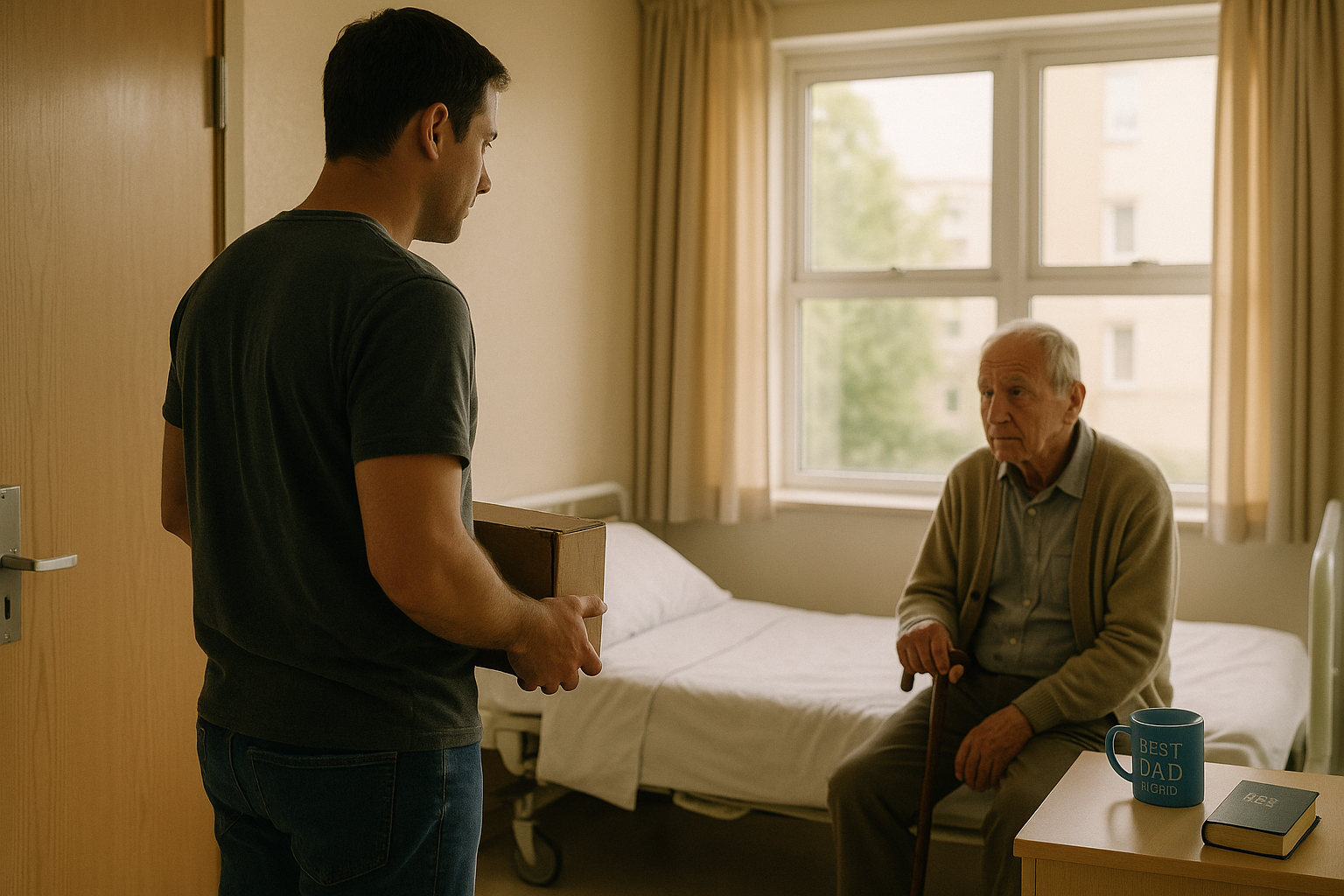
The day Daniel carried a cardboard box to the nursing home and told his father, “I’m just moving some of your things for now,” nobody realized the box held everything the old man still called a life.

Inside were three framed photos, a cracked radio, a worn-out Bible, and a blue mug with a faded inscription: “Best Dad in the World.” The nurse at the reception smiled politely at the mug.
“Is that all?” she asked.
“That’s all he needs,” Daniel answered too quickly, avoiding his father’s eyes.
Martin, thin and slightly hunched, shuffled beside him, gripping his walking stick. His fingers, knotted with age, tightened around the handle as he looked at the doors closing behind them.
“So,” Martin tried to sound cheerful, “this… is temporary, right?”
Daniel’s jaw clenched. “Of course. Just until we finish the renovation at home and… sort some things out.”
There was no renovation. There were, however, a new baby, a wife exhausted from night feedings, and a teenage son who had started slamming doors every time Martin forgot his name for the third time in an hour.
The room they were given was small but clean. A narrow bed, a dresser, a little table by the window. A vase with fake flowers.
Martin sat on the edge of the bed and looked at the cardboard box. “You left Mom’s photo on the shelf in the hallway,” he said after a pause. “Next to the mirror.”
Daniel swallowed. “I’ll bring it next time, Dad. It’s just… I was in a hurry.”
Martin nodded, though his eyes dimmed. He knew that shelf. For thirty-seven years he had kissed his wife’s photo before going to work and when he came back. He could still feel the cold glass against his lips.
“Do they let you cook here?” Martin asked suddenly. “Lena likes my apple pie. She always said it smells like Sundays.”
Daniel looked away. “Dad, my wife is tired. The baby cries all night. It’s… complicated now.”
Martin lowered his eyes to his hands. “I understand. I’m complicated now too.”
The nurse came in, cheerful, efficient, already used to breaking families into two separate worlds. She helped Martin settle, adjusted his pillow, asked routine questions. Allergies? Medications? Nightmares?
Daniel answered for his father, words tumbling out quickly as if he had a plane to catch. He kept glancing at his watch, at the door, at anything but the old man’s face.
When it was time to leave, the silence grew heavy.
“I’ll visit on Sunday,” Daniel said. “I promise.”
Martin forced a smile. “Bring the kids. I’ll show them the garden if they have one. We can pretend it’s our old backyard.”
“They will love that,” Daniel replied automatically.
At the door, Martin suddenly reached out, not touching his son, just hovering his hand in the air.
“Dan?” he said quietly. “If… if I get worse and start forgetting more… don’t be angry, okay?”
Daniel’s throat burned. “Don’t talk like that, Dad.”
“I just don’t want to be a burden,” Martin whispered.
“You’re not a burden,” Daniel lied, and the lie stung both of them.
He left with his hands empty. The cardboard box stayed in the room. And with it, so did the last illusion that Martin would ever go back home.
The first Sunday, Daniel came with a bag of fruit and a plastic container of his wife’s lasagna. Martin didn’t touch the lasagna but asked about the baby, about school, about whether the apple tree in the yard had bloomed.
The second Sunday, Daniel was late. The third, he sent a text to the nurse: “Stuck at work. Tell my father I’ll come next week.”
Weeks merged into months. Texts came instead of visits. Short, hurried, full of excuses. Traffic. The baby is sick. Presentation on Monday. Next weekend for sure.
Martin waited every Sunday anyway. He put on his best shirt, the one Lena had ironed for church years ago, and sat by the window with the blue mug in his hands. The nurses stopped asking if his son was coming. They had learned to recognize that particular kind of hope.
Sometimes Martin got confused and asked the nurse to help him call his wife. “Lena will scold me if I miss Sunday lunch,” he would say.
“Lena passed away eight years ago, Mr. Harris,” the nurse would remind him gently.
Martin would frown, then nod slowly. “Right. The accident. Daniel drove her to the hospital. He was only twenty. I always thought I would die first.”
One rainy afternoon, Martin asked another resident for a sheet of paper. His hands trembled as he wrote.
“Dear Dan,” the letter began, though he crossed out “dear” and simply wrote “Dan.”
“I’m sorry I’m old. I’m sorry I ask the same questions. I’m sorry I walk slowly and forget where I put my glasses. You think I don’t notice, but I see how tired you are. You gave me this room so I don’t disturb your nights. Thank you for thinking of your children. I did the same once for you.
If you can’t come, it’s okay. Just tell me. I will still sit by the window on Sundays. I’ll imagine you are late because of traffic, not because you are tired of me. That thought hurts less.
If I ever was hard on you, forgive me. Being a father is easier when your child is small and thinks you are a hero. It’s harder when he grows up and you become the one who needs help.
Don’t feel guilty, Dan. Every tree that gives shade one day becomes just an old trunk in the yard. People walk past it and don’t even notice they once rested under its branches.
I was happy to be your tree.
Dad.”
He read the letter three times, then folded it and placed it in the Bible. He didn’t ask anyone to mail it. Somewhere inside, he knew the words were not for his son but for the part of himself that still believed in Sundays.
The twist came on an ordinary Tuesday.
Daniel was in the car, stuck at a red light, scrolling through emails. A message from an unknown address slipped into his inbox: “Reminder: Outstanding balance for room 214.”
He frowned, opened it, and saw his father’s name. The bill. The numbers. The polite threat that if payment wasn’t made, other arrangements would have to be discussed.
Only then did he realize he hadn’t visited in nearly five months.
He called the nursing home reception, irritated. “Why did you send me this by email?”

A pause. “Sir, we’ve been trying to reach you for weeks.”
“Well, I’m here now. How is my father?”
Silence on the other end.
“Mr. Harris,” the woman finally said, “didn’t anyone… tell you?”
The steering wheel went cold under his hands.
“Tell me what?”
“Your father passed away two weeks ago. Peacefully, in his sleep. We called, left messages. The number we had didn’t connect. We sent a letter…”
Daniel’s breath stopped. “No. No, that’s impossible. I—I was going to visit on Sunday.”
“I’m very sorry. He kept asking if you were coming. Right up until…” Her voice broke off.
“What… what about his things?” Daniel whispered.
“There wasn’t much. Some clothes. A Bible. A mug. We kept the personal items. We were waiting for you.”
That evening, Daniel walked down the same corridor, but now every step echoed like an accusation.
Room 214 was already half-cleared. The bed stripped, the walls bare. Only the bedside table remained untouched. On it, the blue mug, carefully washed. Inside lay the folded letter, yellowed at the edges from being opened and closed many times.
Daniel recognized his father’s handwriting at once. His knees weakened as he read.
He sank onto the edge of the empty bed, clutching the paper, while tears he hadn’t shed even at his mother’s funeral finally broke free.
“I was going to come,” he whispered into the silence. “I was just… busy.”
Busy living a life his father had once worked three jobs to give him.
A nurse entered quietly. It was the same woman from the first day.
“He wore that shirt every Sunday,” she said softly. “Said his son liked it. He always sat by the window, Mr. Harris. He didn’t want us to feel sorry for him. He said, ‘My boy has his own family now. That’s how it should be.’”
Daniel pressed the letter to his chest. “I left him here,” he choked out. “I said it was temporary.”
The nurse sighed. “You’d be surprised how many times I hear that word.”
He took the mug, the Bible, the letter. The box they gave him on the way out was smaller than the one he had brought months ago. It held everything his father owned, everything that remained of a man who had once seemed too strong to ever fit into a single room.
At home, his wife met him at the door. “How was he?” she asked carefully.
Daniel couldn’t answer. He simply put the blue mug on their kitchen table and the letter beside it. Their teenage son, Leo, wandered in, curious.
“Grandpa’s?” he asked, touching the mug.
Daniel nodded. “He used to drink tea from it every morning.”
Leo shrugged. “I don’t really remember him much.”
The words pierced deeper than any accusation. Because they were true.
That night, while the house slept, Daniel sat alone at the table, the letter unfolded once again. He read it silently, lips moving over the sentences his father had written with shaking hands.
“I was happy to be your tree.”
Outside the window, the old apple tree in their yard stood dark against the sky. Daniel suddenly remembered being five, climbing those branches, his father’s hands always ready below to catch him.
Now, there were no hands. Only a blue mug, a folded letter, and a silence that would never be filled.
In the morning, Daniel woke his son earlier than usual.
“Get dressed, Leo,” he said quietly. “We’re going somewhere.”
“Where?” Leo grumbled.
“To the cemetery,” Daniel answered. “To meet the man who once carried you on his shoulders for an entire afternoon because you were afraid of the grass.”
Leo blinked in surprise.
“Is it really necessary?” he muttered.
Daniel looked at him, seeing his own impatience, his own excuses.
“Yes,” he said softly. “It’s necessary before you also start saying, ‘I was just too busy.’”
He took the mug, washed it carefully, and filled it with fresh flowers from the yard. It looked almost out of place, bright and alive, against the memory of the nursing home’s gray walls.
At his father’s grave, Daniel placed the mug on the stone and laid the letter beneath it, protected from the wind.
“I’m sorry, Dad,” he whispered. “You weren’t a burden. You were my shade. I just forgot how much I needed it until it was gone.”
The wind rustled the leaves of the trees above, and for a moment, very briefly, it seemed to him that the branches swayed in answer, like a hand raised in forgiveness.
Most people walked past the old trees of the cemetery without looking up. Daniel did not. Not anymore.
Because once you’ve packed a whole life into a cardboard box and left it in a small room, you never look at any old tree—or any old man—the same way again.