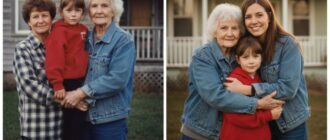
The day Daniel put my old suitcase on the sidewalk with a note that said “Free” I thought my own son was giving me away too. The brown leather case had traveled with me from our village to the city, from the city to a foreign country, and finally to this quiet street where I now lived in his spare room. It was scratched, tired, with a broken handle—much like me.

“Mom, nobody’s giving you away,” Daniel said, seeing my face. “It’s just junk. We’re decluttering. Remember? Minimalism.”
He smiled, but he spoke quickly, like someone trying to finish an unpleasant task. My granddaughter Lily, ten years old with serious eyes, hovered behind him.
“Can I keep the suitcase?” she asked suddenly.
Daniel sighed. “Why? It’s falling apart.”
Lily looked at me instead of him. “Grandma likes it. She told me stories about trains and snow and how she slept on top of it once in a station.”
I had told her that, on one of the nights when the house was quiet and Daniel and his wife Emma were still at work. Lily would sneak into my room with her homework and questions about the world, and I would answer with stories.
Daniel rubbed his forehead. “Fine, keep it in the basement if you want. But it can’t stay in the hallway. We’re trying to sell the house, remember?”
That word again: sell. It had floated through every conversation lately like a crow. Sell the house. Move to something smaller. Closer to Emma’s work. Closer to Lily’s school. Farther from me.
Later that evening, I heard them talking in the kitchen. They thought I was asleep.
“Mom is getting more forgetful,” Daniel whispered. “She put the kettle on and then went to water the plants.”
There was a pause.
“She came back before anything happened,” Emma said softly. “It’s just one time.”
“One time this week,” he answered. “We can’t keep watching her every second. I’m drowning at work. You’re working late. Lily needs us too.”
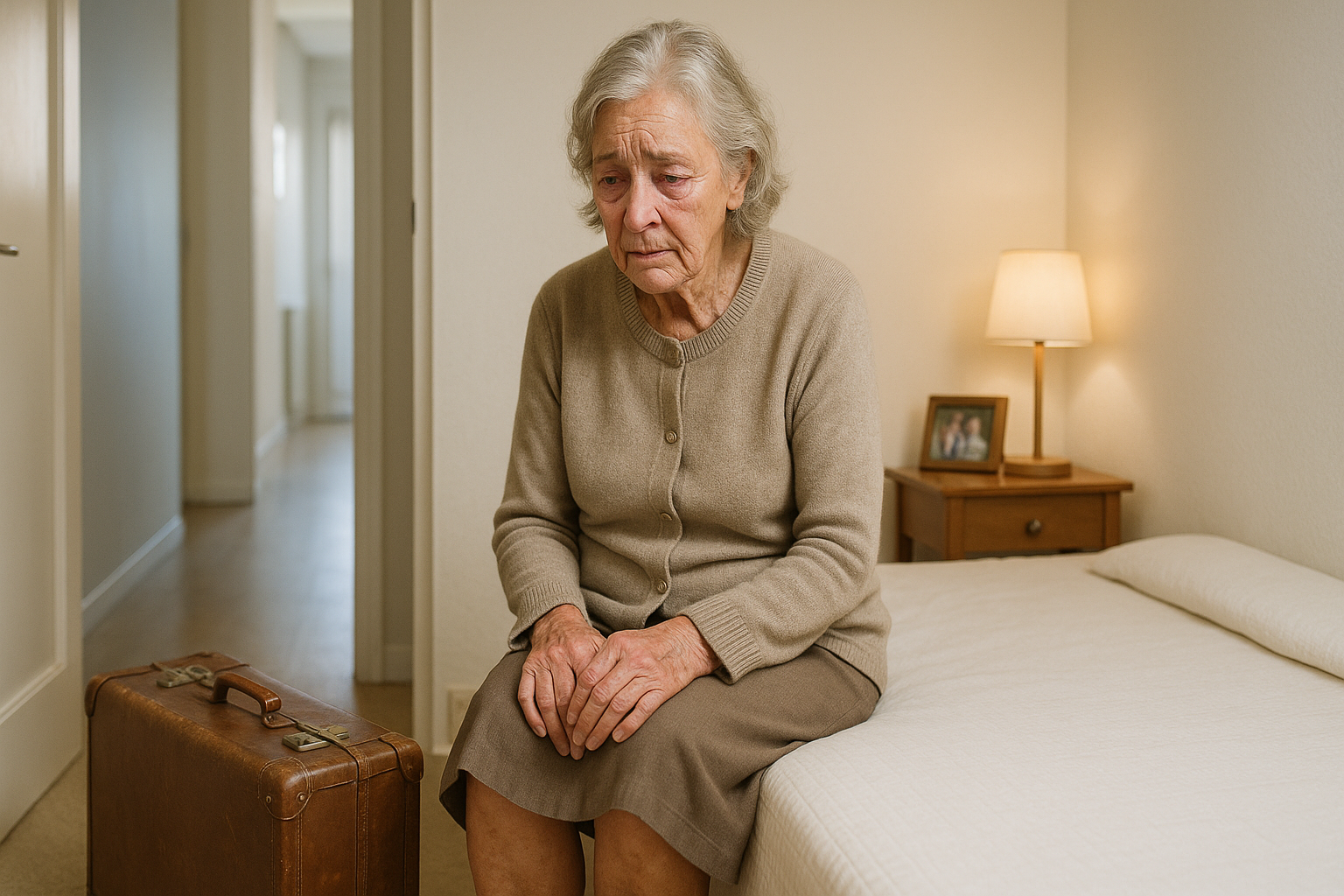
The words settled over me like dust. I sat on the edge of the narrow bed in the spare room—which they now called “Grandma’s room,” though everything in it belonged to them—and stared at the suitcase at my feet. Lily had insisted on carrying it down from the sidewalk.
“Maybe we should look into… a place,” Daniel said finally.
My fingers tightened on the blanket. A place. Not even a name. Just a soft, vague word to wrap something sharp and cold.
Emma’s voice dropped. “Your mom hates nursing homes. You know that.”
“I know,” he said. “But what if something happens while we’re gone?”
What if something happens. What if. What if. Once, he had said, “What if we go to the lake, Mom?” and we ended up with sand in our hair and sunburn on our noses, laughing. Now all his what ifs were about fear.
I lay down without undressing and listened to the house creak. Memories crept in: my late husband Michael carrying that suitcase up three flights of stairs in our first tiny apartment; Daniel, age seven, sitting on it as we waited for the bus; me clutching it when I flew across the ocean alone, a widow, to help my son with his newborn child.
I had thought I was coming here to help. Somehow, slowly, quietly, I had become the one who needed help.
A week later, the twist came like a storm in a clear sky.
I was walking back from the corner store with a bag of apples—Lily liked them sliced thin with cinnamon—when a car horn shrieked. I stepped back automatically, my heart jumping. The driver shouted something I didn’t catch. The bag slipped from my hand, apples rolling into the gutter.
A stranger in a blue jacket ran over. “Are you okay, ma’am?” He picked up the apples and pressed them back into the torn bag.
“I’m fine,” I murmured, but my hands were shaking.
He frowned. “Do you live nearby? Let me walk you.”
I almost said no, proud, stubborn. Then I remembered Daniel’s voice: What if something happens. I nodded toward the house.
Daniel arrived home early that day. He saw the man in the blue jacket leaving and the bruised apples on the table. As I told the story, his face went pale.
“That’s it,” he said quietly. “This is exactly what I was afraid of.”
“Nothing happened,” I protested. “The car stopped.”
He knelt in front of me, his grown man’s hands taking my thin ones. “Mom, you could have fallen. You could have…” His voice broke. He swallowed hard. “I can’t lose you on the street because I was too scared to make a hard decision.”
That night they sat me down at the dining table. Lily sat at the corner, hugging the suitcase like a shield.
“Mom,” Daniel began, “we found a really good assisted living place. It’s not… It’s not what you think. It’s like an apartment, with help if you need it. There are activities, a garden, other people your age.”

My chest tightened. “You’re sending me away.”
“No,” he said quickly, eyes shining. “We’re trying to keep you safe.”
Emma slid a brochure across the table. Smiling gray-haired people, flowers, sunlight. I looked at their printed faces, all of them strangers who had once had kitchens and grandchildren and old suitcases too.
“I raised you alone after your father died,” I whispered. “I worked nights so you could study. I crossed an ocean when you needed me. And now, when I finally slow down…”
Daniel’s face crumpled. “That’s exactly why this is so hard.” His voice shook. “You did everything for me. I don’t want the end of your story to be a fall in the bathroom or a fire in the kitchen while we’re stuck in traffic.”
Silence fell. The clock ticked. Lily’s small voice finally cut through.
“Can I say something?”
Three adults looked at her as if she had appeared from nowhere.
“Why does Grandma have to go alone?” she asked, chin trembling. “Why can’t we go with her?”
Daniel frowned. “Sweetie, it’s not for us. It’s for—”
“I mean,” she rushed on, words tumbling, “what if we visit every day? What if we make a schedule? You go Mondays and Wednesdays, Mom goes Tuesdays and Thursdays, and I go after school. And we bring her suitcase so it feels like her home. And we make videos and call her every morning. Then she’s not being sent away. She’s just… changing rooms.”
“Changing rooms,” I repeated softly.
In that moment I saw Daniel differently. Not as the boy I had sacrificed for, but as a man trapped between love and fear, work and responsibility, his own small family and the mother who had once been his whole world.
“Let me see it,” I said, nodding at the brochure. “But I have conditions.”
Three heads snapped up.
“First,” I said, trying to keep my voice steady, “I choose the room. I am not a piece of furniture you put where it’s convenient.”
Daniel nodded quickly, tears in his eyes.
“Second, the suitcase comes with me. It stays where I can see it.”
Lily hugged it tighter, smiling through tears.
“And third,” I added, looking at my son, “you never again talk about me like I am a problem to solve when you think I am asleep. If you are afraid, tell me to my face. I spent my life being brave for you. Let me be brave with you now.”
The storm inside him broke. Daniel leaned back, covering his face with his hands, shoulders shaking silently. Emma put a hand on his arm—not romantic, just human, shared exhaustion—and then looked at me with wet eyes.
“We’re so tired,” she whispered. “We don’t want to fail you.”
I reached across the table, my fingers trembling, and laid my hand near his, not touching, just close enough that he could feel the warmth.
“You are not failing me,” I said. “You are loving me in the only way you know how right now.”
Two weeks later, I sat on a new bed in a small, bright room. The window looked onto a garden where two women argued cheerfully over roses. My suitcase stood open on the chair, its lining frayed, its pockets stuffed with old receipts and faded photographs.
On the wall, Lily had taped a sign in her uneven handwriting: “Grandma’s Room 2.0”. Underneath she had drawn a tiny suitcase with wings.
There are moments when the ache of not being in my son’s house is sharp. When I hear a kettle whistle in the shared kitchen down the hall, I remember my own stove, my own curtains. I feel like that suitcase on the sidewalk again, with a note that might as well say Free to any passerby.
But every afternoon, without fail, there is a knock. Sometimes it’s Daniel with his tie loosened, eyes tired but smiling. Sometimes it’s Emma with a new book. Most often it’s Lily, bursting in with stories about school, dropping her backpack on the floor and opening the old suitcase.
“Tell me about the station again,” she says. “The night you slept on top of it.”
And so I tell her. About cold floors and long journeys, about waiting and not knowing what comes next, about holding on to the one thing that is yours. Not a house. Not even a room.
A life.
I am not on the sidewalk. I am here, in a small room with a window, a suitcase, and the sound of my family’s footsteps always, always finding their way back to my door.