The old man kept sitting alone on the park bench every evening with a tiny blue backpack, until one day the backpack slipped open and the photo that fell out made Emma sit down beside him and say, “I think I know this child.”

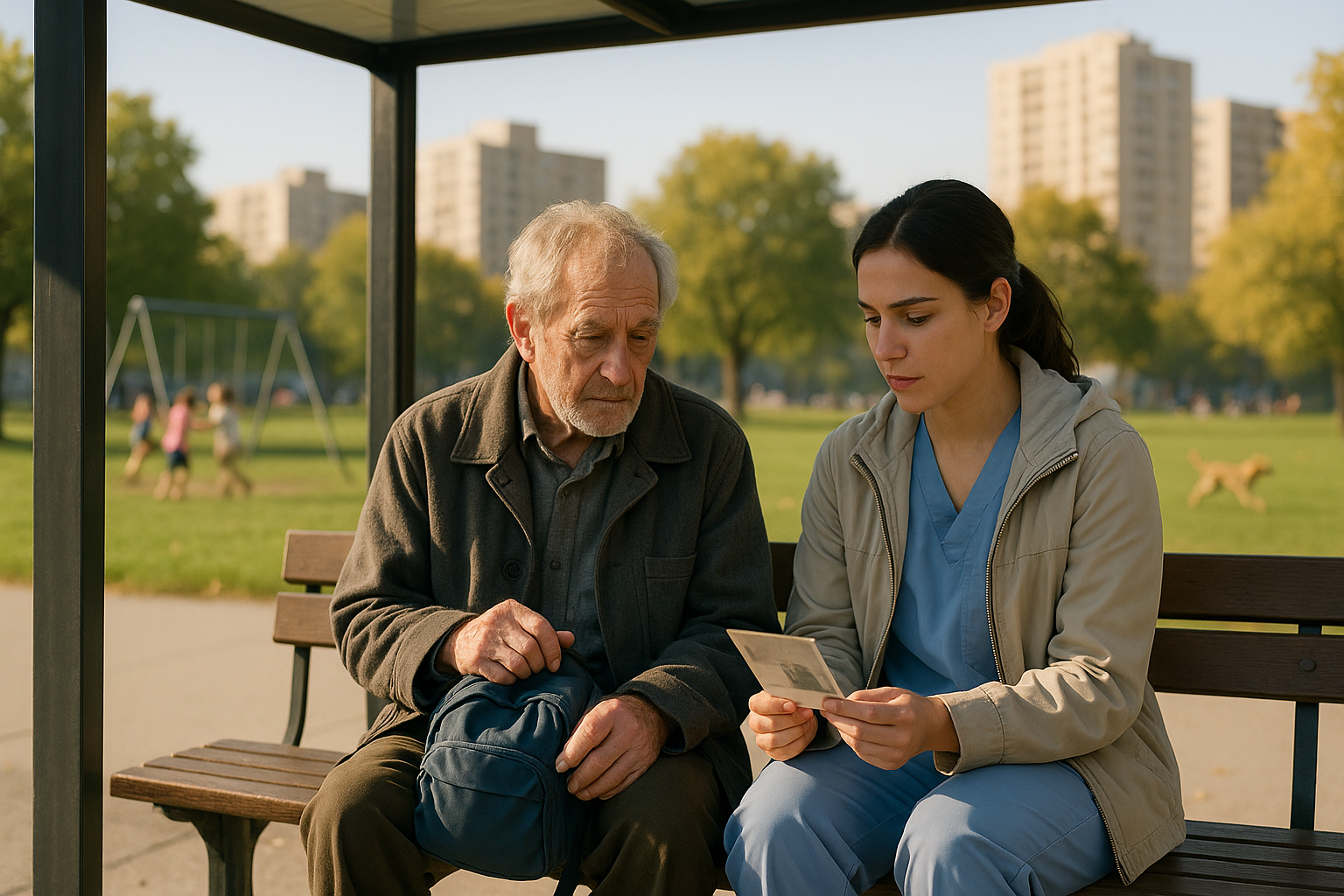
Emma had noticed him for weeks on her way home from the hospital. Always the same bench, always the same hour, always the same worn gray coat and the small blue backpack clutched in his hands as if it held something that might vanish if he loosened his grip.
She was used to sadness. Working as a pediatric nurse meant hearing monitors flatline and mothers cry in waiting rooms. But there was something different about this man. His face didn’t look just sad; it looked… suspended, as if time had stopped for him alone.
That evening, a sharp gust of wind rushed through the park. The man shivered, the backpack slipped from his lap, and the zipper broke open. A few things tumbled out: a tiny pair of socks, a folded paper airplane, and a photo. The photo landed right at Emma’s feet.
She bent down automatically to pick it up, meaning only to hand it back, but her breath caught when she saw it.
A little boy, about four years old, with huge brown eyes and an IV taped to his small hand, grinned at the camera from a hospital bed. Behind him, blurry but unmistakable, stood a younger version of Emma in blue scrubs, holding a stuffed dinosaur.
Her hands started to shake.
“Where… where did you get this?” she asked, her voice barely more than a whisper.
The old man reached for the photo, his fingers trembling. “Please,” he muttered, not looking up. “It’s all I have left of him.”
Emma didn’t let go. “This boy,” she said, forcing herself to breathe, “what’s his name?”
The man finally looked up. His eyes were clouded but sharp, searching her face. “Liam,” he answered. “My grandson. He… he died here. In this city. Eight years ago.”
Emma felt the world tilt. Eight years. A little boy named Liam with brown eyes and an IV. A grandfather who never stopped waiting.
She sank down onto the bench beside him.
“I was his nurse,” Emma said, her voice breaking. “I remember him. He loved dinosaurs and apple juice with two straws. He used to ask me if the stars had hospitals too.”
The old man’s hand flew to his mouth. For a second Emma thought he might faint.
“You knew him?” His voice trembled on the edge of disbelief and something like desperate hope.
Emma nodded, tears stinging her eyes. “He called me ‘the dinosaur lady.’ I… I was with him the night he…” She couldn’t finish. The memories flooded back—the beeping machines, the soft squeeze of a small hand growing still, the exhausted grandfather asleep in the chair, the doctor’s quiet words: ‘We couldn’t reach him in time.’
The man gripped the edge of the bench. “They never let me say goodbye,” he whispered. “I was on the bus. Traffic. My phone battery died. When I got there, they said he was gone. They took him away before I saw him. My daughter… she blamed me. She took all the photos. She said I failed him.”
He swallowed hard, his eyes never leaving the picture in Emma’s hand. “I only have that one. I found it in an old box after she moved away. I come here every evening because this is the bus stop I missed that day. I sit and wait like a fool, as if he might still be late, not gone.”
Emma’s chest ached. She had seen so many grieving families, but she had never thought about the ones who were late, who arrived to find only an empty bed.
“I blamed myself too,” she admitted. “I was the nurse on duty. I thought if I had checked his monitor one minute earlier, if I had called the doctor one minute sooner… Maybe he would have stayed.”
The old man shook his head slowly. “We both live inside that one missing minute,” he said. “But he’s the only one who did not.”
For a while they sat in silence. The park around them was full of life: children laughing by the swings, a dog barking at pigeons, a couple arguing softly by the fountain. And on the bench, two strangers drowning in the same old grief.
Then the twist cut even deeper.
“You said your daughter took all the photos,” Emma asked carefully. “What’s her name?”
The man hesitated, then sighed. “Nina. She left for another country after Liam died. Changed her last name. Said she never wanted to see this city again.”
Emma’s heart stopped.
“Nina… Reed?” she asked, her voice almost inaudible.
His eyes widened. “Yes. Do you know her?”

Emma stared at him, her mind racing. She saw again the young mother who had sat in the hospital corridor years ago, hands clenched, refusing to cry in front of anyone. A woman named Nina Reed who had once grabbed Emma’s wrist and whispered, “If my father hadn’t been late, maybe Liam would still be here. Don’t you dare tell him when it happened.”
“I—” Emma swallowed. “She was Liam’s mother. I mean, of course you know that. But… she was my patient’s mother too. We talked a lot. She asked me not to call you. She said she didn’t want you to see him like that. She blamed you for missing those last minutes.”
The old man’s face crumpled. “She… she told you not to call?”
Emma nodded, guilt washing over her. “I thought I was respecting a mother’s wish. I’ve carried that night with me ever since. I didn’t know you were waiting at this bus stop. I didn’t know you never saw him.”
He pressed his hands over his eyes. His shoulders shook, but no sound came out. It was the quietest kind of crying, the kind that had run out of tears years ago and was now just shaking bones.
“I would have run,” he whispered hoarsely. “Even if I had to crawl, I would have come. I thought they just… moved him too quickly. That it was the hospital’s rule. All these years I thought it was fate. It was a choice.”
Emma’s own voice broke. “A choice I helped keep. I am so sorry.”
The wind rustled the leaves above them like someone turning pages in an old book.
At last the old man lowered his hands. There was a strange calm in his expression, a rawness laid bare.
“You were kind to him?” he asked. “In those last hours?”
Emma nodded, tears streaming freely now. “I read him stories. I let him choose the bedtime song on my phone. He squeezed my hand when he was scared. I told him his grandpa was on his way.” Her voice faltered. “He smiled when I said that.”
The old man’s lips trembled. “Then someone was there,” he whispered. “He didn’t go alone.”
He looked at the photo again, then back at Emma. “I’ve spent eight years hating myself at this bus stop. Maybe… maybe I should have hated the bus, or the traffic, or your hospital. But what good would that do?”
He drew a shaky breath. “If you can carry this guilt for so long and still sit with me, maybe I can carry mine a little differently.”
Emma wiped her face with the back of her hand. “I can’t fix what happened,” she said. “But I can tell you about him. About the way he laughed when the IV pump beeped and he said it sounded like a robot hiccuping. About how he talked about you. He called you ‘Grandpa Leo the Brave.’ He said you were the only grown-up who still knew how to fly paper airplanes properly.”
The old man—Leo—let out a sound that was half sob, half laugh. “He remembered that?”
Emma reached into the backpack and gently picked up the folded paper airplane that had fallen out earlier. “Teach me how to throw it like you did,” she said softly. “You can tell me stories while we try.”
They spent the next half hour by the bench, two clumsy adults tossing paper airplanes that kept diving into the grass. Each throw carried a piece of a boy who loved dinosaurs and stars and late buses that might still arrive.
When the sky began to turn gold, Leo carefully put the socks, the airplane, and the photo back into the little blue backpack. But this time, when he zipped it, his grip around it seemed a shade lighter.
“Will you be here tomorrow?” he asked quietly.
Emma nodded. “Same time. Maybe I’ll bring apple juice. With two straws.”
Leo closed his eyes for a moment, then opened them again. “I don’t know if my daughter will ever forgive me,” he said. “Or you. Or herself. But if you remember Liam’s laughter, and I remember his questions about the stars… then maybe he is not as gone as I thought.”
Emma stood up, then paused. “Do you want me to try to find Nina?” she asked. “I still have an old number in my files. I can tell her what really happened… and that you’ve been waiting.”
Leo looked at the bus stop sign, at the empty road, then back at Emma. There was fear in his eyes, but also something fragile and new.
“Maybe not yet,” he said. “For eight years, every evening was about the goodbye I never had. Tonight… tonight was the first time it felt like a little bit of hello.”
Emma nodded, understanding. “Then we’ll start with hello,” she said. “You, me, and a boy who liked paper airplanes.”
As she walked away, she glanced back. Leo was still on the bench, but he was no longer staring at the road. He was looking at the photo in his hands, lips moving silently, as if he were finally saying all the things he never had time to say.
And for the first time since that long-ago night in the hospital, Emma felt that maybe, just maybe, the minute they both had lost was not the only minute that mattered.