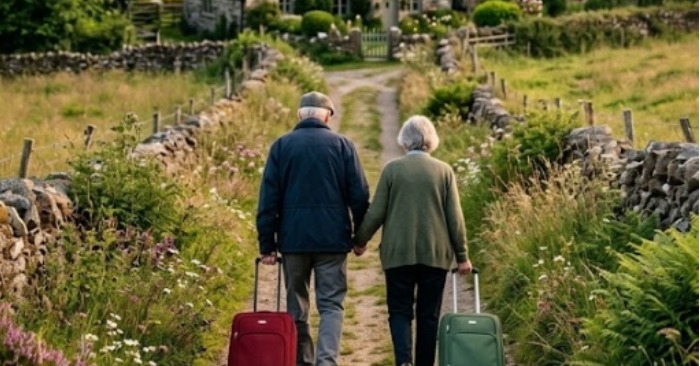
Rosa Ramírez gripped the handle of her red suitcase as if the fate of her entire world depended on that single motion. In front of her, the court officer pressed the seal onto the door of the house that had been her home for forty-three years. The tape snapped taut against the wood with a sharp sound. No one uttered the word “foreclosure,” yet everything spoke of it—the heavy air, the silence of the neighbors watching from afar, and even that autumn day that could not warm a single thing.
Beside her, Armando hoisted the blue suitcase higher on his shoulder and swallowed hard. At seventy-one, his back had carried enough: disassembled engines, heavy toolboxes, endless hours in the workshop… and now the heaviest burden of all: the humiliation of leaving without keys, without a roof, and no one waiting for them in the back seat of the car.
“Where are we going now, Armando?” Rosa asked, her voice breaking as if each word tore another piece from her.
Armando scanned the cobblestone streets of the city—the same old stones Rosa had dashed across to the store so many times, the same stones that had witnessed their children grow. He wished he had an answer. A direction. Anything to cling to. But all he felt was a fatigue that cut to the bone.
“I don’t know, dear… I don’t know anything anymore.”
The worst wasn’t the bank. It wasn’t even the mortgage. It was the children. Fernando, the eldest, didn’t even bother hiding his irritation.
“Figure it out yourselves,” he said, as if all the years, the diapers, the feverish nights, the mad scrambles to get to school, the sacrifices, and the sleepless mornings had long repaid everything he had ever received from them.
Beatriz was even colder.
“IT’S NOT MY JOB TO FIX YOUR MISTAKES.”
And Javier, the youngest… Javier simply didn’t respond. No calls, no messages, nothing. He left behind a silence heavier than any shouting.
They wandered aimlessly. Sat on benches. Quietly watched passing families: laughing children, couples carrying loaves of bread, grandparents holding small hands. Rosa observed them as though they belonged to another life. Yet inside, it burned, because she knew all too well that she had once been that mother—the one who would dash to the hospital at the first fall, who would sit by a fevered bed for an entire week, counting pennies in notebooks, sewing buttons back onto shirts so her children could attend school properly.
“Do you remember when Fernando broke his arm?” she whispered, staring ahead. “We spent the whole night in the hospital.”
Tears welled in Armando’s eyes. He remembered everything. The sharp scent of disinfectant. The tiny hand clinging to his finger. How he had feared as a father, hiding it behind calm words. He remembered Beatriz’s pneumonia, Javier’s nightmares, the table always set even when money ran scarce. There was no beating, no neglect, no humiliation. Only work, patience, and tenderness. And yet, when they needed help, they found only closed doors.
As the evening painted the houses orange, they drifted to the city’s edge, where homes thinned and nature reclaimed the land. Rosa’s legs trembled. Armando searched for a shadow, a nook, any place to sit without the weight of the world pressing down.
“Up there, on that hill,” he said, pointing. “Let’s go higher. Maybe we’ll find a place to rest.”
The climb was merciless. Loose stones slipped underfoot, dry bushes clawed at their clothes, dirt crumbled with each step. Rosa clutched Armando’s arm, Armando clung to the last vestige of his pride—a stubborn pride that refused to let his wife see him give up.
Near the summit, Rosa suddenly stopped. Among the rocks and bushes, as if the mountain itself were hiding something, appeared a shape that didn’t belong: an archway made of stone, and within it, a dark, weathered wooden door.
“Armando… look. That… that can’t just be there.”
Armando adjusted his glasses and stepped closer, cautious but curious. The door was set deep into the rock, as if someone long ago had decided an entrance should be built here. The plants tried to overgrow it, yet could not entirely hide it. Rosa shivered—not from the cold, but from a strange familiarity, though she was certain she had never been here before.
“Is someone living here?” she asked quietly.
Armando knocked gently. The sound echoed unusually, as if behind the door lay not just a hollow, but space, air, rooms. No answer. He tried the handle. Locked. Almost instinctively, he glanced around and noticed a stone lying too neatly on the ground. He lifted it. Beneath it lay an old, rusted key.
Rosa gripped his arm tighter.
“No, Armando… this is going to cause trouble.”
Armando stared at the key as if it weighed more than any iron. Then he looked at Rosa, her empty hands, the suitcases, the darkening sky.
“WHAT TROUBLE COULD BE WORSE THAN SLEEPING ON THE STREET?” he said sadly. “Just one night. Tomorrow we’ll find the owner and explain everything.”
Rosa said nothing. Her silence was agreement. When Armando turned the key, the door groaned open with a long, deep sound, as if the old wood itself were signaling that inside awaited not only refuge, but a truth capable of rewriting their entire lives.
The air that flowed out was cool, damp, yet mingled with an unusually sweet scent—old wood and dried fruit. They stepped cautiously into the darkness. Armando produced the small lighter he always carried and flicked it on. The flickering flame illuminated stone walls, a sturdy wooden floor… and a space that felt more like home than a raw cave.
It was an entire house inside the mountain’s belly.
Rosa inhaled sharply. Worn but sturdy armchairs stood inside, a large table, a kitchen with an iron stove, shelves stacked with preserves, and in the back, the outline of a bedroom. Everything was too orderly for an abandoned hideout. And what unsettled them most: the table was set. Two plates. Two cups. Carefully arranged cutlery. As if someone had paused dinner and could return at any moment.
“This… this is impossible,” Rosa whispered.
Armando found an oil lamp on the table and cautiously lit it. The warm glow revealed even more details, sending shivers down both their spines: neatly folded blankets, chopped firewood, a pantry packed to the brim. This house did not merely exist. It had been lovingly maintained.
On the kitchen table lay a letter, yellowed with age, the handwriting small and precise. At the top, it read: “To my dear children.”
Rosa picked it up with trembling hands and began reading softly, as if lulling someone to sleep.
“Dear children, if you are reading this letter, it means you have finally found your way home…”
The sentences spoke of a woman named Soledad Vargas, a husband named Alberto, and a house they had built, stone by stone, as a refuge when the world turned cruel. She wrote of firewood saved for winter, a pantry always stocked, and a chest tucked beneath the bed holding documents and savings. But most of all, she wrote of waiting—decades of hope for children who never came.
Rosa looked up, tears in her eyes.
“Armando… here lived someone whose children abandoned them, just like us.”
Armando silently surveyed the space, standing as though in a sacred place. And when Rosa finished reading, one sentence hung in the air for a long moment:
“Do not feel guilt for entering here. We built this place out of love, and it is meant to stay home.”
That night, for the first time since the eviction, they ate something warm. Armando lit the stove and heated a can of vegetable soup. Rosa stood at the sink, amazed that real water flowed from a spring. The lamp cast shadows across the stone walls, and fear slowly mingled with something alien: relief. As if this place had been waiting for them.
Yet Rosa could not sleep. In the dark, the name “Soledad” kept returning to her mind. She didn’t know anyone by that name, yet it touched her heart as if it had been living inside her all along.
“Armando…” she whispered. “I feel like I’ve been here before.”
Armando was silent for a few seconds, then spoke gently, as if afraid to break something.
“Rosa… did your adoptive parents ever tell you anything about your biological family?”
The question pierced her like an old thorn. Rosa had been adopted as an infant—or so she had always been told. Whenever she asked more, her parents would divert the topic with uneasy politeness.
“Why do you ask?” she snapped, almost offended.
“Because this house… these letters… and the photograph you found… they are too many coincidences.”
The next morning, sunlight filtered through a narrow crack on the hillside, and they decided to explore slowly, thoroughly. In a closet of the bedroom, they found clean, neatly hung clothes. At the back, a shoebox filled with photographs. Rosa picked one at random—and froze.
The elderly woman in the photo bore an uncanny resemblance to her own features, as if she were seeing herself decades later.
“Armando… look at her.”
“It could be a coincidence,” he said, but his voice wavered.
Then she remembered a line from the letter: “In the master bedroom, under the bed, you will find a chest with important documents…”
They moved the bed. There it was. An old, iron-banded chest. Rosa opened it and nearly stopped breathing. Inside, there was no gold, no jewelry—just folders, photographs, letters tied with ribbons, meticulously organized documents. Evidence of an entire life preserved.
Armando picked up a folder labeled “Records” and began flipping through it, page by page. Then he suddenly stopped.
“Rosa… look at this name.”
Rosa leaned closer.
SOLEDAD VARGAS DE RAMÍREZ.
It hit her like a punch to the chest.
In another folder labeled “Children’s Records” lay three original birth certificates and three adoption documents. One for a girl, two for boys. Years: 1958, 1959, 1960.
Rosa picked up the first page.
And the world tilted beneath her.
“Rosa María Ramírez, born March 15, 1958…”
Her own birth date. Her own name. And her mother’s name:
Soledad Vargas de Ramírez.
A sound burst from her throat that was neither cry nor word, but something deeper, as if her soul itself were speaking for the first time.
“Armando… this is me.”
Armando held her as she collapsed into his arms, trembling as if all the lost years, all the unanswered questions, all the old pain, were falling upon her at once. After forty years of uncertainty, the truth stood before her: her biological mother existed. And not just existed—she had secretly lived in the same city, in an underground house, watching over her, never truly apart.
Inside the chest was a long letter titled “Family History.” Armando read it aloud, for Rosa was crying too hard to hold the papers.
Soledad wrote of drought, hunger, unemployment, the desperation when there was not even enough milk for three children. She described the social worker’s visit, the adoption possibility, and the decision that was at once the most painful and most loving: to let her children go so they could survive, so they could have a future. One condition: they could remain in the same city, watching from afar, never intervening.
Memories began flashing before Rosa’s eyes: a woman in the back row of school ceremonies; a calm, familiar smile in the church; an anonymous benefactor supporting her studies. What once seemed random now aligned perfectly.
The letter also revealed that Soledad had witnessed Rosa’s recent suffering—she had seen the eviction, the children turning away. And she had deliberately left clues so Rosa could find this house when nowhere else remained.
Nothing had happened by chance.
With tears streaming down her face, Rosa took a deep breath—perhaps for the first time in years.
“My mother loved me…” she whispered. “She loved me all along.”
They spent days in the house. Reading letters, touching objects, and Rosa felt something long dormant awaken within her. Behind a shelf, they found a small hidden room: newspaper clippings, photographs of the three children, documents, and three small labeled chests. Inside Rosa’s chest lay a rag doll.
When she held it, she could not explain why, but instantly recognized it. She hugged it instinctively, as if her body remembered, even if her mind could not. Then a diary emerged. Between the pages, Soledad explained that Rosa had not been given up as an infant—but at two and a half years old.
Rosa broke down again. But this pain was no longer just loss—it was understanding. That was why the house felt familiar. That was why dreams returned to it. That was why the sense of home never fully left her.
Armando simply held her. Some loves require no words.
The next step was to locate the siblings. Soledad had left addresses and phone numbers. Rosa hesitated, afraid of rejection—she knew all too well how it feels when your own blood turns away. But she also understood that family doesn’t always arrive on time. Sometimes it is born when you finally dare to reach out.
She dialed the first number. A man’s voice answered.
“Hello?”
“Please… don’t hang up. I’m Rosa Ramírez. I need to speak with your biological mother.”
There was silence on the line. Heavy, uncertain breathing.
“How do you know about this?”
“Because… she was my mother too. We are siblings.”
The conversation ended with a promise. The man, Eduardo, said he would come to them.
The second call was more difficult. Rafael—who had been called Javier in his childhood—answered with a skeptical, harsh tone.
“I don’t want to reopen the past.”
Rosa sent him photographs and documents. Not angrily, not forcefully. Patiently.
The following weekend, Eduardo arrived. When Rosa saw him get out of the car, a feeling overwhelmed her that she had never known—like seeing a face she had never truly known, yet had always carried within. When they embraced, the resemblance erased all doubts. They spent hours reading letters, examining objects, and shared two distinct childhoods that grew from the same root.
Finally, Rafael came as well. His doubts vanished as he entered the house and saw with his own eyes the silent devotion with which their parents had preserved them in love. The three siblings explored the tunnels as if following traces of shared memories.
Then another discovery upended them. A room that had clearly been used recently by someone. Clean clothes. Fresh food. A made bed.
“Someone’s been here… not long ago,” Rafael said.
Rosa’s heart began to beat like a child’s, waiting behind a door for its mother.
They decided to wait.
One night, footsteps echoed down the tunnel. Eduardo raised a lantern. In the light, a small, hunched figure appeared, carrying a bag.
“Who’s there?” a trembling voice asked.
When the light revealed the face, they all froze. White hair. A scarf draped over the shoulder. Eyes that had waited for decades.
Rosa stared, breathless.
“Soledad…” she whispered, as if her soul spoke the name before her lips did.
The woman dropped the bag. Her mouth trembled.
“Alberto…?”
“No, Mother…” Eduardo sobbed. “I’m Eduardo. Your son.”
Soledad leaned against the wall, as if her body could not withstand the happiness. When Rosa and Rafael rushed to her, their four-way embrace overrode everything: three children holding the mother who had loved them from the shadows all her life, and a mother finally touching the faces she had only caressed in her dreams.
Soledad revealed that she had written farewell letters in case her health failed. Her husband, Alberto, had died a year earlier. She had stayed ever since, leaving only for essentials. She waited. Always waited.
THE FOLLOWING MONTHS BROUGHT REBIRTH. Rosa and Armando remained in the underground house, which was no longer a hideout but a home. Eduardo and Rafael took turns caring for Soledad. The woman met her grandchildren, heard their laughter echo through the stone corridors, and finally saw her children together, not as strangers, but as siblings. The dream she had carried all her life had come true.
And Rosa’s children—Fernando, Beatriz, and Javier—also had to face what they had done. One by one, they returned, shame weighing on their shoulders. But they faced no punishment, only lessons. Rosa received them with dignity. She did not beg for love. They understood that love could be rebuilt, but could not be bought with excuses.
Over time, Rosa no longer looked at her story as only pain. She saw it as a slow revelation. That parents are not old furniture to be set aside when inconvenient. Parents are stories. Calloused hands. Invisible sacrifices.
Soledad passed on a cold morning, at peace, surrounded by those she loved. Her last words were barely more than a breath.
“Now… I can find Alberto in peace. Our mission… fulfilled.”
After the funeral, the underground house no longer existed as a sad secret. It became a symbol. A reminder. Rosa, who once stood aimlessly with a red suitcase in hand, finally understood that coming home does not always mean returning to an address. Sometimes it means returning to a truth. To a love that remains love even after decades.
And when someone asked her if she resented the lost years, Rosa always looked at that wooden door—the door that opened for her when every other door in the world had slammed—and simply replied:
“True love does not dwell on what is lost. It dwells on what, against all odds, can still be found. Because as long as there is a heart capable of forgiving and trying again… there is always a way back.”