The day Daniel left his old father at the supermarket “just for ten minutes” and drove away, he was so sure he was doing the right thing that he even turned off his phone to avoid hearing the guilt in his sister’s voice.

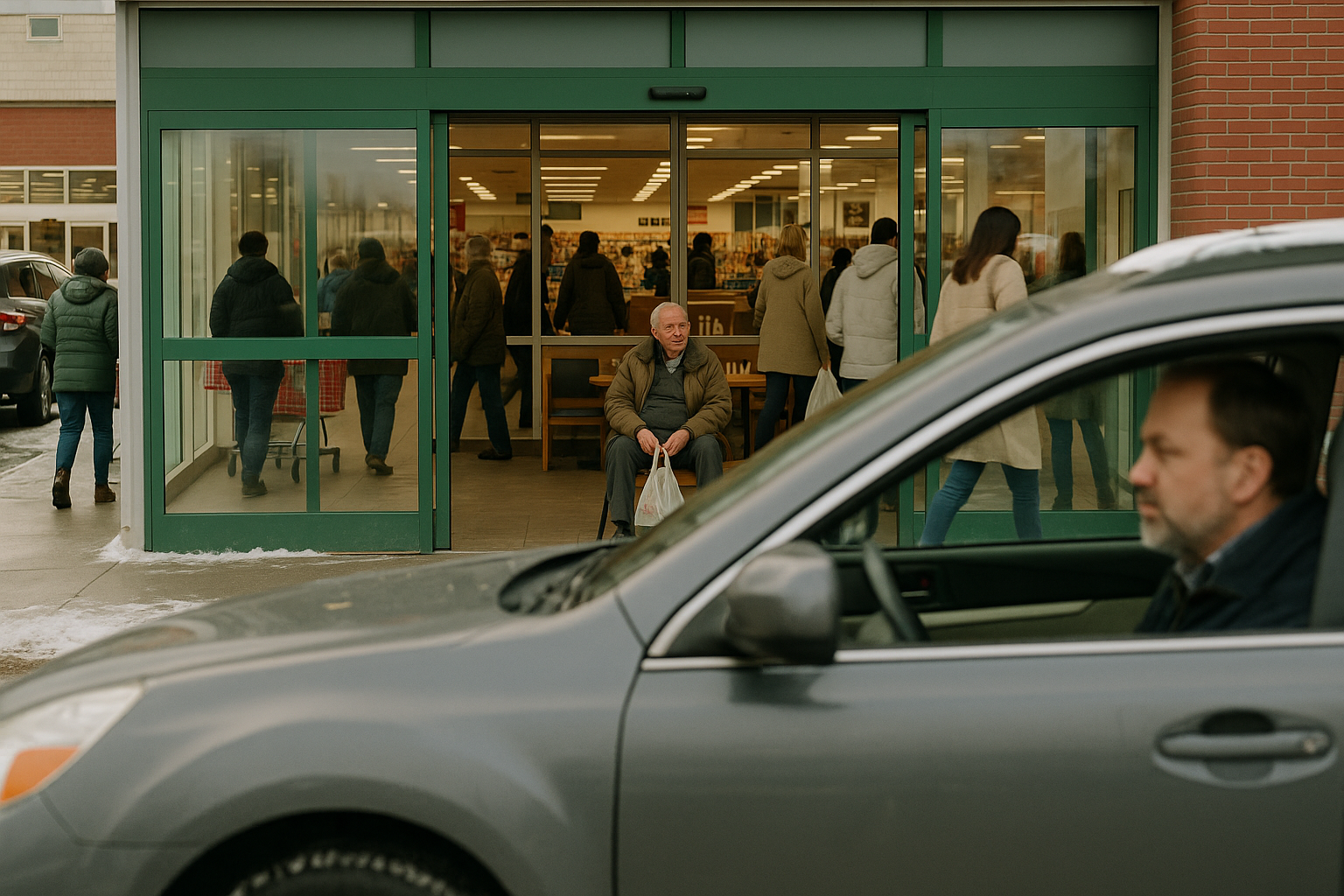
He had rehearsed the lie in his head a hundred times. “Dad, wait for me by the café, I’ll bring the car around.” His father, Mark, nodded obediently, fingers gripping the handle of his worn cane. He always trusted Daniel. That was the worst part.
The automatic doors closed behind Daniel, and the hum of the supermarket faded. He walked briskly to the car, heart pounding against his ribs. This is what the social worker had said: memory clinics, professional care, 24-hour supervision. “You cannot provide this at home, Mr. Harris. It’s not safe.”
But the care home had a waiting list and a price tag that made Daniel’s stomach twist. His little apartment was already overflowing with his eight-year-old son’s things. His wife had left a year ago, saying she was tired of living with “two children and one of them doesn’t even remember my name.”
His father’s dementia had crept in slowly, then all at once. First, forgotten keys. Then, water boiling dry on the stove. Finally, the phone call at 2 a.m. from the police: they had found Mark wandering in his pajamas, confused, shivering.
Now, in the supermarket parking lot, Daniel unlocked the car and slid into the driver’s seat. His hands shook. He placed his phone face down on the passenger seat and started the engine. “Ten minutes,” he whispered. “They’ll find you. Someone will help you. Someone better than me.”
He drove away.
For the first five minutes, he stared straight ahead, knuckles white on the steering wheel. The city blurred into gray. He tried not to imagine his father sitting on the bench near the café, watching the doors, glancing at the clock on the wall, trusting.
At the seventh minute, the guilt began to talk louder than the engine. He heard his sister’s voice, Emma, from her hospital bed two weeks earlier: “Promise you won’t put him away like a bag of trash, Danny. Promise me.” She had lung cancer, stubborn and fast. She was the one who used to take care of their father, the patient one, the kind one.
“I won’t,” he had said, holding her cold fingers.
At the twelfth minute, he reached the bridge out of town. The river below reflected the pale winter sun. A notification flashed on his phone screen, even though it was muted: a message from the care home. He glanced at it at the red light.
“Mr. Harris, we are deeply sorry. Due to a sudden outbreak, we cannot accept new residents for at least three months. We know this is difficult…”
For a moment, the world narrowed to that one sentence. Three months. No place. No help.
Daniel’s breath caught. The car behind him honked. The light had turned green. He didn’t move.
Three months.
His father’s face appeared in his mind with painful clarity: confused, apologetic for being confused. “I’m sorry, son,” he would say, every time he forgot Daniel’s name. “It’s like the words fall out of my pockets.”
The driver behind him honked again, longer this time. Daniel pulled over to the side of the road, turned off the engine, and grabbed the steering wheel with both hands as if he could squeeze the decision out of it.
This was the twist he hadn’t prepared for: there was no care home waiting. There was no professional solution. There was only a frail old man sitting on a bench in a supermarket, and a son who had just abandoned him like unwanted groceries.
His chest hurt. He fumbled for the phone, hands clumsy, and finally turned it on fully. Missed calls from an unknown number, a voicemail from the supermarket manager, and one text from a stranger: “Are you the son of an elderly man named Mark? He seems lost. Please contact the store.”
Daniel’s entire body went cold.
He started the car with shaking hands and swerved back into traffic, heart thundering. Every red light was an accusation. Every minute felt like an hour stolen from his father’s last years of clarity.
When he finally pulled back into the supermarket parking lot, his stomach lurched. He half-expected flashing lights, police, an ambulance. Instead, there was only the quiet chaos of carts and people and the familiar sliding doors breathing in and out.
He ran inside.
There, by the small café with its sticky tables, sat his father. His cane leaned against his knee. His hands were folded on top of a plastic bag with a loaf of bread sticking out. Next to him stood a young woman in a red staff vest, talking softly.
Mark looked up first.
“Daniel,” he said clearly, with a smile that almost broke his son in half. “There you are. I thought maybe I got lost, but this kind young lady said you would come back.”
The woman turned, eyes sharp, measuring. “Are you his son?” she asked.
Daniel nodded, breathless. “Yes. I’m… I’m sorry. I—”
“We called the number on his card,” she said, pointing to the emergency contact card peeking out from his jacket pocket. “He was a bit confused. Said you went to get the car. That was… almost an hour ago.”
An hour.
Daniel swallowed. “Traffic,” he whispered, the lie sour on his tongue. Then it cracked. “No. No, that’s not true. I… I panicked. I didn’t know what to do.”

The woman’s gaze softened, but only slightly. “He was scared,” she said quietly. “Kept saying, ‘My boy will come back. He always comes back.’”
Daniel’s legs almost gave out. He crouched in front of his father, trying to catch his eyes.
“Dad,” he said, voice breaking. “Did you… Did you think I left you?”
Mark blinked slowly, then shook his head. “No, no,” he said, patting Daniel’s shoulder clumsily. “You’re a good boy. You always have been. Sometimes you forget things too, hmm?” He chuckled. “We’re both getting old.”
The mercy in those words hurt more than any accusation.
Tears blurred Daniel’s vision. He pressed his lips together to keep from sobbing in the middle of the supermarket.
“I got a message from the home,” he said softly, more to the air than to anyone. “They can’t take you. Not now. Maybe not for months.”
Mark frowned. “Home? But I am home. With you. And Emma.”
Emma. The hospital. The white walls. The promise.
The young employee hesitated, then spoke gently. “There are community nurses,” she said. “Day centers. My grandmother had dementia. It’s hard, but there’s help. You don’t have to do it by yourself. Just… don’t leave him alone like that again.”
Her words weren’t cruel, just honest. That tiny, quiet scolding was heavier than any shout.
Daniel nodded, wiping his face with the back of his hand. “I won’t,” he whispered. “Never again.”
He helped his father stand up, carefully, as if he were made of glass. Mark winced, but smiled.
“Did you find the car?” his father asked, hopeful.
“Yes,” Daniel said. This time it wasn’t a lie. “And I found something else too.”
“What’s that?”
“The courage to try again,” he thought, but instead he said, “I found out they have good soup at home. Let’s go make some.”
As they walked slowly through the bright sliding doors, Daniel wrapped his arm around his father’s back, not to hold him in place, but to hold himself there.
Outside, the winter sun was surprisingly warm on their faces. The world hadn’t changed. The problems were still there: the bills, the long nights, the fear. But the worst thing he had done in his life was still, miraculously, reversible.
In the car, as he buckled his father’s seat belt, Mark studied him with a rare moment of sharpness.
“Daniel,” he said quietly. “If I ever forget you, don’t forget me, all right?”
Daniel’s throat closed.
“I won’t, Dad,” he answered, voice low and steady. “Even when you’re not sure who I am, I’ll remember for both of us.”
On the way home, he called the community center, the social worker, even Emma’s old nurse. He would beg, borrow, rearrange his life piece by piece. He had almost lost his father on a plastic bench between a rack of candy bars and a discount sign.
He wasn’t going to lose him in his own heart as well.
Back in the supermarket, the young employee cleared the empty bench and wiped the table. She glanced once at the doors where the old man and his son had disappeared and allowed herself a small, relieved smile.
Sometimes, she thought, the saddest stories are the ones that almost happen.
For Mark and Daniel, this would always be the day he was left at the supermarket.
But it would also be the day his son came back.