I was convinced that inheriting Grandma’s house would finally bring me peace. Instead, it sparked a battle I never expected. And the person who lit the fire? My own cousin.
My name is Elena, I’m 27 years old, and I work as a freelance illustrator. Most of the time I sit with my sketchbook in cafés or on my back porch, a cup of coffee beside me, my dog curled up at my feet. It’s not a glamorous life, but it’s mine, and I’ve made peace with it.
I rarely talk about my family. Mainly because there’s hardly anyone left.
My mother died in a car accident when I was six. From then on, everything changed. While other children learned to ride bikes with their fathers or went on vacations, I packed my things and moved into a small house with my grandmother Lily. I always called her Gran.
Gran was my everything. Her gentle voice could calm even the fiercest storm, and her cinnamon rolls were the best you could imagine. She was stubborn, humorous, warm – and even in her late seventies still mentally sharp.
She filled the silence of our house with soft humming, always some old melody neither of us knew the name of.
The two of us against the rest of the world.
After Mom’s death, my father practically disappeared from my life. To this day, I don’t know where he is. Gran never spoke badly about him. She just shook her head and called him “a runner.”
GRAN’S OTHER DAUGHTER, MY AUNT GRETA, LIVED IN THE NEIGHBORING TOWN.
Gran’s other daughter, my Aunt Greta, lived in the neighboring town. She also had a daughter – my cousin Lydia, only a year older than me. We were never close. Lydia always acted as if anything that didn’t directly benefit her was a complete waste of time. Her nails were always immaculate, she held her nose high, and she had that look as if the world owed her something.
They occasionally showed up at Christmas, sometimes at Easter, but they never stayed long. They didn’t call. They didn’t help when Gran was sick or needed to see a doctor. It was always me. Only me.
When Gran died last spring, I didn’t cry at the funeral. I had already shed all my tears in her final weeks in hospice. When the lawyer handed me the will and I learned she had left me the house, I wasn’t surprised. I only felt that quiet, lingering pain.
The house was small – a modest two-bedroom cottage with peeling white paint and a creaking porch swing. But it was saturated with her: with the scent of baked apples and lavender oil, with the worn crocheted blanket she wrapped us in during thunderstorms, and with the faded photos of my mother in her prom dress on the mantel.
That house was her heart. And by then, mine too.
On a gray Tuesday, heavy clouds hanging low in the sky, my phone vibrated. Lydia.
Surprised, I stared at the screen. We hadn’t had contact in months. Apart from a few tense words at Gran’s funeral, we hadn’t spoken at all.
I answered cautiously. “Hello?”
HEY,” SHE SAID HASTILY, WITHOUT PLEASANTRIES.
“Hey,” she said hastily, without pleasantries. “I need a favor. I think Grandma kept some documents of mine. They’re important, I need to get them.”
“What documents?” I asked, confused.
“Oh, just… papers. Birth certificate, school stuff. I don’t know. Can I stop by quickly?”
I hesitated. “Could it wait a few days? I’m leaving for work tomorrow. I’ll be back Thursday.”
“No, that won’t work,” she snapped. “Just leave the keys out for me. I’ll be in and out.”
Her tone made me pause. Lydia never asked for anything without an ulterior motive. Still – she was family.
“Fine,” I finally said. “I’ll leave them under the doormat.”
“Thanks,” she replied shortly. Then the line went dead.
I WAS ONLY GONE ONE NIGHT.
I was only gone one night.
From the outside, everything looked unchanged. The porch was untouched, the flowerpots crooked as before. For a moment, I thought I had worried for nothing.
Then I opened the door.
The silence in the house felt different. Heavier.
The smell hit me first: sour milk, decay. I felt nauseous. Slowly I stepped inside, my heart pounding in my throat.
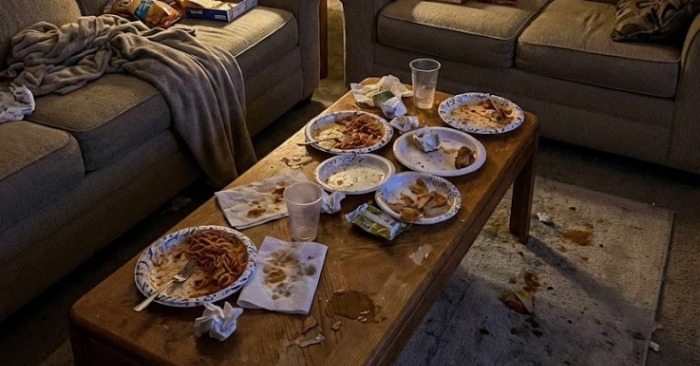
The living room looked like the aftermath of a wild college party. Fast-food wrappers were everywhere, greasy boxes with half-eaten burgers, cans on the floor. Chips had been ground into the carpet, crushed into dusty crumbs.
My breath caught. I dropped my bag and walked down the hallway, past the kitchen, straight to Gran’s bedroom – the room I had barely entered since her death.
I opened the door – and felt dizzy.
RED AND BLACK PAINT HAD BEEN ANGRILY SMEARED ACROSS THE WALLPAPER.
Red and black paint had been angrily smeared across the wallpaper. The bed had been slashed open, feathers floating through the air. Greasy handprints streaked across the wardrobe. Candy wrappers and food scraps overflowed from the drawers.
This wasn’t chaos. This was intentional.
I stared at the scene, pulled out my phone, and called her.
Lydia answered immediately.
“What did you do?!” I burst out. “Why did you destroy the house? And Grandma’s room? How could you?”
Silence. Then her cold voice.
“Don’t play innocent. You know exactly why. Grandma left you the house. It should have been mine. You don’t deserve it.”
“You were barely there! You never helped!”
HER LAUGHTER SOUNDED SHARP.
Her laughter sounded sharp. “Irrelevant. You got what I wanted. So I made sure you can’t enjoy it.”
She hung up.
I stood there, the phone still at my ear. Only the soft rustling of feathers could be heard.
It had been pure malice. It was never about documents. It was a message.
And as I looked around, something inside me shifted.
I wanted to collapse. Instead, I rolled up my sleeves.
The next morning I woke up exhausted and furious. But the moment I stepped into the hallway and inhaled that disgusting smell, I knew: I would not let this stand.
My first stop was the hardware store. Buckets, sponges, bleach, gloves, heavy-duty trash bags, and liters of lemon cleaner went into the cart. The cashier eyed the pile.
BIG CLEANING?” SHE ASKED CASUALLY.
“Big cleaning?” she asked casually.
“Something like that,” I replied briefly.
At home, I tied my hair back, put on old jeans, and started in the living room. The stench was overwhelming. I gagged but kept working. On my knees, I scrubbed until my arms burned. Trash bags piled up outside the house.
But the smell clung to me, even after showering.
By the third day, I realized I needed help. The paint in Gran’s bedroom wouldn’t come off. Vinegar, baking soda, internet tips – nothing worked. The dark streaks looked like open wounds.
That room hurt the most.
I called painters. Rick and Brian arrived the next morning. They asked no questions.
“Is this some escalated dare?” Rick muttered.
NO,” I SAID TENSELY.
“No,” I said tensely. “Just disrespect.”
They worked in silence. Nearly five hundred dollars later, the walls were bright and clean again. I almost cried.
The bedding couldn’t be saved. I bought new ones, but every time I smoothed them out, I thought of Gran’s warm hands.
The house no longer smelled like her. That hurt the most.
The living room took even more time. The carpet cleaner roared like an airplane. I scraped dried cheese off the old armchair. When I realized the sofa was beyond saving, tears streamed down my face.
I took the furniture to the dump. A worker helped me.
“Looks like that thing’s seen a war,” he said.
“More than you think,” I replied.
NEW FURNITURE MOVED IN.
New furniture moved in. Simple, neutral. It looked good – clean. But inside me, there was still unrest.
Lydia’s words echoed.
She thought she had gotten away with it.
That’s when I decided to take the next step.
I didn’t confront her directly. Instead, I went to see a lawyer – Michelle. Clear words, sharp gaze.
I showed her photos and receipts. She nodded.
“This is clear. She will pay.”
And she did.
AFTER A FEW WEEKS, THE COURT RULED IN MY FAVOR.
After a few weeks, the court ruled in my favor. Lydia had to reimburse every cent.
For the first time since this nightmare began, I smiled.
But I wanted more than just sending a letter. I wanted her to understand.
I placed the documents and receipts in a box, tied a pink ribbon around it, and wrote on a card: “From the house you destroyed.”
I left the package at her door.
Not ten minutes later, she called.
“WHAT IS THIS?!”
“A court order,” I said calmly. “You’re paying for everything.”
She raged.
“You think you’ve won?” she hissed.
I answered quietly: “No. Grandma won. You couldn’t take her house from me. And now you face the consequences.”
I hung up.
The payments came. Small checks with biting comments. I cashed them.
With every envelope, I felt freer.
The house was quiet again.
In the evenings, I sat in the living room with tea, listening to the silence. It wasn’t like before – but it was safe.
Sometimes I sat in Gran’s room.
“I fixed it, Gran,” I whispered.
One day I placed the framed court ruling in the bottom drawer of her desk, next to her Bible and the photo of her and my mother.
It felt as if I had put something broken back together.
I didn’t need to boast. But that judgment reminded me of her words:
“You are stronger than you think, Elena.”
And for the first time in a long time, I truly believed it.